
Story
Best Time to Visit China 2026: Is It Safe for American Tourists?
China's year turns on two gentle shoulders and one punishing month. Late April to early June and mid-September to late October bring mild days, drier skies and 4-star rooms around CNY 400–600, while July collides with 31°C heat, heavy rain and school-holiday prices. Here is the honest safety answer, the full month-by-month table and the month to skip.
Yes — China is safe for American tourists in 2026, provided you book official taxis, carry your passport at all times and stay clear of China's drug and exit laws; violent crime against visitors is rare. The best window is April 15 to June 5 or September 10 to October 20, when a solid 4-star Beijing double costs CNY 400–600.
The short answer to whether China is safe for American tourists is yes. Every metro station in Beijing, Shanghai and Xi'an screens bags at the gate, central districts stay lit and busy past 23:00, and travelers routinely walk back from dinner alone without incident. The US State Department still rates China Level 2, exercise increased caution, which reflects legal and traffic risk rather than street violence. Petty theft follows crowds, so keep your wallet out of a back pocket on the subway and hold your phone with two hands on the Bund.
The two risks that are genuinely real are money and law. The money risk is a rigged taxi meter, a tea-ceremony bill or a “fast pass” no gate will scan; our China travel scams guide lists nine of them. The legal risk is absolute: drug offences are prosecuted hard, carrying a parcel for a stranger can end in prison, and overstaying a visa or signing the wrong contract can trigger an exit ban. Photographing military sites or immigration areas can end at a police station.
Entry paperwork, 2026. American citizens still need a visa for ordinary sightseeing, and the reciprocal fee for US passports is USD 185 with roughly four working days of processing, so apply at least three weeks before you fly. The only shortcut is 240-hour visa-free transit, which requires flying onward to a third country — not straight home. Carry your passport at all times, and note that hotels must register your stay within 24 hours.
Here is the best time to visit China, month by month, built on 1991–2020 normals from the China Meteorological Administration for three anchor cities: Beijing, Shanghai and Xi'an. Each row gives the high and low across those cities, the rainfall spread, crowds and a price band, where ¥ is cheapest and ¥¥¥¥ dearest.
January: high 2–9°C / low −8–2°C; rain 2–74 mm; quiet; ¥ February: high 6–10°C / low −4–3°C; rain 4–59 mm; Spring Festival, Feb 17; ¥¥¥ March: high 13–15°C / low 1–6°C; rain 8–94 mm; shoulder, ramping up; ¥¥ April: high 20–21°C / low 8–11°C; rain 21–80 mm; Qingming Apr 4–6; ¥¥ May: high 25–27°C / low 14–17°C; rain 34–92 mm; May Day peak May 1–5; ¥¥¥ June: high 28–31°C / low 19–21°C; rain 63–185 mm; hot and humid; ¥¥¥ July: high 31–32°C / low 22–25°C; rain 98–185 mm; school holidays; ¥¥¥¥ August: high 30–32°C / low 21–25°C; rain 78–168 mm; wet and packed; ¥¥¥¥ September: high 25–28°C / low 16–21°C; rain 46–118 mm; Mid-Autumn Sep 25; ¥¥¥ October: high 19–24°C / low 9–15°C; rain 23–62 mm; Oct 1–7 crush, then golden; ¥¥¥ November: high 11–18°C / low 1–9°C; rain 7–56 mm; quiet and dry; ¥ December: high 4–11°C / low −5–3°C; rain 2–44 mm; cheapest, indoor sights; ¥
Skip July. It joins 31–32°C highs, the heaviest rain of the year, roughly 185 mm in Beijing and 142 mm in Shanghai, and the domestic school holidays, so flights and hotels sit at their annual ceiling while the east coast is also inside typhoon season. If your dates must fall in summer, go to Gansu, Qinghai or the Yunnan highlands instead of the coast. In October, book from the 8th onward: National Day runs October 1–7, when the Great Wall and the Forbidden City take their biggest gates queues of the year.
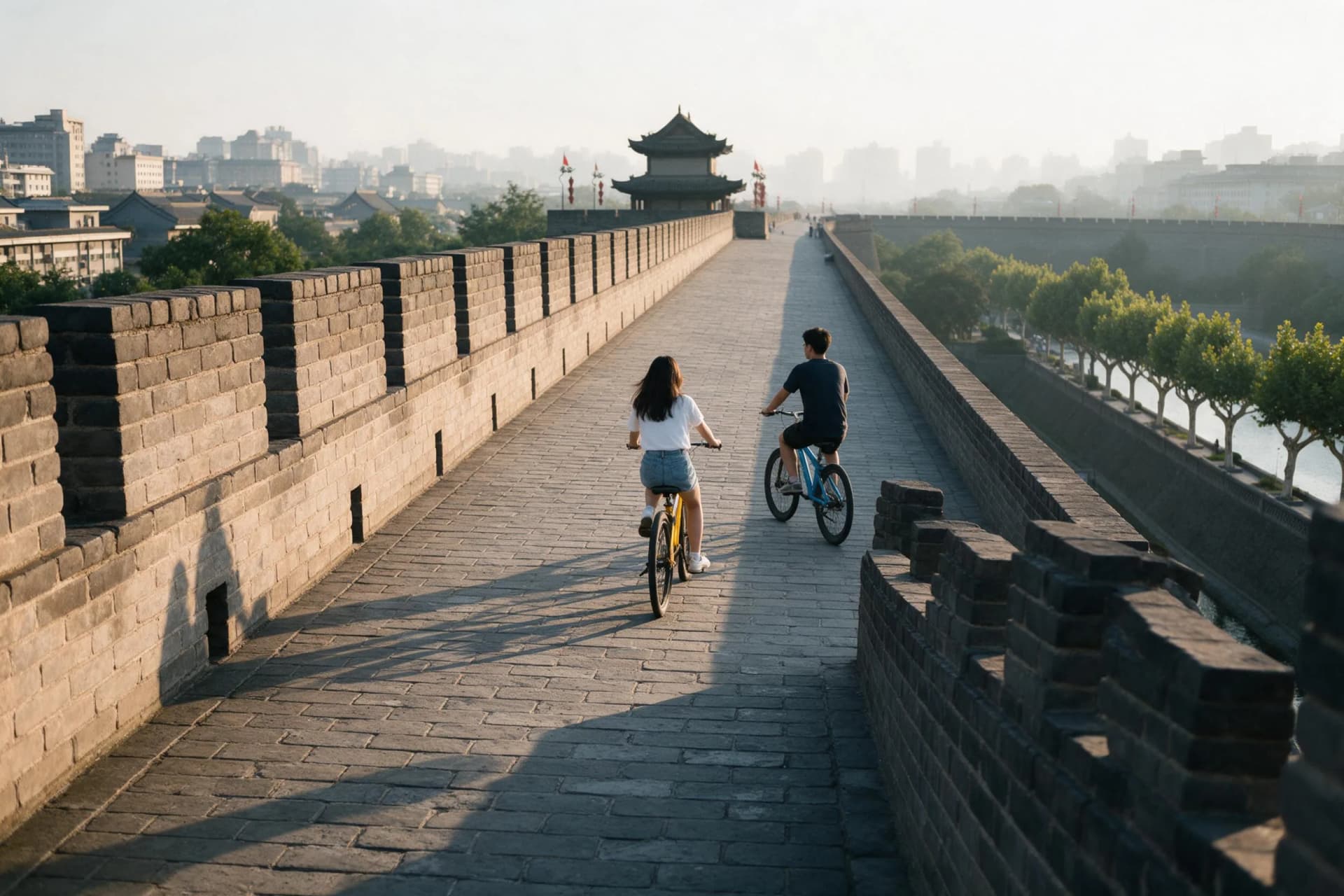
Two windows are worth building a trip around: mid-April to early June and mid-September to late October. In spring, aim for late April or mid-May, steering around Qingming (April 4–6) and May Day (May 1–5). In autumn, aim for September 10–24 or October 8–20, around Mid-Autumn (September 25) and National Day. Shoulder season is also the honest answer for history: walk the Xi'an City Wall from the South Gate, Yongning Gate, a five-minute walk from Line 2's Yongningmen station, where the ticket is CNY 54, the rampart stays open until 22:00 and two hours of bike hire runs about CNY 45. Mid-October gives 19°C afternoons and a 17:20 sunset, cool enough to ride the full 13.7 km circuit without the summer sweat.
Day-to-day safety is mostly plumbing and sidewalks. Do not drink the tap water; hotels provide kettles and sealed bottles cost CNY 2–5. The real daily hazard is traffic: electric scooters arrive silently from both directions on sidewalks and crossings. Save 110 for police, 120 for an ambulance, 119 for fire and 122 for traffic, and keep the US Embassy in Beijing's 24-hour line, +86-10-8531-3000. A private clinic visit runs about CNY 500–1,500, so buy travel insurance with evacuation cover before you fly.
Book the shoulder-season dates first. Train seats on 12306 open 15 days out and vanish fast around holidays, Spring Festival falls on February 17 in 2026, and a 4-star double that costs CNY 400–600 in late April or late September climbs to CNY 700–1,200 in July. Set your dates, then open our honest 2026 safety answer for the full risk list, and let ChinaMira build the route around the window you choose.
Good to know
- Best months, 2026
- April 15–June 5 and September 10–October 20: highs of 18–27°C, the year's driest stretches and 4-star doubles around CNY 400–600.
- Month to avoid
- July: about 185 mm of rain in Beijing and 142 mm in Shanghai, 31–32°C highs, school holidays and the year's highest room rates at CNY 700–1,200.
- Visa for US citizens
- An L tourist visa is required in 2026 at USD 185 with about four working days of processing; 240-hour visa-free transit applies only with onward travel to a third country.
- Emergency numbers and embassy
- 110 police, 120 ambulance, 119 fire, 122 traffic; US Embassy Beijing 24-hour American Citizen Services line +86-10-8531-3000.
- Shoulder-season weather, mid-October
- Beijing 19°C/9°C, Shanghai 24°C/15°C and Xi'an 19°C/10°C, with 23 mm, 59 mm and 62 mm of monthly rain; Beijing sunrise about 06:20 and Shanghai sunset 17:20.
- Daily costs outside peak weeks
- Noodles CNY 15–30, metro CNY 3–8, hostel dorm CNY 80–150, 4-star double CNY 400–600 in shoulder season against CNY 700–1,200 in July.
Frequently asked questions
Is China safe for American tourists in 2026?
Yes, with conditions. Violent crime against visitors is rare and metro stations, streets and tourist districts are staffed and lit, but the US State Department still rates China Level 2, exercise increased caution. The real risks are rigged taxi fares, petty theft in crowds and China's strict drug and exit-ban laws.
What is the best month to visit China?
April and May, then mid-September to late October. Those weeks give highs of 18–27°C, the year's driest skies and 4-star hotel doubles at roughly CNY 400–600, well below the July peak of CNY 700–1,200.
What is the worst month to visit China?
July. It combines 31–32°C heat with the heaviest rain of the year, about 185 mm in Beijing and 142 mm in Shanghai, and it sits inside the domestic school holidays, when flights and hotel rooms climb to their annual ceiling.
How much does a day in China cost in 2026?
Budget roughly CNY 400–700 per person per day outside peak weeks: CNY 15–30 for a bowl of noodles, CNY 3–8 for a metro ride, and either CNY 80–150 for a hostel dorm or CNY 400–600 for a 4-star double room.
Do US citizens need a visa for China in 2026?
Yes for ordinary tourism, because the United States is not on China's visa-free list. The reciprocal fee is USD 185 with about four working days of processing. The one exception is 240-hour visa-free transit, which needs onward travel to a third country rather than a flight home.