
City Guide
Guilin Travel Guide: Karst Peaks, Rivers and Two Thousand Years
Guilin pairs two thousand years of history with the limestone peaks that made it famous. This guide covers the Li River cruise, Yangshuo, the Longji rice terraces, the city's hills and caves, where to eat Guilin rice noodles, how to arrive by air or high-speed rail, and the best months to visit.
Guilin sits in the northeast corner of Guangxi, where the Li River cuts through a forest of limestone towers that have been dissolving out of the earth for hundreds of millions of years. More than eight centuries ago the Song dynasty official Wang Zhenggong wrote that Guilin's scenery is the finest under heaven, and travelers have been arriving to argue with him ever since. The city itself is easy to like: a walkable center, a riverside of pagodas and banyan trees, and bowls of rice noodles for breakfast. The mountains do the rest.
History runs deep here, and it is not background decoration. In 214 BC, Qin Shi Huang's engineers completed the Lingqu Canal, a still-working waterway that joined the Yangtze basin to the Pearl River basin and turned a frontier garrison into a trading town on the road south. Guilin later served as the capital of Guangxi through the Ming and Qing dynasties, and the Jingjiang Princes' City, begun in 1372, remains the best-preserved Ming princely palace in China, with the Solitary Beauty Peak rising inside its walls. Reed Flute Cave holds ink inscriptions dated to 792 AD, and during the Second World War Guilin became a wartime cultural capital for writers and artists before the 1944 battle left much of the old city in ruins.
Start downtown. Elephant Trunk Hill, the city's emblem, dips its stone trunk into the Li River beside Fubo Hill; both are quick, pleasant stops in the early morning, when locals practice tai chi along the bank. Diecai Hill and Seven Star Park reward a longer walk, and the Jingjiang palace grounds deserve two hours for their carved stone tablets and the view from the summit. After dark, the Two Rivers and Four Lakes cruise drifts past the Sun and Moon Pagodas and illuminated bridges, about 200 yuan for roughly 90 minutes, and it is a gentle introduction to the city's geography.
Then comes the river. The classic Li River cruise runs 83 kilometers from Guilin's Zhujiang Pier to Yangshuo in four to four and a half hours, past Nine Horse Mural Hill and the bend at Xingping printed on the back of the 20-yuan note. Sit on the top deck, bring a light rain shell, and let the towers slide by. In Yangshuo, the quieter Yulong River is best seen from a two-person bamboo raft, while bicycles and electric scooters open the lanes between the rice paddies. Stay at least one night.
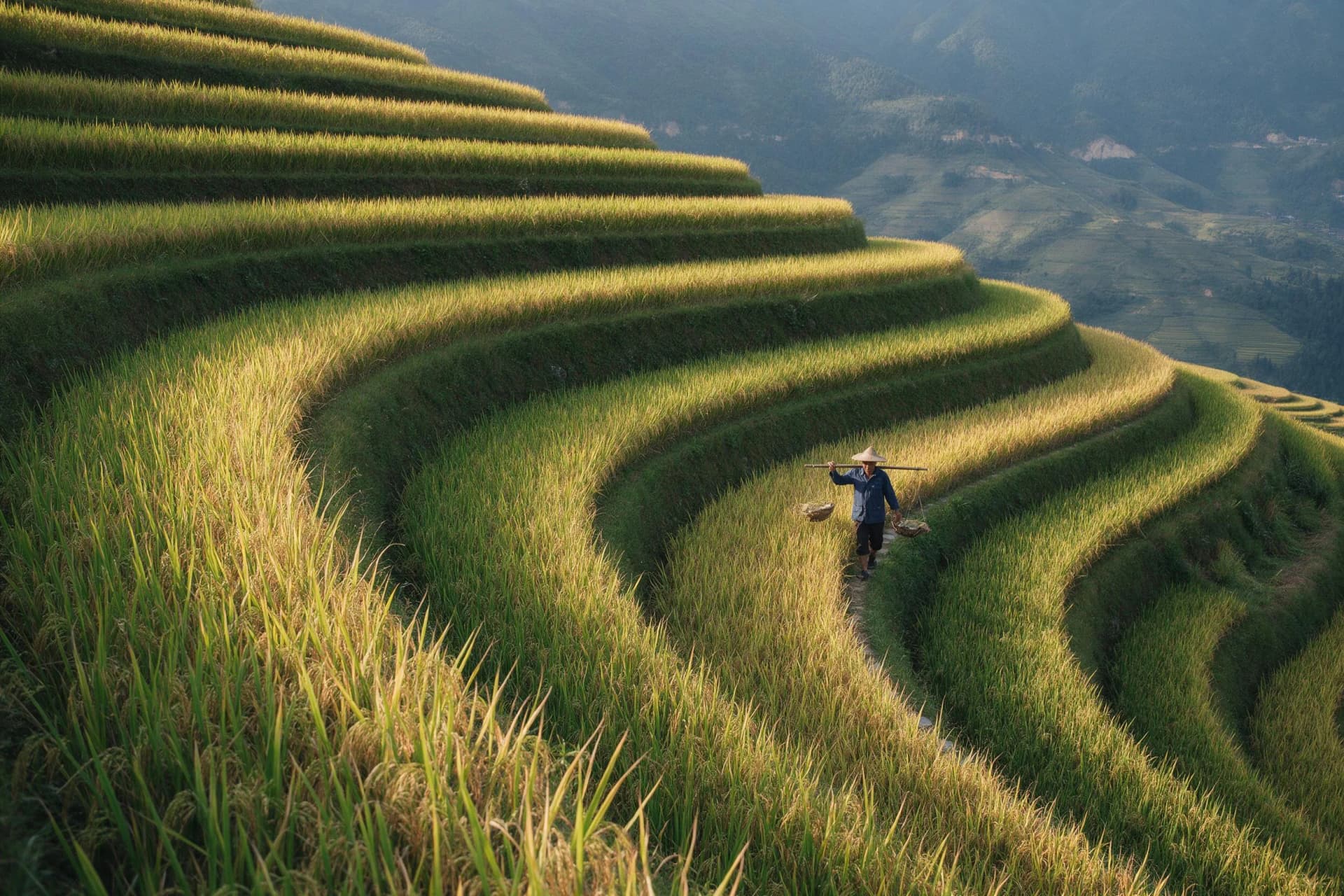
North of the city, the Longji rice terraces climb the shoulders of the mountains around Longsheng, roughly a two-hour drive away. Zhuang and Yao villagers began carving these steps in the Yuan dynasty and kept going through the Ming and Qing, until the slopes above Ping'an and Dazhai looked like the layered spine of a dragon; longji means dragon's backbone. May and June fill the paddies with silver water mirrors, September and October turn them gold. Dazhai, the largest and steepest of the villages, is the one to choose if you can only make one.
Eat like a local. Guilin rice noodles are breakfast, not a side dish: slippery rice noodles with braised beef or brisket, pickled green beans, fried peanuts, chili oil and a splash of broth, usually for less than 15 yuan. In the evening, look for beer fish in Yangshuo, Lipu taro cooked with pork belly, and the oil tea poured in Zhuang and Yao villages. Zhengyang Pedestrian Street, Dongxi Alley and the night stalls around the center cover most of it in a single evening.
Logistics are straightforward. Guilin Liangjiang International Airport lies about 30 kilometers from the center, with shuttle buses into town for around 20 yuan and taxis nearer 100; the high-speed rail station at Guilin North connects to Guangzhou in under three hours, Guiyang in about two and Nanning in roughly two and a half. There is no metro, so plan on city buses, taxis or DiDi, and link Alipay or WeChat Pay before you land. The rainy season runs April through June, which is also when the mist does its finest work; September to November brings clear, comfortable days, and winter is cool, damp and quiet.
Three days is the honest minimum: one for the city's hills, caves and pagodas, one for the Li River and Yangshuo, and one for Longji. Add a fourth for the Yulong River, Daxu Ancient Town and a slow morning over noodles. Book cruise tickets, terrace transport and high-speed rail seats early, especially around Chinese public holidays, and pack for rain in every season. Tell ChinaMira your dates and pace, and we will shape a Guilin itinerary around the light, the water and the two thousand years beneath it.
Good to know
- Getting there
- Guilin Liangjiang International Airport (KWL) is about 30 km from downtown; shuttle buses cost around 20 yuan and taxis nearer 100 yuan.
- High-speed rail
- Guilin North station links to Guangzhou in under three hours, Guiyang in about two and Nanning in roughly two and a half.
- Best months
- April to June for mist and green hills, September to November for clear, comfortable weather; rain is possible year-round.
- Li River cruise
- About 83 km from Zhujiang Pier to Yangshuo, four to four and a half hours; four-star tickets roughly 210 to 450 yuan.
- Longji rice terraces
- Roughly a two-hour drive north near Longsheng; entry around 80 yuan, with Ping'an and Dazhai the main villages.
- Payments
- Alipay and WeChat Pay work almost everywhere with a linked foreign card; carry a little cash for village stalls.
Frequently asked questions
How many days do you need in Guilin?
Three full days is a comfortable minimum: one for the city's hills, caves and lakes, one for the Li River cruise and Yangshuo, and one for the Longji rice terraces. Add a fourth day for the Yulong River, Daxu Ancient Town and slower meals.
What is the best time of year to visit Guilin?
September to November brings the clearest skies and mildest temperatures, while April to June is the misty rainy season that makes the karst look like a Chinese ink painting. Summer is hot and humid, and winter is cool, damp and much quieter.
How do you get from Guilin to Yangshuo and the Longji rice terraces?
Yangshuo is reached by the four-hour Li River cruise, by high-speed train to Yangshuo Station, or by road in about 90 minutes. The Longji terraces are roughly a two-hour drive north through Longsheng, usually done as a day trip or an overnight in Ping'an or Dazhai.
Is Guilin worth visiting for history as well as scenery?
Yes. Guilin has more than two thousand years of recorded history, from the Qin dynasty Lingqu Canal and the Ming-era Jingjiang Princes' City to Tang dynasty inscriptions inside Reed Flute Cave and its role as a wartime cultural capital in the 1940s.