
Wonder Story
The Avatar Mountains of Zhangjiajie
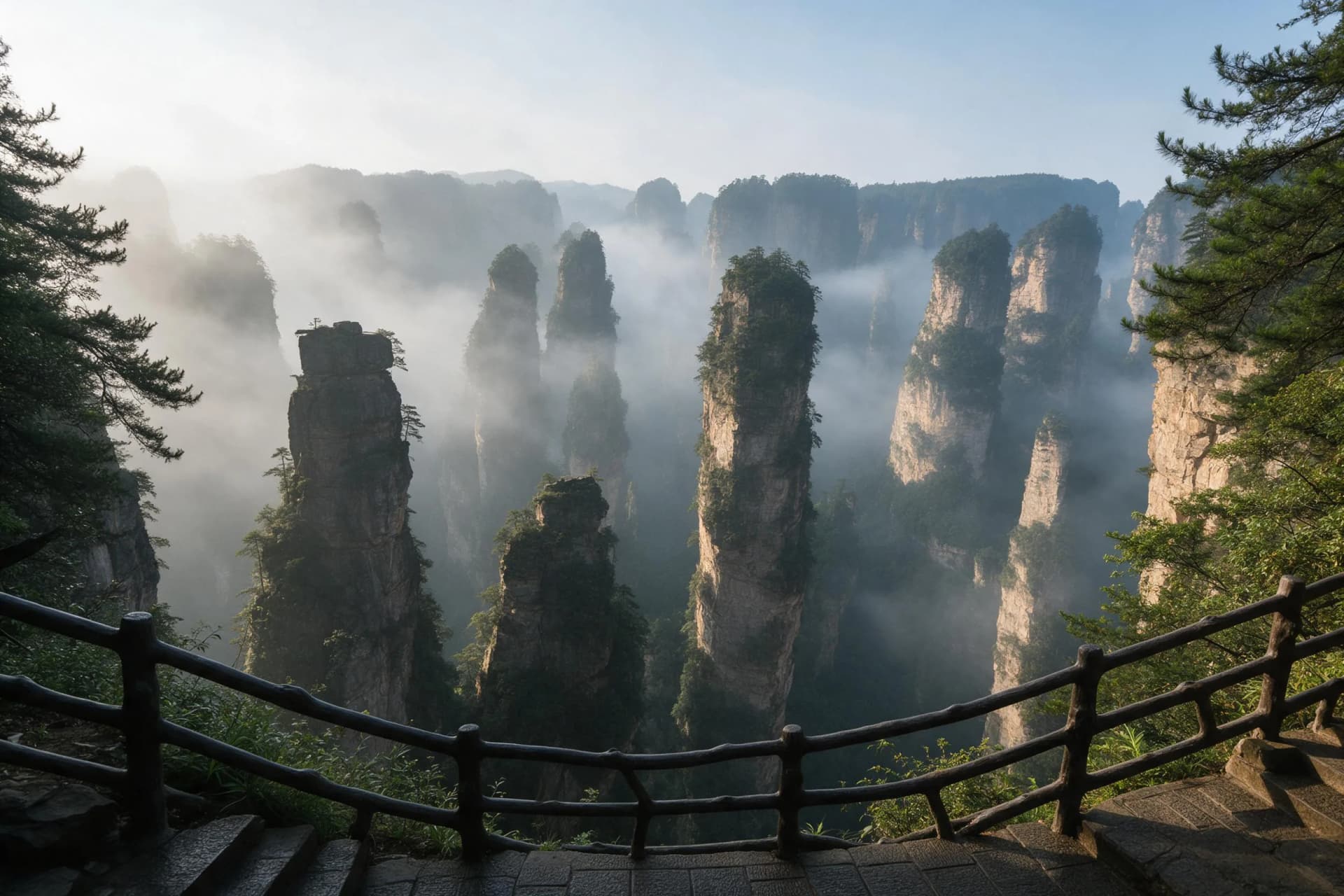
In 2009 a Hollywood film turned floating mountains into a global image, and Zhangjiajie's sandstone pillars became the place everyone wanted to stand. This is the story of how the nickname stuck, what the pillars actually are, where to see them through mist and snow, and how to plan a trip that survives the crowds, the queues, and the fog.
Stand on the wooden platform at Yuanjiajie just after sunrise and the valley below you turns into a slow river of mist. One by one the sandstone pillars push through it — a dozen, then a hundred — each one wearing a crown of dark green pine. Somewhere behind you a cable car hums into the station. A stranger at the railing says the word "Avatar," and everyone within earshot nods. That is the strange gift of Zhangjiajie: a landscape that feels familiar the first time you see it with your own eyes.
You are looking at a quartz sandstone peak forest, and it is rarer than it appears. Layers of sandstone and quartz were laid down hundreds of millions of years ago, then lifted, cracked along vertical joints, and carved by water, wind, and freeze-thaw cycles into the slender freestanding towers you see today. More than three thousand of them stand within the scenic area. Zhangjiajie National Forest Park was created in 1982 as China's first national forest park, and it later joined Suoxi Valley, Tianzi Mountain, and Yangjiajie to form the Wulingyuan Scenic and Historic Interest Area, a UNESCO World Heritage Site since 1992.
The Avatar connection is real, but it is looser than the posters suggest. When James Cameron's team designed the floating Hallelujah Mountains for the 2009 film, they drew on several Chinese mountain landscapes, and a Hollywood photographer scouted Zhangjiajie in 2008. No scene was filmed here. In January 2010, local officials unveiled a plaque at Yuanjiajie renaming one pillar — the roughly 150-meter Southern Sky Column — "Avatar Hallelujah Mountain." Tourism jumped almost overnight. Officials later described the change as a promotional nickname rather than a formal renaming, but the name stuck in guidebooks, on signs, and in the imaginations of everyone who came looking for floating rock.
Yuanjiajie is where most visitors start, and it earns the fuss. The Bailong Elevator, an outdoor glass lift built into a cliff face and certified by Guinness World Records as the world's tallest outdoor elevator at 326 meters, carries you up in under two minutes. From the top, a short walk reaches the Avatar Hallelujah Mountain viewpoint and the First Bridge Under Heaven, a natural rock arch spanning two peaks hundreds of meters above the valley. Arrive early: by mid-morning the plateau fills, and the elevator queue can swallow an hour of your day.
Tianzi Mountain, named for a Tujia leader who declared himself "Son of Heaven" in the fourteenth century, is the place to chase cloud seas. When a temperature inversion settles over the valleys, the pillars float on white and the whole range rearranges itself every few minutes. Below it all, Golden Whip Stream runs about 7.5 kilometers along the forest floor — a flat, green, almost jungle-like walk between the pillars rather than above them, with clear water, mossy boulders, and macaques that will absolutely investigate an open bag of snacks.
Across the city, Tianmen Mountain is a separate day and a different kind of drama: a 7.5-kilometer cable car ride from the edge of town, a cliff-hugging glass skywalk, and Heaven's Gate, a natural arch 131.5 meters high that you reach by climbing 999 steps. The Zhangjiajie Grand Canyon Glass Bridge, about 430 meters long and roughly 300 meters above the canyon floor, is another popular add-on and requires a timed reservation. Most travelers give Wulingyuan three full days and Tianmen Mountain one.
Timing decides what you actually see, because fog is the great variable here. Spring, especially April and May, brings mist, fresh green leaves, and waterfalls after rain. Autumn, from late September through October, delivers the clearest light and the local "cold dew wind" that pushes cloud through the valleys at dawn. Summer is hot, wet, and crowded. Winter is quiet, cheap, and occasionally spectacular, with snow and rime ice on the pines and long views through cold, dry air. The park ticket is typically valid for several days, and free shuttle buses link the trailheads, but a single-day visit is always a gamble.
Prepare for the practical side. Viewpoints buzz from mid-morning, the Bailong Elevator and the big cableways develop long queues in peak season, and wet stone steps are genuinely slippery — grippy shoes matter more than a good camera. Distances inside the park are larger than they look on the map, and a full day usually means ten thousand steps or more. Keep food zipped away from the macaques, and carry a rain shell even on a blue-sky morning. At the end of it all, Tujia cooking is the reward: smoked pork with dried radish, sour fish soup, and rice steamed in bamboo.
Zhangjiajie rewards planning more than most places in China, because the difference between a gray wall of fog and the view you came for is often a matter of one morning, one route, and one hotel location. A ChinaMira travel designer can time your trip to the misty weeks after the rains, book park tickets and timed glass bridge slots in advance, choose between staying in Wulingyuan town at the park gate or in Zhangjiajie city near Tianmen Mountain, and route you to the viewpoint that matches the day's weather. Tell us your dates and how much walking you want, and we will build the trip around the pillars.
Good to know
- Best time to visit
- April–May for mist and green valleys; late September–October for the clearest views
- Ideal trip length
- 3 days in Wulingyuan, plus 1 day for Tianmen Mountain
- Getting around
- Free park shuttles, the Bailong Elevator, and cableways between trailheads
- Must-book ahead
- Timed entry for the Grand Canyon Glass Bridge in peak season
- Local food
- Tujia smoked pork with dried radish, sour fish soup, and bamboo-steamed rice
- Nearest airport
- Zhangjiajie Hehua International Airport (DYG), near the city center
Frequently asked questions
How many days do you need in Zhangjiajie?
Three full days for the Wulingyuan park, plus one more for Tianmen Mountain and the Grand Canyon glass bridge, is the comfortable minimum for most travelers.
When is the best time to visit Zhangjiajie?
April to May brings mist, green valleys, and waterfalls, while late September through October offers the clearest light; winter is quiet and snowy but genuinely cold.
Is Zhangjiajie really the same as the Avatar mountains?
Zhangjiajie's sandstone pillars helped inspire the floating Hallelujah Mountains in Avatar, and one pillar was nicknamed Avatar Hallelujah Mountain in 2010, though no scenes were filmed there.