
City Guide
Xi'an Travel Guide: City Wall, Terracotta Warriors & Muslim Quarter
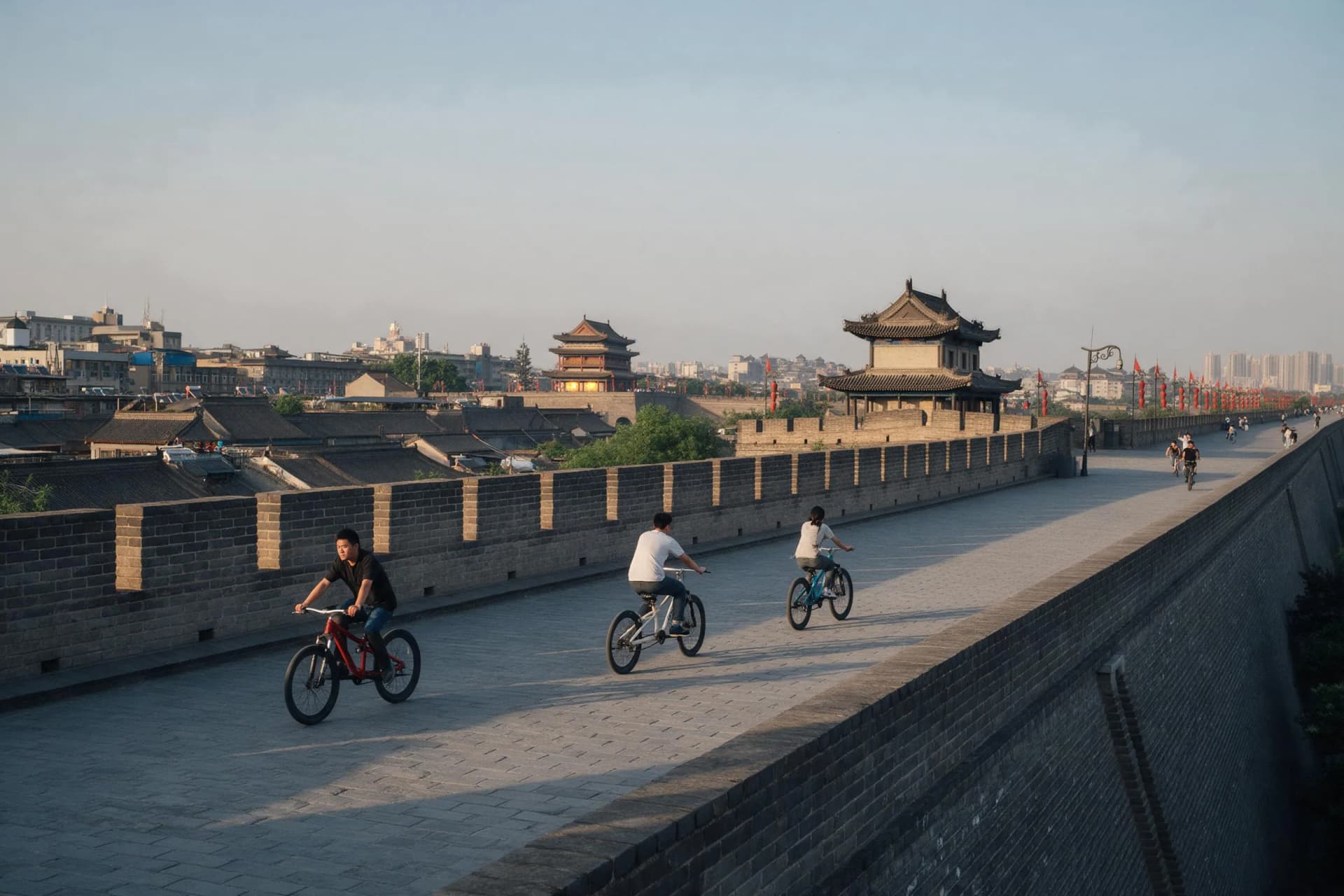
Xi'an is China's old capital you can still walk through: a 13.7-kilometer Ming city wall to cycle at sunset, the Muslim Quarter's smoky food lanes, Tang pagodas, a world-class history museum and the Terracotta Army an hour east. This guide covers what to see, what to eat, how to get around and when to come.
Xi'an does not ease you in. The airport metro leaves you at the North Railway Station, one transfer and twenty minutes later you surface beside the Bell Tower, and the old city closes around you: gray brick, a green moat, gate towers lit amber against a violet sky. For roughly a thousand years this was Chang'an, capital of thirteen dynasties and the eastern end of the Silk Road, until Beijing took the imperial title. One sentence of history is enough here, because Xi'an's past is not behind glass. It is a walkable rectangle you sleep inside, eat inside and, on the city wall, ride a bicycle around at sunset.
The wall is the reason to give Xi'an a full day rather than a stopover. Built in the 1370s on Tang-dynasty foundations, it runs 13.7 kilometers around the old town, about twelve meters high and wide enough at the top for a two-lane road. Walking the whole loop takes three to four hours and gets monotonous; hire a bike at the South Gate and the circuit takes ninety minutes with photo stops. Go up in the late afternoon. The light turns gold on the rooftops, the watchtowers switch on one by one, and you come down hungry, straight into the Muslim Quarter. Ticket prices, bike rates and gate hours live in the fact sheet; buy at the gate or through the official mini program.
Then eat. Xi'an's Hui community has cooked in the lanes behind the Drum Tower since the eighth century, and the food is the best argument for the neighborhood. Start on Beiyuanmen, the neon-lit main drag, but graze rather than dine. A roujiamo here is braised beef or lamb in a warm flatbread, not the pork version sold elsewhere; the quarter is halal, so you will not find pork at all. Order yangrou paomo, lamb soup with flatbread you tear yourself into pea-sized pieces — the smaller you tear, the better the bowl. Add belt-wide biangbiang noodles, lamb skewers dusted with cumin, a persimmon cake, and pomegranate juice pressed in front of you in autumn. When Beiyuanmen becomes a crush, walk west to Dapiyuan for sit-down paomo or to Sajinqiao for the morning market.
Between meals, the city keeps unfolding. The Shaanxi History Museum holds the Tang gold and bronze that the dynastic timeline promised, and it rewards booking before you fly. The Big Wild Goose Pagoda, raised in 652 to hold the scriptures Xuanzang carried back from India, rises over a working temple, and its squares fill at night with fountains, dancers and families. Tucked into the Muslim Quarter lanes, the Great Mosque is built like a Chinese temple — courtyards and pavilions instead of domes and minarets — a reminder of how long this community has been here. After dark, walk the lights of Grand Tang Ever-Bright City, or watch the Bell and Drum towers glow above the traffic.
Most travelers come for the Terracotta Army, about forty kilometers east at Lintong, and it deserves a full morning rather than an afternoon squeezed between stops. Metro Line 9 to Huaqingchi and then a local bus is the cheapest route; a taxi or private car is the fastest. Our Terracotta Army guide covers the pits, the real-name ticket system and the opening hours, because those details belong on that page, not this one. Pair the visit with the hot springs at Huaqing or the emperor's tomb mound at Lishan. Go at opening, or after lunch when the tour buses thin.
Xi'an is easy to move through once you are here. The metro reaches the wall, both pagodas, the history museum and the high-speed rail station; scan Alipay or WeChat Pay at the gate instead of buying a ticket. Xi'an North Railway Station is the hub for trains to Beijing, Luoyang, Chengdu and beyond, and the journey times are in the fact sheet. Metro Line 14 links the airport terminals to Xi'an North and on into town, with fares and timings also in the fact sheet. DiDi works without Mandarin, taxis are metered, and almost every stall would rather take a QR code than cash.
Stay inside the wall if you can. The lanes around the Bell Tower and the South Gate put the wall, the food and the metro on your doorstep, while Qujiang suits museum and pagoda days. Aim for the shoulder seasons, when the skies clear and the evenings stay warm enough for the wall; summer on the Guanzhong Plain is humid and punishing, and winter is cold, dry and quiet, with the occasional dusting of snow that makes the ramparts look newly built. The fact sheet lists the exact months and the temperatures to expect, and hotel prices follow the same curve.
ChinaMira can build the trip around your dates: booking real-name Terracotta tickets and museum reservations, securing high-speed rail seats with our China high-speed rail guide, and putting an English-speaking guide beside you on the wall at sunset. If you are still choosing when to come, start with our best-time guide, then let us handle the logistics. Tell us your dates, and we will make sure the city has room for you. Xi'an has waited a thousand years; it can wait one more email.
Good to know
- City wall
- 54 yuan adult. Single bikes 45 yuan for three hours and tandems 90 yuan, with a refundable deposit. The South Gate opens 8:00-22:00 March to October and 8:00-20:00 November to February.
- Best months
- March to May and September to November. July and August are humid with highs above 35°C, and January can drop below -5°C.
- Airport transfer
- Metro Line 14 runs from Xianyang airport to Xi'an North Railway Station in about 48 minutes for 7 yuan, and on to the old town for 8-9 yuan. Airport shuttle buses cost 25 yuan.
- High-speed rail
- From Xi'an North: Beijing in about 4.5 hours, Luoyang in about 1.5 hours and Chengdu in about 3.5 hours. Book with the passport you travel on.
- Book ahead
- Terracotta Army tickets are real-name and time-slotted; the Shaanxi History Museum is free but reserved and closed Mondays. See our Terracotta Army guide for its prices and hours.
- Street food
- Most Muslim Quarter snacks cost 5-20 yuan, and a sit-down bowl of yangrou paomo runs about 25-40 yuan. Every stall takes Alipay or WeChat Pay.
Frequently asked questions
How many days do you need in Xi'an?
Three full days is a comfortable minimum. Give one to the city wall and the Muslim Quarter, one to the Terracotta Army and Huaqing Hot Springs, and one to the Shaanxi History Museum, the pagoda and the night squares. Add a fourth for Huashan or a slower food crawl.
Do I need to book Xi'an attractions in advance?
Book the Terracotta Army and the Shaanxi History Museum ahead, because both use real-name reservations and daily quotas. The city wall, the Muslim Quarter, the Bell Tower and the pagoda squares can all be visited on the day. The fact sheet lists the booking channels and the museum's closing day.
Is Xi'an easy to visit without speaking Chinese?
Yes. The metro is signed in English, Alipay and WeChat Pay handle almost every payment, and DiDi books taxis by map pin. English is thin in small restaurants, so keep a translation app and point at whatever looks good in the window.
What should I eat in Xi'an?
Start with yangrou paomo, the lamb soup you tear flatbread into, then a roujiamo of braised beef or lamb, belt-wide biangbiang noodles and cumin-dusted lamb skewers. The Muslim Quarter is halal, so there is no pork anywhere in those lanes.