
City Guide
Suzhou Travel Guide: Classical Gardens, Canals and Slow Days
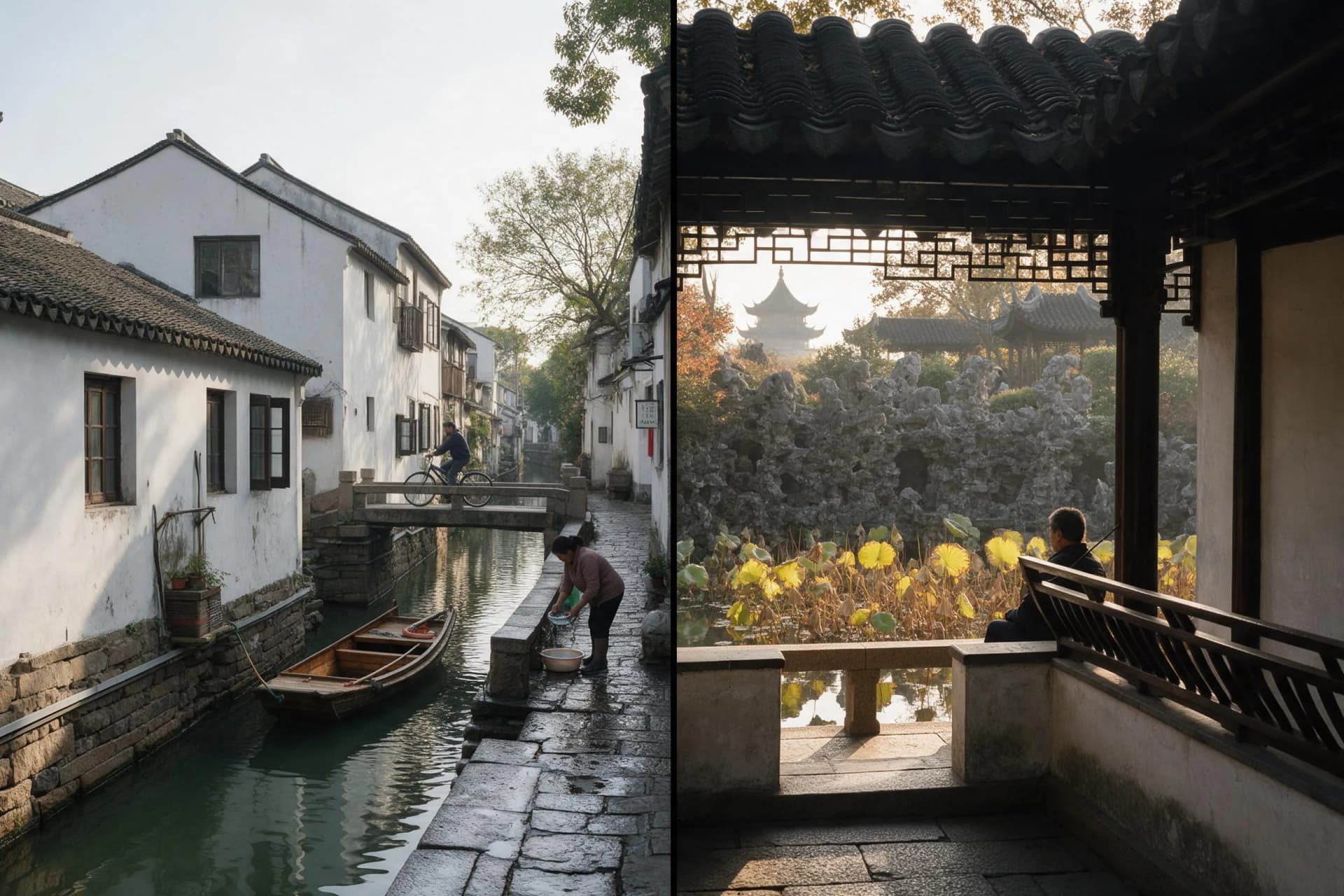
Suzhou is China's garden city: nine UNESCO-listed classical gardens, canal lanes where people still live and wash, the leaning pagoda on Tiger Hill, and a midnight bell at Hanshan Temple. This guide walks the old city slowly, adds Kunqu opera, silk, Suzhou noodles and squirrel fish, and covers tickets, boats, rail and timing in the fact sheet.
The canal wakes before the shops do. On Pingjiang Road the water holds the night's cool, a woman rinses a basin off a stone step, and steam rises from a noodle kitchen two lanes over. Whitewashed houses lean across the channel; a humpbacked bridge, a wooden boat tied to an iron ring. Suzhou does not announce itself. It asks you to slow down, look through a window, and notice how a branch is arranged against a white wall. That is the whole idea of this city: a place built to be read one framed view at a time.
Suzhou has been a city since 514 BC, when it was founded as the capital of Wu, and its water grid was laid out long before the gardens. Those gardens are the work of a later, quieter era: retired scholar-officials of the Ming and Qing who built private worlds behind high walls. Unlike the Forbidden City's symmetry or Beijing's imperial scale, a Suzhou garden is intimate and deliberately unfinished, composed so that every doorway frames a scene. Nine of them form a UNESCO World Heritage ensemble, and together they explain what the literati valued: restraint, suggestion, and a view you have to earn.
Start with the Humble Administrator's Garden, the largest of them. Its central section is the heart: the Hall of Distant Fragrance opens onto a lotus pond, and on a clear day the pagoda of Beisi Temple floats above the roofline, borrowed from beyond the walls. Cross the Small Flying Rainbow Bridge, the only covered bridge in the garden, and find the fan-shaped pavilion whose name asks, “With whom shall I sit?” At the right hour, the answer is nobody. When the crowds press in, walk ten minutes to the Lion Grove, where a maze of Taihu limestone swallows you whole, or to the Master of the Nets, the smallest and arguably the most perfect garden; on summer evenings its courtyards host Kunqu and pingtan performances.
Then leave the walls and follow the water. Pingjiang Road runs beside a canal for about 1.6 kilometers, and the lanes that branch off it are the real Suzhou: a barber's chair on a doorstep, laundry strung between eaves, a teahouse where an old man reads while a pipa player tunes up. Farther west, Shantang Street stretches 3.6 kilometers from Changmen Gate to Tiger Hill, a route the Tang poet Bai Juyi laid out when he governed the city. Its eastern end glows with lanterns and snack stalls after dark; walk west and the crowds thin into something closer to an ordinary neighborhood. A hand-rowed boat is the slowest and best way to see either canal, and the fares are listed in the fact sheet below.
Two sites beyond the old town's walls carry its oldest stories. Tiger Hill rises only 34 meters, but it carries 2,500 years of story: the leaning Yunyan Pagoda, which predates Pisa's tower; Sword Pond, said to hide the tomb of King Helü and his legendary swords; and a rock where a thousand people once sat to hear Buddhist teaching. The Song poet Su Shi wrote that a trip to Suzhou without Tiger Hill was a lifelong pity. At Hanshan Temple, the draw is a poem most Chinese children can recite, Zhang Ji's lines about a midnight bell reaching a moored boat. Ring the bell yourself — three strikes cost 5 yuan — then wander the free Maple Bridge area outside the temple walls.
Kunqu opera, born in this river delta and listed by UNESCO as a masterpiece of intangible heritage, is staged in intimate courtyard settings, while pingtan storytelling drifts out of canal-side teahouses with its pipa and sanxian. Suzhou embroidery and silk weaving still have working studios. And I. M. Pei's Suzhou Museum, his last major building, sets whitewashed walls and a sliced-roof silhouette beside the gardens, pairing a Northern Song pearl pillar with a rockery courtyard of his own. Entry is free, but you reserve a time slot in advance and it closes on Mondays — the fact sheet has the details.
Eat the way the city does. Breakfast is a bowl of Suzhou noodles: thin, springy wheat noodles in a red soy broth or a pale, clear one, with the topping served on a separate plate so it stays crisp. In late spring, order the sanxia version, heaped with shrimp meat, roe, and head paste. Yaba Shengjian's pan-fried buns arrive with a crackling bottom and a burst of pork juice, and Rongyanglou on Shantang Street has sold its oil-fried glutinous rice balls for a century, still about 4 yuan each. At dinner, order sweet-and-sour squirrel fish, the signature dish: scored, fanned, and fried so the flesh rises like a tail, then drenched in a sauce that hisses as it hits the table. Songhelou has served it since the Qianlong emperor supposedly stopped by.
Plan Suzhou as a slow two or three nights, not a checklist. Trains from Shanghai make the city an easy addition to a Yangtze Delta itinerary. Come with an appetite, comfortable shoes, and a willingness to sit over tea while the light changes. Our ChinaMira designers can pair Suzhou with Shanghai and Hangzhou, book your high-speed rail seats, and tell you when to visit so the gardens are at their best; send us your dates and pace, and we will build the days around the way this city likes to be seen.
Good to know
- Getting there
- Shanghai Hongqiao to Suzhou by high-speed rail takes about 25–30 minutes, with second-class seats from roughly 40 yuan; Suzhou Railway Station sits on the edge of the old city.
- Tickets
- Humble Administrator's Garden about 80 yuan peak season (April–October) and 70 yuan off-season; Tiger Hill about 70 yuan peak and 60 yuan off; Hanshan Temple 20 yuan. Pingjiang Road and Shantang Street are free. The Humble Administrator's Garden sells no tickets at the gate, and advance online booking is recommended at Tiger Hill; reserve with your passport.
- Opening hours
- Gardens generally open 7:30 a.m. to 5:30 p.m.; Suzhou Museum runs 9 a.m. to 5 p.m. with last entry at 4 p.m. and closes Mondays. Aim for the first hour after opening.
- Best time
- Late March to May for blossom and mild weather, and late September to November for osmanthus, clear skies and fewer crowds; summer is hot and humid, winter quiet and bare.
- Canal boats
- Hand-rowed yuloh boats run about 40 yuan per person on Pingjiang Road and about 50 yuan on Shantang Street.
- Suggested stay
- Two to three nights based in the old city, with a half day set aside for a water town such as Tongli or Zhouzhuang.
Frequently asked questions
Can I visit Suzhou as a day trip from Shanghai?
Yes, and many travelers do, but a day trip only reaches the old city's core: one garden, Pingjiang Road and a bowl of noodles. Tiger Hill, Hanshan Temple, the museum and a water town need more time, so treat a day trip as a taste rather than the full meal.
If I only have time for one classical garden, which should I choose?
Choose the Humble Administrator's Garden for scale and the full repertoire of pavilions, ponds and borrowed views. Pick the Master of the Nets instead if you want intimacy and a garden you can cross in minutes, or the Lion Grove for its rockery maze.
Do I need to book Suzhou garden tickets in advance?
Yes, book ahead. The Humble Administrator's Garden sells no tickets at the gate, and Tiger Hill recommends reserving one to seven days out, so use the official Suzhou Gardens Tourism WeChat account and carry your passport. The fact sheet lists prices and hours.
What food should I not miss in Suzhou?
Start with a bowl of noodles for breakfast, choosing a red or white broth and a seasonal topping, then graze the snack stalls around Shantang Street. For dinner, order sweet-and-sour squirrel fish, the city's signature dish.