
City Guide
Beijing Travel Guide: The Capital of Wonders
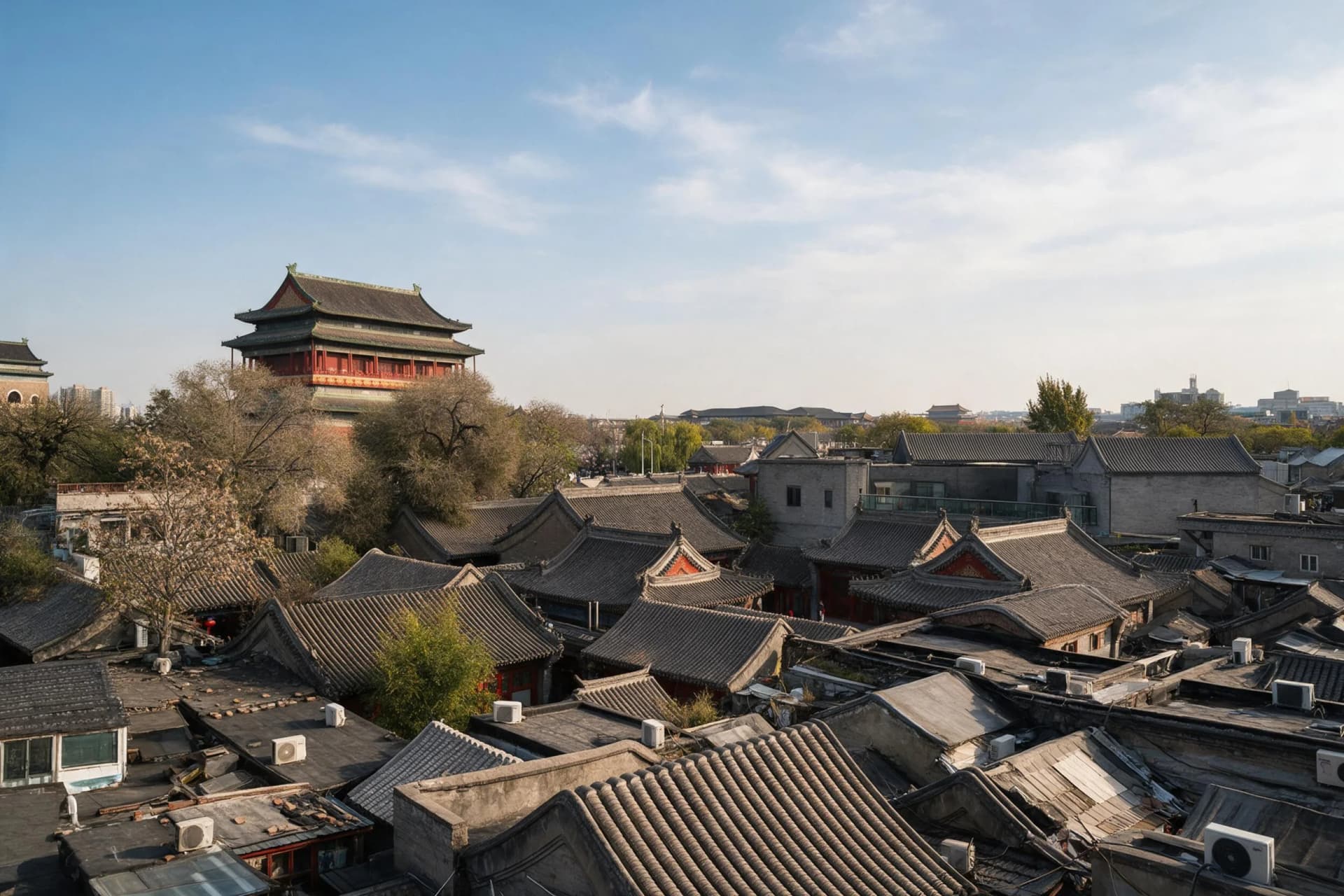
Beijing is a capital of wonders, where imperial palaces, a walkable stretch of the Great Wall, and gray-brick hutong lanes sit beside a fast, modern city. This guide covers the Forbidden City, Jinshanling, the Temple of Heaven, Peking duck, metro and airport logistics, the best seasons, and how many days to give China's first city. Start with the central axis, then let daily life fill the rest.
Beijing does not ease you in. You step off the Airport Express at Dongzhimen, ride one stop on Line 2, climb into daylight near Tian'anmen, and the city arrives all at once: broad avenues, gray brick lanes, cyclists ringing bells, and a skyline that stacks glass towers behind palace roofs. Stand on the central axis and the logic of the place begins to show itself. Everything old and new is pinned to one north-south line, and you are standing on it. For many travelers this is the first morning of their first trip to China, and it sets the tone for everything after.
The Forbidden City is the reason that axis exists. Built between 1406 and 1420 for the Ming emperor Yongle, it served as the seat of 24 emperors across the Ming and Qing dynasties. Its walled rectangle covers about 72 hectares — roughly 180 acres — and holds some 980 surviving buildings and more than 8,700 rooms. Yellow glazed roofs were reserved for the emperor; deep red walls carried good fortune. UNESCO inscribed the site in 1987. Tickets sell out, so reserve timed entry online with your passport up to seven days ahead, and remember that the museum closes most Mondays.
Walk north from the Meridian Gate through the Hall of Supreme Harmony and the inner palaces, then exit at the Gate of Divine Prowess. Cross the street into Jingshan Park and climb the short path to Wanchun Pavilion. From there the whole axis unrolls south — roof after golden roof running toward Tian'anmen — and you can finally see the scale you have been walking through. In late afternoon the light turns the tiles to honey. Beihai Park, with its white dagoba and willow-lined lake, is a fifteen-minute walk west if your legs still have anything left.
For the Great Wall, choose your section by the day you want. Jinshanling, about 130 kilometers northeast of the city in Hebei, is the hiker's favorite: roughly 10 kilometers of restored and wild wall, 67 watchtowers, and ridges that roll away toward the horizon. Mutianyu is closer and easier, with a cable car and a toboggan down. Badaling draws the biggest crowds but is the simplest to reach by train. Go early, carry water, and wear shoes with real grip — the stone steps are uneven, and the climb is steeper than it looks in photographs.
Between the monuments, watch how Beijingers use their city. In the Temple of Heaven's long corridors, retirees sing opera, play cards, and practice calligraphy with water brushes on the paving stones at dawn. At the Summer Palace, families stroll the Long Corridor beside Kunming Lake and climb Longevity Hill for views over the water. These are not performances for tourists. They are the ordinary texture of a morning, and joining them — quietly, at a respectful distance — tells you more about the capital than any plaque.
The hutongs are the other half of the story. These narrow lanes of gray brick courtyard houses once threaded the whole city; today the best-preserved run around Shichahai, Nanluoguxiang, and the Drum and Bell Towers. Walk them slowly. You will pass vegetable stalls, bicycle repairmen, grandmothers on folding chairs, and red lanterns strung between doorways. Some courtyards now hold small cafes, galleries, and guesthouses. Do not treat the lanes as a museum: people live here, and a nod or a greeting goes a long way.
Then there is the food, and Beijing takes it seriously. Peking duck is the headline act — lacquered, carved tableside, and wrapped with scallion, cucumber, and sweet bean sauce in thin pancakes. Quanjude has roasted duck since 1864; Bianyifang, which uses a closed oven, traces its lineage to 1416. Beyond duck, look for zhajiangmian (noodles with fermented soybean sauce), jianbing for breakfast, lamb hotpot in winter, and tanghulu — candied hawthorn skewers — from a street stall on a cold afternoon.
Practical matters are easier than first-timers expect. Beijing has two airports: Capital (PEK) and Daxing (PKX). The Capital Airport Express reaches Dongzhimen in about 25 minutes for 25 yuan. The metro is cheap, signed in English, and security-screened at every entrance; DiDi and Alipay or WeChat Pay cover almost everything else, though a little cash is still useful. Many nationalities now enter visa-free for up to 240 hours when transiting to a third country, but rules change, so confirm your own eligibility before booking.
Time your visit for spring or fall. April and May bring blossom and mild air; September and October deliver crisp, blue-sky days that photographers wait all year for. Summer is hot and crowded, and winter is cold but wonderfully empty — a light snowfall on the golden roofs is a sight few travelers forget. Three days is enough for the greatest hits; five lets you slow down. Whenever you come, book the Forbidden City and the Wall first, then build the hutongs, the food, and the quiet mornings around them. Beijing rewards the traveler who arrives prepared.
Good to know
- Best time to visit
- April–May and September–October for clear, mild weather
- Ideal trip length
- 3 days for highlights, 5 days for a relaxed pace
- Airport transfer
- Capital Airport Express to Dongzhimen: about 25 minutes, 25 yuan
- Getting around
- Cheap, English-signed metro plus DiDi; Alipay or WeChat Pay
- Must-book ahead
- Forbidden City timed entry with passport, up to 7 days ahead
- Entry rules
- Up to 240-hour visa-free transit for eligible nationalities; confirm current rules
Frequently asked questions
How many days do you need in Beijing?
Three full days cover the Forbidden City, the Great Wall, and the hutongs; five days let you add the Temple of Heaven, the Summer Palace, and a slower neighborhood morning.
When is the best time to visit Beijing?
April to May and September to October bring clear skies and mild temperatures of roughly 50 to 75 F, while winter offers empty palaces and the occasional snowfall on the golden roofs.
Do I need to book Forbidden City tickets in advance?
Yes. There are no same-day tickets; book timed entry through the official Palace Museum channel with your passport, usually up to seven days ahead. The museum closes most Mondays.