
Story
Who Qualifies for China's 240-Hour Visa-Free Transit in 2026?
China's 240-hour visa-free transit lets citizens of 55 countries, including the US, photograph Beijing, Shanghai and Xi'an for up to 10 days with a confirmed third-country ticket. This guide explains who qualifies, then gives exact viewpoints, light windows, ticket prices, crowd timing and camera or phone settings for five memorable photo stops.
As of October 19, 2026, citizens of 55 countries, including the US, Canada, the UK, Australia and Japan, can use China's 240-hour visa-free transit with a confirmed onward ticket to a third country through one of 60 approved ports. A round trip home does not qualify; US applicants otherwise face a tourist visa fee of about $185.
The test is itinerary logic, not nationality alone. Your ticket must show country A to China to country B within 240 hours, with a confirmed date and seat. New York-Beijing-Toronto works; New York-Beijing-New York does not. Carry your passport, arrival card and onward booking. The waiver covers tourism, family visits and business, not employment, study or news reporting. Stay within the 24 designated province-level areas and follow the area on your arrival endorsement.
The 55-country roster includes all 27 EU members, plus the UK, Norway, Switzerland, Russia, the US, Canada, Brazil, Mexico, Argentina, Chile, Australia, New Zealand, Japan, South Korea, Singapore and Malaysia. Verify your exact nationality and route on the official list before buying tickets. If either test fails, apply for a regular visa; a 10-day China stop is not automatically visa-free.
A workable 10-day photo route is Beijing, Shanghai and Xi'an: land in Beijing, take the 4 hour 30 minute high-speed train to Shanghai, then a 6 hour train or 2 hour 15 minute flight to Xi'an and depart from Xi'an Xianyang. Rail seats open 15 days ahead. Keep nine hotel nights, so a delayed train cannot cause an overstay.
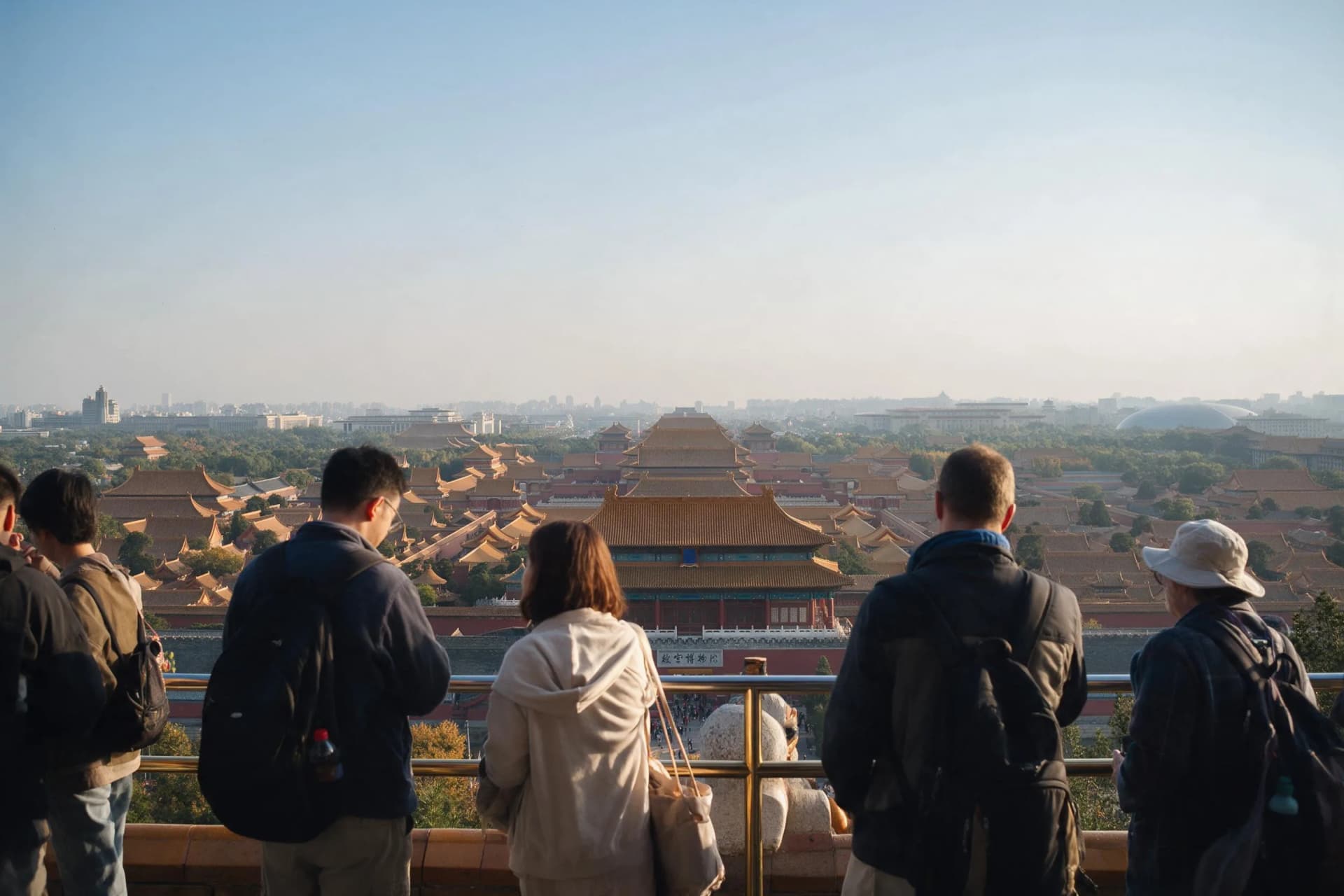
Spot 1: Jingshan Park's Wanchun Pavilion, Beijing. Exact viewpoint: the south balustrade at the summit, centered on the Forbidden City's north-south axis. Aim for 90 to 30 minutes before sunset; late October is roughly 16:00-17:15, June about 18:00-19:15. The summit crowds after 17:00 in autumn, so arrive 15 minutes early. Jingshan costs CNY 2. The Forbidden City costs CNY 60 April-October or CNY 40 November-March, closes Mondays, and releases timed tickets seven days ahead at 8 p.m. Beijing time; bring the booking passport.
Spot 2: the Inner Golden Water River inside the Forbidden City. Exact viewpoint: the west bank between the westernmost bridge and Taihe Gate, looking northeast across the five bridges. Entry at 8:30 is cleanest; 10:00-14:00 is the crush. Camera: 24-28mm, f/8, ISO 100, 1/250 sec, focus on the second bridge and set minus 0.7 EV so sunlit roofs keep detail. Phone: use 1x, turn on the grid, tap a bright roof and lower exposure. Skip ultra-wide; it bows the gate and shrinks the bridges.
Spot 3: Mutianyu Great Wall. Exact viewpoint: the westbound path about 10 minutes from Tower 14 toward Tower 15; turn back east for the wall's double bend. The cable car's first hour, roughly 8:00-9:30, gives side light and quiet ramparts. Tours dominate 10:00-14:00; light improves again from 15:30 until the last car. Admission is CNY 45; a return cable car about CNY 120. Camera: 35-70mm, f/8, ISO 100, 1/250 sec, minus 0.3 EV on sunlit stone. Phone: use 2x or 3x, lock focus on a tower and burst; avoid digital zoom beyond 3x.
Spot 4: the Bund, Shanghai. Exact viewpoint: the railing at Nanjing East Road and Zhongshan East 1st Road, in front of the Fairmont Peace Hotel, facing Lujiazui. It is free and open 24 hours. Best clean light is 30 minutes before sunrise to 20 minutes after, roughly 5:30-6:30 in mid-October; blue hour beginning 20 minutes after sunset is the backup. Crowds own the promenade 18:30-22:00, so shoot at dawn. Camera: 24-35mm, f/8, ISO 100-200, 1/4-2 sec on a tripod or braced on the rail. Phone: use night mode for 2-3 seconds on the rail, tap the sky and lower exposure to keep light detail.
Spot 5: Xi'an City Wall at Yongningmen South Gate. Exact viewpoint: the inner parapet about 150 meters west of the gate tower, looking east along the south wall. Shoot 40 minutes before and after sunset; mid-October sunset is near 17:55. The floodlit wall after 19:30 is busy, while 8:00-9:00 is quieter. Entry is CNY 54 and bike hire about CNY 45 for two hours. Camera: 16-24mm, f/8, ISO 100, 1/250 sec; include a cyclist for scale. Phone: use 1x with level grid, tap the wall and reduce exposure slightly.
Build the shoot around the forecast. Check rain, wind and visibility the night before; if visibility is under 5 km or rain probability exceeds 60%, move Mutianyu to the next morning and use the free National Museum of China, closed Mondays, as the indoor backup. On clear days, photograph east-facing facades in the morning and west-facing walls after 15:30. Carry rain cover and silica. High wind can suspend the cable car, and haze can erase the Great Wall.
Before booking, verify your passport on the National Immigration Administration's official site, save the onward ticket offline and keep a screenshot of the rule and entry port. If your route is a round trip to the US, apply for the visa instead. Then reserve the Forbidden City at the seven-day mark, lock the Mutianyu transfer and set two photo alarms: sunrise at the Bund and 90 minutes before sunset at Jingshan. Linked guides cover stations, arrivals and tickets.
Good to know
- 2026 transit eligibility
- 55 nationalities, including the US, UK, Canada, Australia and Japan; a confirmed onward ticket to a third country; up to 240 hours through 60 approved ports.
- Photo tickets
- Jingshan CNY 2; Forbidden City CNY 60 April-October or CNY 40 November-March; Mutianyu CNY 45 plus about CNY 120 return cable car; Bund free; Xi'an City Wall CNY 54 plus about CNY 45 bike hire for two hours.
- Best light windows
- Jingshan 16:00-17:15 in late October; Forbidden City from 8:30; Bund 5:30-6:30 at dawn; Mutianyu 8:00-9:30 or after 15:30; Xi'an City Wall around 17:15-18:35.
- Booking deadlines
- Forbidden City timed tickets release seven days ahead at 8 p.m. Beijing time and close Mondays; China rail seats normally open 15 days before departure.
- If the waiver fails
- A US tourist visa costs about $185 per person; standard processing is commonly four business days, and applications can open three months before travel.
Frequently asked questions
Can US citizens use China's 240-hour visa-free transit in 2026?
Yes, if they enter through one of the 60 approved ports from another country and hold a confirmed onward ticket to a third country within 240 hours. A round trip back to the US does not qualify.
Does a round trip to the US qualify for the 240-hour transit waiver?
No. The trip must continue from China to a different country or eligible region, not return directly to the country you came from. New York-Beijing-New York fails the third-country test.
Where can I photograph the Forbidden City skyline without buying a palace ticket?
The south balustrade at Wanchun Pavilion in Jingshan Park gives the classic overview and costs CNY 2. The Forbidden City requires a separate timed ticket of CNY 60 April-October or CNY 40 November-March.
Do I need a ticket to photograph the Bund and Jingshan Park?
The Bund promenade is free and open 24 hours. Jingshan Park costs CNY 2, and a separate Forbidden City ticket is needed only if you want to photograph inside the palace grounds.
Can I travel from Beijing to Shanghai and Xi'an on the 240-hour waiver?
Yes, provided each city is within the designated area and time limit shown on your arrival endorsement. Keep your itinerary and onward ticket ready for inspection and leave from an approved exit port.