
City Guide
Hong Kong Food Guide 2026: Dim Sum, Dai Pai Dong and Market Eats
Hong Kong eats best at street level, and the transit is the trail: a HK$5.00 Star Ferry, a HK$3.30 tram and the MTR link dim sum teahouses, wet markets, roast-meat windows and Temple Street's night stalls. Budget HK$150 to HK$300 a day, chase the 2025 Michelin Bib Gourmand list capped at HK$400, and come between October and December.
Eat Hong Kong at street level: dim sum before 11 a.m., roast goose and wonton noodles at lunch, dai pai dong stir-fries after dark. Budget HK$150 to HK$300 a day, ride the HK$5.00 Star Ferry between Kowloon and the island, and go between October and December for dry, mild weather.
Hong Kong is a food city you traverse, not one you drive through. The harbor, the steep slopes and the tram lines kept it compact, and nearly every great meal sits within a few minutes of a ferry pier, an MTR exit or the Central-Mid-Levels escalator. That is the local rhythm: a HK$5.00 Star Ferry crossing from Tsim Sha Tsui to Central, then a bowl of noodles in Sheung Wan; a HK$3.30 ding-ding tram along the island's north shore, then roast meat in Wan Chai. Plan the eating around the transit, not the other way around, and Hong Kong unfolds like a menu.
Mornings belong to tea. A classic teahouse opens before 7 a.m., and dim sum is at its best before 11 a.m., when the trolleys are still moving and the room is full of regulars reading newspapers. Expect har gow, siu mai, cheung fun and char siu bao at roughly HK$28 to HK$48 per basket; Lin Heung Tea House in Central keeps the old trolley-and-ticket ritual, while the original Tim Ho Wan in Sham Shui Po, the cheap dim sum shop that famously won a Michelin star, does the same dishes faster. For the diner version, step into a cha chaan teng for a set breakfast of scrambled eggs, toast and Hong Kong-style milk tea, usually HK$40 to HK$60, and watch how quickly the tables turn.
The markets show you what the city actually cooks. Graham Street Market in Central is the oldest, a steep lane of fruit, dried seafood and butcher stalls that has traded since the 1840s. In North Point, Bowrington Road Market stacks a wet market below and a cooked-food hall above, where you point at tanks of fish and sit down to have it steamed. Sham Shui Po adds fabric stalls, cheap electronics and Pei Ho Street's produce, while Kowloon City, a few MTR stops north, is Hong Kong's Little Thailand, fragrant with basil, lime and grilled pork. Go before 10 a.m. for the freshest produce, or at lunch when the cooked-food floors fill with office workers.
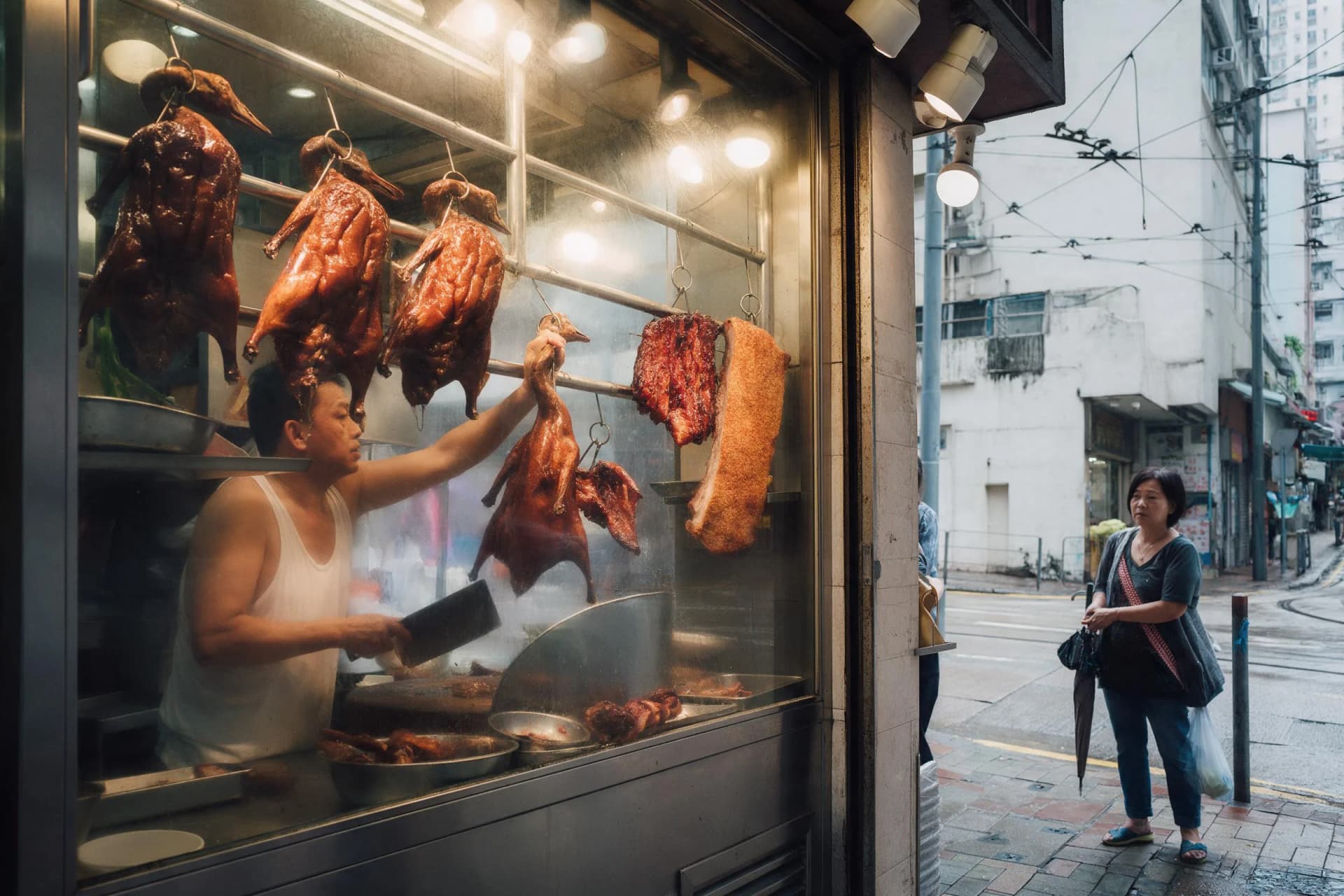
Midday is for roast meat. Cantonese siu mei windows hang glossy ducks, geese, char siu and crackling roast pork, and the best are rarely fancy: Yung Kee in Central has roasted goose since 1942, while neighborhood shops in Wan Chai, Yau Ma Tei and Mong Kok sell rice boxes with two meats for HK$50 to HK$80. Pair that with wonton noodles, thin egg noodles and plump shrimp wontons in a clear broth, at old shops such as Mak's in Central for around HK$40 to HK$60. Finish with an egg tart, flaky or cookie-crust, warm from the tray at Tai Cheong Bakery in Central for about HK$10 to HK$15, and a strong milk tea to go.
After dark, the city eats outdoors. Temple Street Night Market in Yau Ma Tei and Jordan starts setting up around 2 p.m. and turns lively at dusk, when more than 100 stalls sell clothes, watches and trinkets while seafood, claypot rice and fried noodles cook at the roadside. Mong Kok's Fa Yuen Street keeps similar hours, and in Sai Kung the seafood restaurants let you choose your fish from a tank. For a benchmark on value, the Michelin Guide's 2025 Bib Gourmand list named 66 Hong Kong eateries and caps the award at HK$400 for three courses without drinks, which makes it a reliable shortlist rather than a splurge.
Two practical habits save money and confusion. Buy an Octopus card at any MTR station and tap it on trains, trams, ferries and convenience stores, but carry some cash because dai pai dong stalls and older noodle shops may not take cards. Expect a 10 percent service charge in sit-down restaurants and a small tea or pickle fee per person, which is standard rather than a scam. October to December is the best window: humidity drops, temperatures ease from about 28°C to 20°C, and outdoor market tables are pleasant. Avoid Chinese New Year on February 17, 2026, and the October 1 to 7 National Day week, when queues and hotel rates jump.
Land at Hong Kong International Airport and the Airport Express reaches Kowloon in about 22 minutes; from there the MTR links every district in this guide. US passport holders can enter Hong Kong visa-free for up to 90 days, so a food-focused long weekend needs no paperwork beyond the usual. Tell ChinaMira your travel dates, your appetite and the dishes you already love, and we will build a walking-and-riding food route around the teahouses, markets and tram stops that fit your trip.
More ChinaMira planning: our Hong Kong travel guide, a three-day Hong Kong itinerary, the best time to visit Hong Kong, the China food guide, and food and tea journeys across China.
Good to know
- Street food and meal prices
- Dim sum baskets about HK$28 to HK$48 each; wonton noodles HK$40 to HK$60 a bowl; egg tarts HK$10 to HK$15; cha chaan teng set breakfast HK$40 to HK$60; two-meat rice boxes HK$50 to HK$80
- Michelin Bib Gourmand 2025
- 66 Hong Kong eateries received the award, which caps a three-course meal without drinks at HK$400
- Temple Street Night Market hours
- Stalls begin around 2 p.m. and the market is liveliest from dusk into the late evening, daily; more than 100 stalls in Yau Ma Tei and Jordan
- Getting between food districts
- Star Ferry upper deck HK$5.00 Monday to Friday and HK$6.50 on weekends and public holidays; ding-ding tram a flat HK$3.30 since May 12, 2025; Octopus card accepted on the MTR, trams and ferries
- Best months to eat
- October to December, with highs easing from about 28°C to 20°C; avoid Chinese New Year on February 17, 2026, and the October 1 to 7 National Day week
- Entry and payment
- US passports enter Hong Kong visa-free for up to 90 days; restaurants often add a 10 percent service charge plus a small tea fee, and dai pai dong stalls prefer cash
Frequently asked questions
How much does food cost in Hong Kong?
Plan on HK$150 to HK$300 per person per day. Dim sum baskets run about HK$28 to HK$48 each, a bowl of wonton noodles HK$40 to HK$60, an egg tart HK$10 to HK$15, and a cha chaan teng set breakfast HK$40 to HK$60. A Michelin Bib Gourmand dinner stays under HK$400 for three courses without drinks, while dai pai dong stir-fries are often HK$50 to HK$90 a plate.
When is the best time of year to eat your way through Hong Kong?
October to December, when temperatures ease from about 28°C to 20°C and outdoor market tables are comfortable. Avoid Chinese New Year on February 17, 2026, and the October 1 to 7 National Day week, when teahouse queues and hotel rates both spike. June to September is hot and typhoon-prone, and a Signal No. 8 closes ferries and stalls.
What time does Temple Street Night Market open?
Stalls begin setting up around 2 p.m. and the market turns lively at dusk, staying busy into the late evening daily. More than 100 stalls line Temple Street in Yau Ma Tei and Jordan, selling clothes and trinkets alongside seafood, claypot rice and fried noodles. Arrive after 7 p.m. for the fullest food row.
Where do locals go for dim sum in Hong Kong?
Before 11 a.m., when trolleys still circulate and baskets cost about HK$28 to HK$48. Locals favor old teahouses such as Lin Heung in Central, neighborhood halls in Sham Shui Po and Mong Kok, and the original Tim Ho Wan in Sham Shui Po, the cheap dim sum shop that won a Michelin star. Book nothing; arrive early and share a pot of tea.
How do I travel between Hong Kong's food neighborhoods?
For HK$5.00 you can cross the harbor on the Star Ferry, or HK$6.50 on weekends and public holidays, and for a flat HK$3.30 the ding-ding tram runs the length of Hong Kong Island after the May 12, 2025 fare change. The MTR covers Kowloon and the New Territories, and an Octopus card taps onto all of them plus convenience stores; carry cash for dai pai dong.