
Attraction
Shanghai Museum 2026: Free Entry, Two Buildings and Its Greatest Bronze
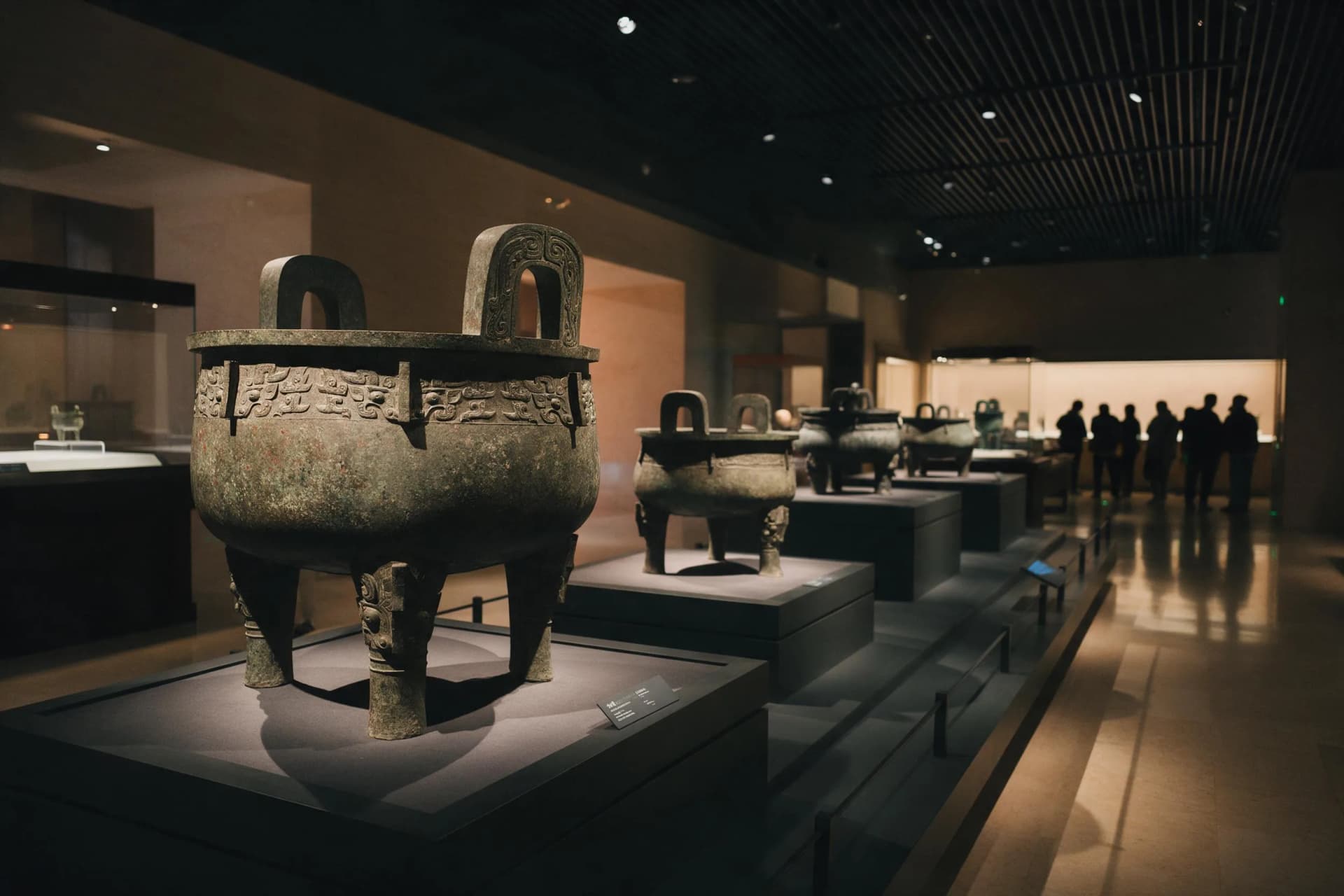
For most of its life the Shanghai Museum meant one bronze-hued building on People's Square. In 2024 it became two, and the split matters: the permanent Chinese art galleries — including the museum's master bronze — now live at the East branch in Pudong, while People's Square gives itself to one world exhibition at a time. This guide explains which door to choose, what the two buildings hold, and how to book.
Entry to both Shanghai Museum buildings is free, but the two sites now do different jobs: the bronze, ceramics, jade and painting galleries sit at the East branch in Pudong (open 10:00–18:00, closed Tuesdays), while the 201 Ren Min Da Dao building on People's Square shows one exhibition at a time.
The object that anchors the collection is also its best story. In 1890, farmers digging near Famen Temple in Shaanxi unearthed the Da Ke Ding, a ritual bronze food vessel cast in the late 10th century BCE, during the reign of King Xiao of Zhou. It stands 93.1 centimeters high, weighs 201.5 kilograms, and carries 290 characters on its inner wall — a record of the land and titles a king granted to an official named Ke. In 1951 the Shanghai collector Pan Dayu, whose family had hidden the vessel through years of wartime looting, donated it to the museum then being founded. It is still the museum's master treasure.
The museum dates to 1952, when its founding collections went on show in a former racecourse clubhouse on West Nanjing Road. It moved to People's Square in 1996, into a five-story hall designed by Xing Tonghe in the shape of a bronze ding, with a round top and a square base. Today the collection spans 33 categories and nearly 1,020,000 items, 140,000 of them graded national treasures — one of the most complete surveys of ancient Chinese art anywhere. In February 2024 that collection gained a second, far larger home: the Shanghai Museum East on Century Avenue in Pudong, which opened to the public on February 2.
The East branch is where to spend your time. Its 20 galleries and interactive spaces run through bronzes, sculpture, ceramics, jade, seals, calligraphy, painting and coins, so the collection finally has room to breathe. The Ancient Chinese Bronze Gallery alone justifies the trip: the Da Ke Ding and the Jin Hou Su Zhong bells share cases with vessels whose inscriptions record royal grants, military campaigns and rituals. Two spaces, The Curio-City and the Digital Gallery, are built for families and need their own timed slots. Allow three to four hours to walk the permanent halls without hurrying, and longer if a ticketed special exhibition is running.
The People's Square building has changed character. Rather than permanent Chinese art, it now concentrates on world cultures, one major exhibition at a time. Through 14 November 2027 it hosts “On Top of the World Tree: Ancient Civilizations of the Americas,” and the museum has said it will show nothing else during that run, so if you came for the bronzes, the East branch is the answer. What People's Square still offers is the building itself — the ding silhouette, the round atrium, the address that has been the museum's face for three decades — plus evening sessions, which on selected dates extend to 21:00 and are announced on the museum's WeChat account.
Practicalities are simple once you know the split. General admission to the East branch needs no advance booking for individuals; bring your original passport or ID, pass security at the B1 East Gate near Dingxiang Road, and scan in. Book ahead only for The Curio-City and the Digital Gallery, and for ticketed special exhibitions. At People's Square, advance booking is required while the Americas exhibition runs: individuals use the museum's official WeChat Mini Program, and overseas visitors can book through Trip.com. Original documents are mandatory — a phone photo will not get you through the gate. Groups of 20 or more must telephone at least seven days ahead.
Both buildings sit on the metro. People's Square station on Lines 1, 2 and 8 puts you a short walk from the south entrance on Wusheng Road. For the East branch, take Line 2 to Shanghai Science and Technology Museum and leave by Exit 8, or Lines 4 or 6 to Pudian Road and use Exit 2 or Exit 1. Century Avenue itself is a broad, walkable boulevard lined with the Oriental Art Center and the science museum, so the last stretch is pleasant rather than grim. Taxis and DiDi work well too, but the metro dodges the worst of Pudong traffic.
Pair the museum with the rest of Shanghai rather than treating it as a separate errand: a morning among the bronzes, lunch in Lujiazui, then the Bund at dusk, or a rainy afternoon at the East branch swapped for a morning at Yu Garden. If you are choosing between the two buildings, remember the rule of thumb — Chinese art at the East, world exhibitions at People's Square — and book the one that matches your trip. ChinaMira can build the day around your dates, with timed entry, an English-speaking guide who can read the inscriptions, and a car waiting when the galleries close. Tell us when you are coming, and we will put the bronzes first.
Good to know
- Admission
- Free at both buildings. Only ticketed special exhibitions cost extra; buy online or at the Information Desk, with prices posted on the official website and WeChat channel.
- Opening hours
- People's Square: Tuesday–Sunday 09:00–17:00, last entry 15:00, closed Mondays (evening sessions to 21:00 on selected dates). East: Wednesday–Monday 10:00–18:00, last entry 17:00, closed Tuesdays. Both open on national holidays.
- Getting there
- People's Square: Metro Lines 1, 2 and 8 to People's Square station, south entrance on Wusheng Road. East: Metro Line 2 to Shanghai Science and Technology Museum, Exit 8; Metro Lines 4 or 6 to Pudian Road, Exits 2 and 1.
- Addresses
- East: 1952 Century Avenue, Pudong New Area, with individual entry at the B1 East Gate near Dingxiang Road. People's Square: 201 Ren Min Da Dao, Huangpu District.
- Collection in numbers
- 33 categories, nearly 1,020,000 items and 140,000 graded national treasures, shown across 20 East-branch galleries; the Da Ke Ding alone weighs 201.5 kg and carries a 290-character inscription.
- Time to allow
- 3–4 hours at the East branch for the permanent galleries, and 1.5–2 hours at People's Square for its current single exhibition.
Frequently asked questions
Which Shanghai Museum building should I visit?
If you want the permanent Chinese art collection — bronzes, ceramics, jade, calligraphy and painting — go to the Shanghai Museum East in Pudong. The People's Square building currently devotes itself to a single world-culture exhibition, so it is the better stop only when that show interests you.
Do I need to book the Shanghai Museum in advance?
At the East branch, individual visitors can usually walk in with an original passport, but The Curio-City and the Digital Gallery still need their own advance reservations. At People's Square, advance booking is required while the Americas exhibition runs; use the official WeChat Mini Program, or Trip.com if you are booking from overseas.
Can US citizens visit the Shanghai Museum without a visa?
Many can. China's 240-hour visa-free transit policy covers US passport holders and 56 other nationalities who arrive with a confirmed onward ticket to a third country or region, allowing up to 10 days in the permitted areas. A plain round trip back to the United States still needs a tourist (L) visa.
Where are the Shanghai Museum's famous bronzes now?
They are on show at the Shanghai Museum East, in the Ancient Chinese Bronze Gallery, alongside the ceramics, jade, seals, calligraphy and painting galleries. The People's Square building no longer displays them while it hosts On Top of the World Tree: Ancient Civilizations of the Americas.