
Story
Does Google Maps Work in China in 2026? What Actually Works for Food
Every food plan in China starts with a map, and the map you know does not work here. This is the practical swap first - a roaming eSIM, Amap and Dianping - and then the eating itself: a roast duck, a bowl of hand-pulled noodles, a hotpot, two street snacks, and one breakfast street that opens before the city does.
Short answer: no. Google Search, Maps, and Play have been blocked on mainland networks since 2010, and 2026 brings no change: pins sit on the offset GCJ-02 grid, so a restaurant can show up in the wrong block. Download Amap or Baidu Maps before you fly; both are free and good enough to find dinner.
Underneath it all this is a network problem, not a maps problem. Hotel Wi-Fi in Beijing and Shanghai runs on mainland networks, where Google's search, mail, video and app-store services have been unreachable for well over a decade. There is a special kind of cruelty to the way Google Maps half-loads there: a bare map without business names, drawn on a shifted grid, so a dumpling shop appears in the middle of a canal. Personal VPNs sit in a legal gray zone, only state-approved channels are sanctioned, and connections collapse without warning, so do not build a two-week food trip on one. The route most visitors use instead is an international roaming plan or travel eSIM: your traffic leaves through your home carrier, so Google, Gmail and Instagram behave exactly as they do at home. It costs more per gigabyte than a local SIM and removes the entire argument.
What to use instead. Amap, sold abroad as Gaode Maps, is the closest thing to a working Google Maps in China: free, live traffic, metro and walking routes, English labels in its international version, and reliable to the door. Baidu Maps is stronger on buses and Chinese-only searches, and on iPhone the Apple Maps app is powered by the same local Chinese data, which makes it a genuinely accurate fallback. For eating, two apps do the heavy lifting. Dianping is the local review platform, with millions of dish photos, average spend per head and real opening hours. Meituan handles vouchers and delivery. Install all four, then download the offline map for each city while you are still on fast home Wi-Fi.
Five dishes to order, with street-level prices. Peking duck, Beijing - CNY 238-328 for a whole bird at a solid mid-range roast-duck house, plus CNY 10-20 per person for pancakes, scallion and sweet bean sauce. Lanzhou beef noodles - CNY 12-18 in an ordinary noodle shop, CNY 26-32 at the polished chains, and the soup is the whole point. Xi'an roujiamo - CNY 12-16 for one chopped-pork flatbread, with biang biang noodles next to it at CNY 22-35 a bowl. Chongqing hotpot - CNY 90-150 per person once you have ordered tripe, beef and a vegetable or two; order mild, then dial up. Shanghai xiaolongbao - CNY 25-40 for a steamer of eight to twelve in a neighbourhood shop, CNY 60-90 for a smaller, fancier basket.
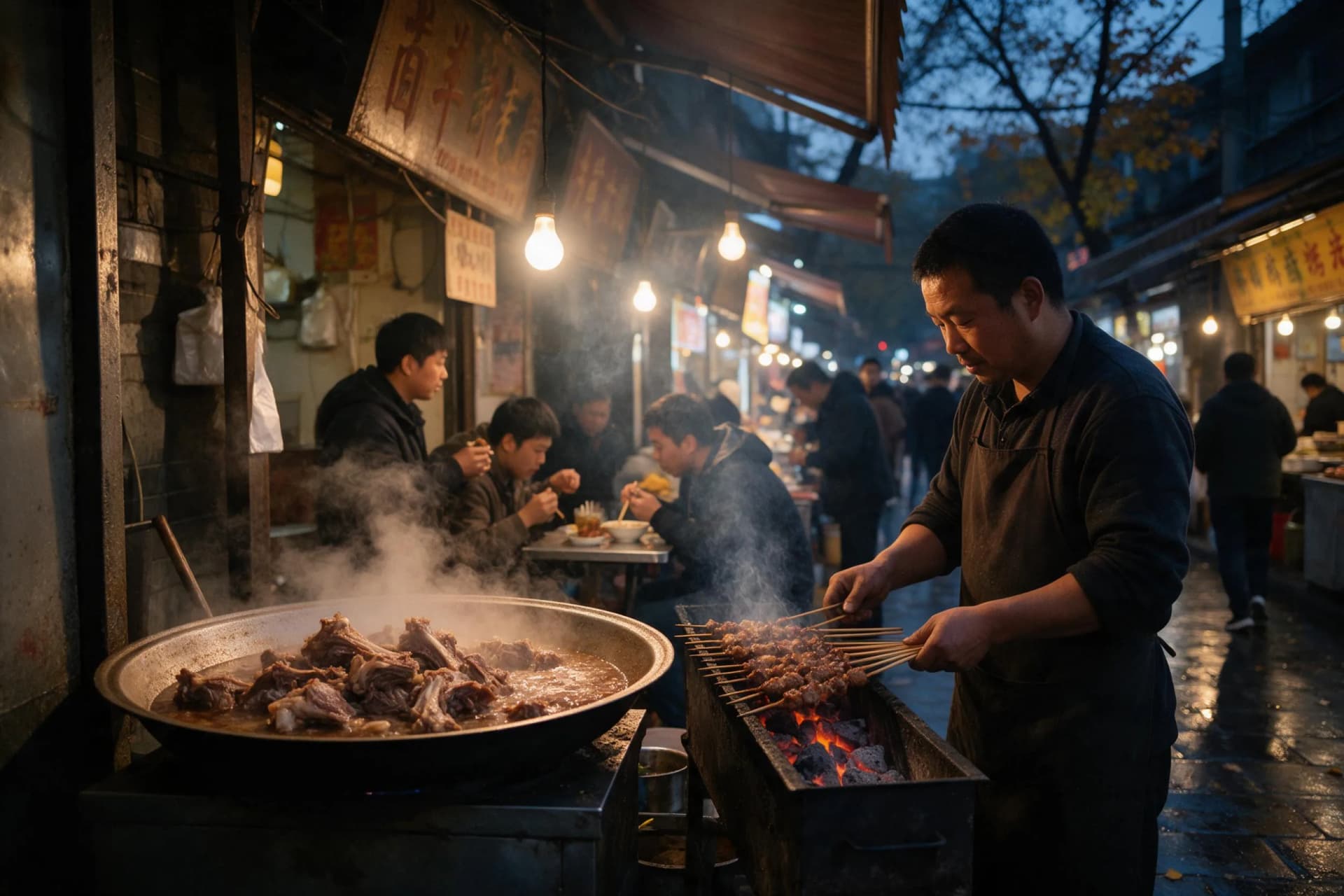
One street to eat breakfast on: Xi'an's Muslim Quarter. The lanes around Beiyuanmen Street and the parallel Sajinqiao grid make the best single food walk in the country, and they start early. Pulled lamb soup, yangrou paomo, arrives as a bowl of broth with bread you tear and soak yourself for CNY 28-45; hulutou at CNY 20-30 is the fiercer cousin; persimmon cakes go for CNY 5-8, and lamb skewers for CNY 3-5 a stick. Stalls wake up around 08:00, the local breakfast rush is 07:00-09:00, the tourist crush lands between 18:00 and 21:30, and nearly everything closes by 23:00. Come hungry, carry small notes, and bring tissues.
Halal and vegetarian, sorted. The Muslim Quarter is Hui Muslim territory, so halal is the default: look for the two characters for qingzhen on the signboard, and the Lanzhou noodle chains carry the same mark. For meat-free travelers, Shanghai's Gongdelin has been cooking vegetarian food since 1922, and a full meal of mock duck, braised gluten and soup costs CNY 70-120 per person. Buddhist temple restaurants, including the one at Hangzhou's Lingyin Temple, run set menus for CNY 50-80. Learn two phrases before you go: su means vegetarian, and bu yao rou means no meat. Show them on your phone screen at the counter and most cooks will simply nod.
How to find food without Google. Screenshot everything before you leave the hotel: the Chinese name and address of each restaurant, the nearest metro exit, and its rating on Dianping. Search inside Amap in Chinese, not English, because English searches return hotels rather than noodle shops. In a taxi, hand over the Chinese address on your screen instead of saying it aloud. Alipay and WeChat Pay both link to international cards now, which is how almost every stall takes money, and Didi is the ride-hailing app that works inside both. Give yourself one free afternoon in your first city to get deliberately lost; the best bowl of noodles on a trip is usually the one you find by following a queue of construction workers at half past eleven in the morning.
Set the trip up in this order: buy a roaming plan or travel eSIM, install Amap, Dianping and Alipay about two weeks before you fly, download the offline map for every city on your route, then write your restaurant wishlist in Chinese before you board. Land, drop the bags, order the roast duck for your first night and the pulled lamb soup for the morning after. Leave Google Maps at home, and spend the frustration you save on a second basket of xiaolongbao.
Good to know
- Google status in mainland China
- Search, Maps, Gmail, YouTube and Play are unreachable on mainland networks; 4 free replacements do the job: Amap, Baidu Maps, Dianping and Meituan.
- Map accuracy
- GCJ-02 coordinate offset: a foreign map pin can land 100-600 m from the real door. Amap, Baidu and Apple Maps in China use the local grid and point accurately.
- Download window
- Install Amap, Dianping, Meituan and Alipay about 2 weeks before departure and download each city's offline map at home; all 4 apps are free.
- Signature dish prices, 2026
- Peking duck CNY 238-328 whole; Lanzhou beef noodles CNY 12-18; roujiamo CNY 12-16; Chongqing hotpot CNY 90-150 per person; xiaolongbao CNY 25-40 a basket.
- Xi'an Muslim Quarter
- Stalls open about 08:00 and close by 23:00, breakfast rush 07:00-09:00, night crush 18:00-21:30; snacks run CNY 3-45 and the whole quarter is halal.
- Halal and vegetarian
- Qingzhen on a signboard means halal; Gongdelin in Shanghai has served meat-free set meals since 1922 at CNY 70-120 per person, and temple restaurants run CNY 50-80.
Frequently asked questions
Can I use Google Maps in China in 2026?
Not reliably. Google's services are blocked on mainland networks, so Maps often will not load even on fast hotel Wi-Fi, and any data you do see is out of date and drawn on an offset grid. Do not plan walking routes with it.
What is the best Google Maps alternative in China?
Amap, called Gaode Ditu in Chinese, is the closest match: free, English-friendly in its international version, and strong on live traffic, metro exits and walking routes. Baidu Maps is better for buses, and Apple Maps uses accurate local Chinese data on iPhone.
Does a VPN make Google Maps work in China?
Sometimes, and never dependably. Only state-approved VPN channels are sanctioned, personal use sits in a legal gray zone, and apps are blocked unpredictably. An international roaming plan or travel eSIM is the stable and legal alternative for most visitors.
Is it easy to eat halal or vegetarian in China?
Yes, with a little vocabulary. Xi'an's Muslim Quarter is halal throughout and its signboards carry the characters for qingzhen, and Lanzhou beef noodle shops are halal too. For vegetarian eating, look for dedicated meat-free restaurants and Buddhist temple kitchens; the word to know is su.
How do I find restaurants in China without Google?
Use Dianping for ratings, dish photos and average spend, then copy the Chinese restaurant name into Amap for the route. Save each address as a screenshot before you leave the hotel, and show the Chinese name to your taxi driver rather than pronouncing it.