
Travel Guide
China Food Guide Photography Spots: 7 Light Windows for 2026
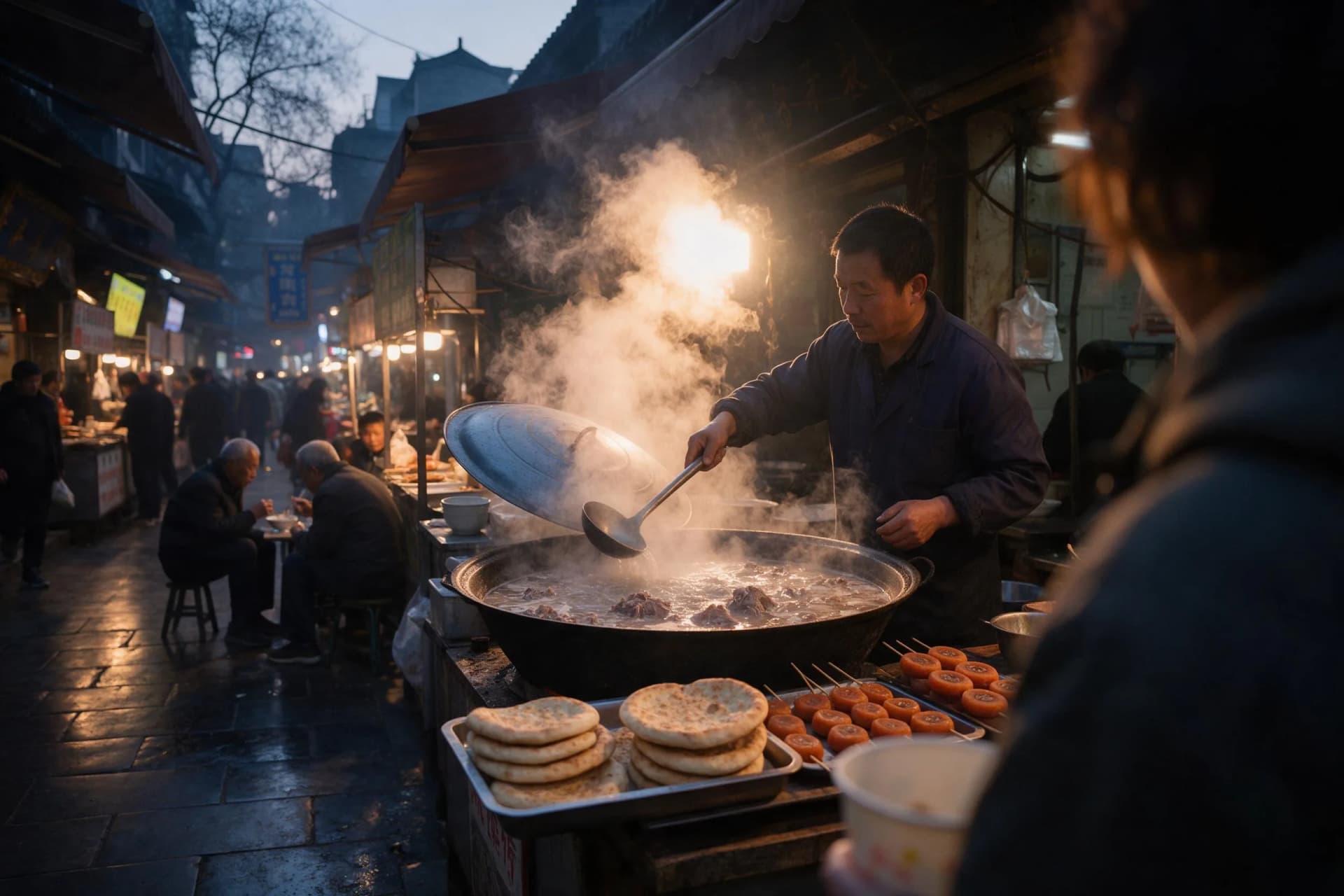
Chinese food is the hardest thing you will ever photograph: small, hot, backlit and gone in ninety seconds. Here are seven spots with the exact light window, the viewpoint, the entry cost and the settings that actually work, from a dawn lane in Xi'an to steam in a Harbin winter market.
For 2026, the answer is simple: photograph Chinese food in the first hour after sunrise and the last hour before sunset, at spots that cost little or nothing to enter. Be at Xi'an's Beiyuanmen Street by 07:00, or Harbin's Hongzhuan Street market by 05:30 in winter, and carry CNY 40-60 in cash for snacks.
Food is the hardest subject in travel photography because it is small, hot and backlit. Steam confuses the sensor and overhead restaurant lamps turn everything yellow. Fix it in this order: put a light source behind the bowl so the steam glows, expose for the highlights of the broth, and shoot within 90 seconds. On a camera, start at 35mm, f/2.8, 1/125s, ISO 1600; on a phone, tap the dish, drag the exposure slider down about 0.7 stops, and hold the shutter for a burst.
Spot 1, Xi'an: Beiyuanmen Street at the Xiyangshi Street junction. In mid-October 2026 sunrise falls near 06:55, so stand at the junction of Beiyuanmen and Xiyangshi by 07:00, when the stall lamps are still lit and the first steam rises off the lamb broth. The Muslim Quarter has no ticket and no booking. Shoot down the lane toward the Great Mosque gate for depth, and work the stalls between 07:00 and 09:00; it is a 10-minute walk from Bell Tower (Zhonglou) station on Metro Line 2. By 18:00 the lane is shoulder to shoulder until about 21:30, so trade that crowd for the morning.
Spot 2, Harbin: the Hongzhuan Street morning market in Daoli District, along Hongzhuan Street where it meets Tongjiang Street. Winter here is the best steam in China. Stalls start before dawn and are packing up by about 08:30, so aim for 05:30 in January and February, when the air sits near -18°C and every griddle throws a column of white. Nothing to pay: a youtiao costs CNY 2-3 and hot soy milk CNY 3. Your enemy is condensation, not light, so pocket a spare battery and wipe the lens with a microfibre cloth before each burst. It is a 12-15 minute walk from Central Street.
Spot 3, Chengdu: Heming Teahouse in People's Park, free to enter, tea CNY 20-40. The bamboo-chair courtyard suits the flat grey basin light photographers usually complain about, because that even light holds detail in the steam and the wicker. Go between 09:00 and 11:00 and shoot across the table so the pour lands against dark trees rather than white sky. Weekday mornings are calm; from 13:00 the courtyard fills. Settings: 50mm, f/2, 1/250s, ISO 800.
Spot 4, Guangzhou: Taotao Ju on Dishifu Road in Liwan District, where morning tea is a seated performance. There is no entrance fee and a full spread runs CNY 60-120 per person. Take a window table between 07:30 and 09:00, when side light rakes across the stacked bamboo steamers, and take a number at the door: the wait runs 45 minutes by 11:00. Shoot the steamers from slightly above at 35mm, f/2.8, 1/160s, ISO 800.
Spot 5, Shanghai: the Nanxiang takeaway window beside Yu Garden. This one is light plus queue maths. The street-side window opens around 08:00 with a short line; by 11:30 the wait for the same basket of xiaolongbao is 30-60 minutes, at about CNY 25-45 a steamer. Shoot from just above the table edge to catch rim light on each pleat. Settings: 35mm, f/2.5, 1/200s, ISO 1000, exposed for the wrapper so it stays white rather than grey.
Spot 6, Chongqing: hot pot after blue hour. In mid-October sunset falls near 18:20 and the sky holds colour for another 30-40 minutes, the only window where a bubbling red-oil pot and a lit skyline fit in one frame. Stand on the 11th-floor viewing platform at Hongyadong, free and jammed after 20:00, or shoot across the pot at a river-side hot pot house in Nan'an District. Budget CNY 90-150 per person. Settings: brace on the rail, f/2, 1/60s, ISO 3200, and take three frames because steam softens one of them.
Spot 7, Beijing: the carving trolley at a roast duck house near Qianmen. Order a whole bird, about CNY 238-328, and ask for a table by the window at the 17:00 sitting, because the last light of the afternoon is the only time the skin reads as lacquered rather than flat. Shoot the first slice going down at 35mm, f/2, 1/160s, ISO 1600 - and never use flash in the dining room.
Three rules tie these spots together. Only two need a reservation: the Beijing duck house, where the 17:00 sitting books out two to three days ahead, and Guangzhou's Taotao Ju if you want a window table. Pay with Alipay or WeChat Pay, but keep CNY 100 in small notes for dawn market stalls. Distances are short by rail - Xi'an to Chengdu 3-4 hours, Chengdu to Chongqing about 1.5 hours - so a two-week China food guide route covers four of these spots without an internal flight, and the same sunrise-and-steam maths carries over to a Taiwan food guide circuit if you extend east.
Your next step: open our China food guide for the dishes and 2026 prices, then book the two tables that matter - the 17:00 duck sitting in Beijing and a window table at Taotao Ju in Guangzhou - for the mornings and evenings that match the light windows above.
Good to know
- Light windows by spot
- Xi'an Beiyuanmen Street 07:00-09:00; Harbin's Hongzhuan Street market 05:30-08:00 in winter; Chengdu's Heming Teahouse 09:00-11:00; Guangzhou's Taotao Ju 07:30-09:00; Chongqing hot pot and skyline 18:20-19:00.
- Free entry, paid food
- Beiyuanmen Street, Chengdu's People's Park and the Hongyadong viewing platform cost CNY 0; the Hongzhuan Street market has no gate fee and sells youtiao at CNY 2-3; only the meals are paid for, CNY 2-150 per person.
- Food spend per stop
- Chengdu tea CNY 20-40; Guangzhou dim sum CNY 60-120 per person; Shanghai xiaolongbao CNY 25-45 a steamer; Chongqing hot pot CNY 90-150 per person; Beijing roast duck CNY 238-328 a bird; market snacks CNY 2-45.
- Crowd timing
- Xi'an lanes fill 18:00-21:30; Guangzhou dim sum wait hits 45 minutes by 11:00; Shanghai's bun line runs 30-60 minutes after 11:30; Hongyadong's platform is jammed after 20:00.
- Mid-October 2026 light
- Sunrise about 06:55 in Xi'an, 06:00 in Harbin and 07:00 in Chengdu; Chongqing sunset near 18:20 with usable colour until about 19:00. China has no daylight saving.
- Settings that work
- Camera: 35mm, f/2.8, 1/125s, ISO 1600, exposed for the brightest part of the dish. Phone: tap to focus on the food, drop exposure 0.7 stops, burst rather than single frames.
Frequently asked questions
What is the best time of day to photograph Chinese street food?
The first hour after sunrise and the last hour before sunset. Low light sits behind the steam so it glows, shadows fall away, and stall lanes are still quiet. In Xi'an, plan on 07:00 to 09:00; in Harbin in winter, 05:30 to 08:00.
Do I need a ticket to photograph the Muslim Quarter in Xi'an?
No. Beiyuanmen Street and the lanes around the Great Mosque are open public streets with no entry fee and no booking. You only pay for food, roughly CNY 5 to 45 per item, and stallholders are used to visitors photographing what they buy.
How do I stop steam from ruining my food photos?
Put the light behind the dish instead of behind your shoulder, expose for the brightest part of the broth, and shoot within about 90 seconds of the plate arriving. Wipe your lens before each burst, and take three frames, because steam softens at least one of them.
What camera settings work best for dim sum and night markets?
Start at 35mm, f/2.8, 1/125s and ISO 1600, then raise ISO before shutter speed drops below 1/60s. On a phone, tap the food, drag exposure down about 0.7 stops and hold the shutter for a burst rather than shooting single frames.
Is it rude to photograph food vendors in China?
Not if you buy something first and keep it brief. Ordering a bowl, asking with a smile and a gesture toward your camera is almost always answered with a nod. Avoid filming a vendor's face at length, and never block the queue to set up a shot.