
What to Pack for China Photography Spots in 2026
China's photo spots reward a small, weather-ready kit rather than a full camera bag. This family-focused packing plan pairs a 7 kg carry-on with a 1.5 kg shared photo pouch, then tests it at three exact viewpoints: Jingshan at sunrise, West Lake's Wangshan Bridge in mist and Huangshan's Refreshing Terrace. It gives ticket costs, crowd timing and practical camera or phone settings for October 25, 2026.
For a family photo trip across China on October 25, 2026, pack one 7 kg carry-on per adult and one shared 1.5 kg camera pouch. Bring a rain shell, microfiber cloth, 10,000 mAh power bank and 24–70 mm equivalent lens; budget about US$27 for Huangshan entry and US$11–US$13 for one cableway.
A photo trip is a carrying problem before it is a camera problem. China's best light windows can split a family across dawn stairs, wet stone and a summit in near-freezing wind, so set a hard 7 kg limit per adult and keep one photo pouch in the group. For a camera kit, pack one body, one 24–70 mm equivalent zoom, two batteries, one 10,000 mAh power bank, one circular polarizer, two microfiber cloths, a rain cover and two 2 L dry bags. That lands near 1.5 kg. A phone-only group can cut the photo load to about 0.6 kg. Leave the second lens and full-size tripod at home unless the whole trip is dedicated to wildlife.
Build clothing around three modules: a quick-dry base layer, a light fleece and a packable rain shell. For this late-October route, prepare for roughly 0–24°C across the Huangshan summit and the lake basin, then check the 48-hour forecast; that is an elevation planning range, not a monthly climate average. Add grippy shoes, two pairs of socks, thin gloves and a beanie for dawn. Carry a 15–20 L family daypack with a 500 ml bottle for each child, a 1 L bottle for each adult, high-energy snacks and one spare layer. China uses 220 V at 50 Hz with type A, C and I sockets, so bring one universal adapter and a compact three-outlet strip rather than a charger for every device.
Spot 1: Jingshan Park's Wanchun Pavilion upper terrace, facing south over the Forbidden City roofscape. Entry costs about US$0.30. On October 25, 2026, sunrise is about 06:35, so reach the terrace by 06:15; the useful window runs from roughly 06:20 to 07:05. As a planning estimate, rail space can fill by 06:25, while weekday tour traffic is noticeably heavier after 08:00. Camera: 35 mm, f/8, ISO 200, 1/125 sec and minus 1 EV to protect bright roofs. Phone: use 2×, tap the roof tiles, lower exposure by 0.7 EV, and turn off aggressive HDR if it flattens the red-gold contrast.
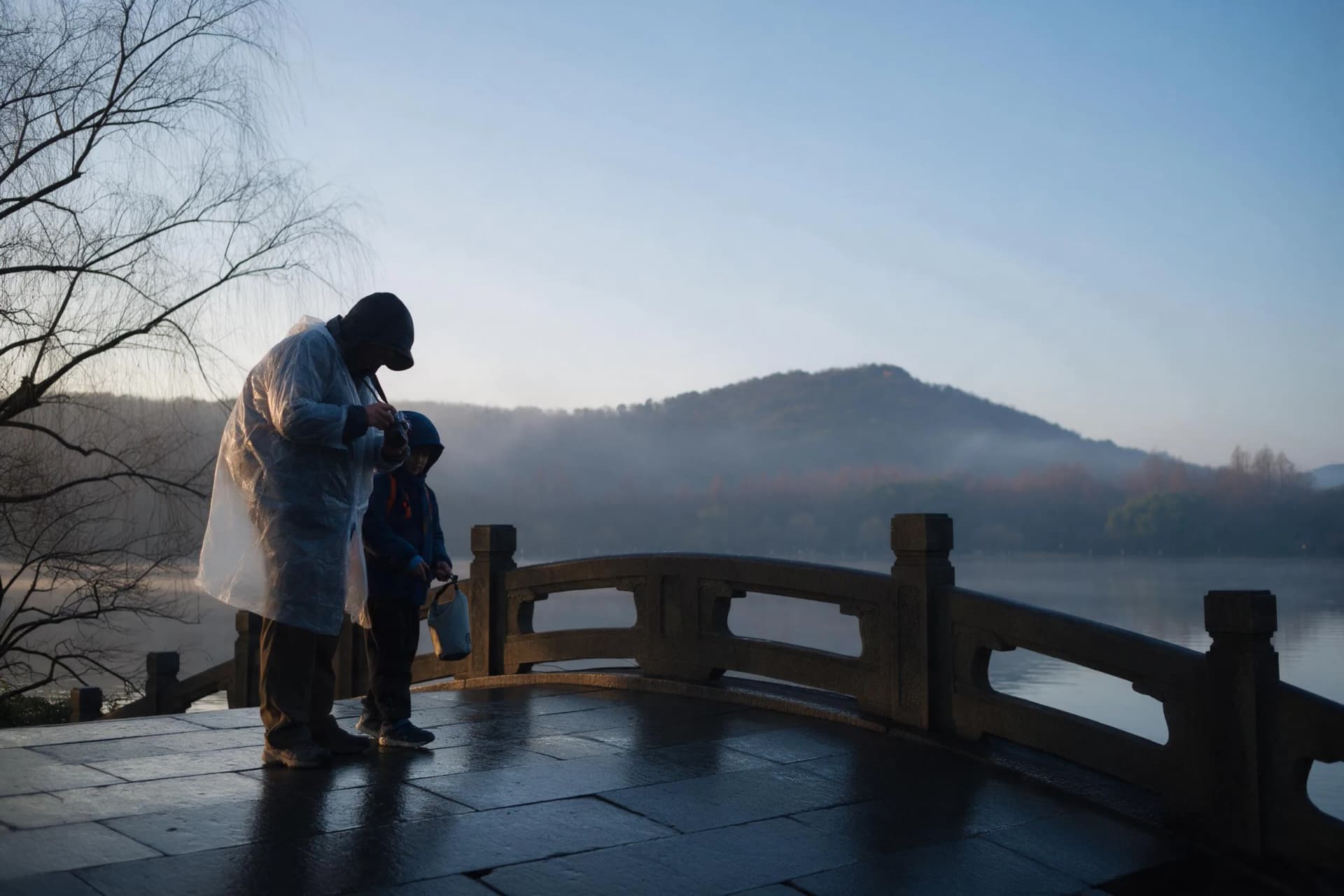
Spot 2: the west parapet of Wangshan Bridge on Hangzhou's Su Causeway, looking west-northwest toward the layered hills. The causeway is free, with no ticket needed. On October 25, 2026, sunrise is about 06:08; arrive at 05:45 and shoot the mist window through about 07:00. The bridge is usually calm before 07:15, while group walking builds after 08:30; those are estimated crowd patterns, not timed guarantees. Camera: 35–50 mm, f/5.6–8, ISO 200–400 and 1/125 sec, with the polarizer rotated only enough to control glare. Phone: use 1× or 2×, tap the brightest mist, lower exposure by 0.7 EV and avoid 5× digital zoom.
Spot 3: the east-facing rail at Huangshan's Refreshing Terrace. Scenic entry is about US$27 from March 1 to November 30, 2026; one cableway ride is about US$11–US$13, and the mountain shuttle is about US$3 each way. Sleep on the summit the night before. Sunrise on October 25, 2026 is about 06:16, so be at the railing by 05:30; a planning estimate puts the best positions 30–45 minutes ahead of a clear dawn. Camera: 24–70 mm at f/8, ISO 200 and 1/250 sec, bracketing minus 1, zero and plus 1 EV for fast-moving cloud. Phone: use 1×, tap the cloud rather than the bright sky, lower exposure by 1 EV and keep Night mode off after sunrise.
A cloud sea is a forecast decision, not a packing promise. Favor a rainy front followed by clearing, check the previous evening's mountain forecast and webcam, and keep the summit transfer flexible. If the valley is clear, do not waste the morning waiting for fog: side-lit granite often becomes graphic between 06:45 and 08:00. In wind or lightning, stay below exposed rails. One adult should hold the child's hand and guard the daypack while the other shoots, then swap after a short block; never change lenses while a crowd is pressing past you. Leave flash off in worship halls and use a compact tripod only where signs permit one.
Pack for two dawn attempts, not five. Three consecutive pre-06:00 starts leave children tired and make every photograph worse. Use one spare morning for the best forecast, reserve exact entries through official channels, and keep the final afternoon free for a dry-bag check, battery charge and a meal together. Start with the shared pouch, then use the Beijing, Hangzhou and Huangshan guides to fix each viewpoint and ticket before you leave home. A good China photo trip is not built from more gear; it is built from a bag you can carry, a forecast you can act on and a family that still enjoys the last morning.
Good to know
- Family bag target
- One 35–40 L carry-on per adult, each held to about 7 kg; one 15–20 L daypack; one shared camera pouch at about 1.5 kg or a phone kit at about 0.6 kg.
- Sunrise windows, October 25, 2026
- Jingshan 06:20–07:05, sunrise 06:35; West Lake 05:50–07:00, sunrise 06:08; Huangshan 05:45–07:15, sunrise 06:16. Astronomical times are approximate; mountain silhouettes can delay direct light.
- Tickets and access
- Jingshan about US$0.30; West Lake causeway US$0; Huangshan about US$27 for March 1–November 30, 2026, plus about US$11–US$13 for one cableway and about US$3 each way for the mountain shuttle.
- Weather to dress for
- Prepare for a 0–24°C elevation planning range on October 25, 2026, with three clothing layers, gloves, a beanie and a rain shell. This is not a monthly normal; check the 48-hour forecast before departure.
- Power and charging
- China uses 220 V at 50 Hz with type A, C and I sockets. Carry one universal adapter, one compact three-outlet strip, two camera batteries and one 10,000 mAh power bank.
- Rain and crowd kit
- Carry two microfiber cloths, one rain cover and two 2 L dry bags. Target 20–45 minutes before sunrise; crowd ranges are planning estimates, so verify opening time and local notices for each date.
Frequently asked questions
What should I pack for photography in China?
Pack one 7 kg carry-on per adult and a shared photo pouch of about 1.5 kg: a camera, one 24–70 mm equivalent lens, two batteries, a 10,000 mAh power bank, microfiber cloths, a rain cover and two 2 L dry bags. Add a fleece, rain shell and grippy shoes.
How early should I arrive at a China sunrise photo spot?
Use the astronomical time as your anchor. At Jingshan on October 25, 2026, reach the upper terrace by 06:15 for a 06:35 sunrise; at West Lake, reach Wangshan Bridge by 05:45 for a 06:08 sunrise. Arrive 20–45 minutes early, then recheck the forecast.
Do I need a tripod for China's photography spots?
Usually not for this family route. A railing, bridge parapet or rock ledge can steady a camera, and many crowded attractions restrict full-size tripods. Pack a pocket tripod only if you confirm site rules, and never use flash or a tripod where worship areas prohibit them.
Are camera settings different on a phone in China?
Use the optical 1× or 2× lens, tap the place you want to protect from overexposure, lower exposure by 0.7–1 EV and turn off heavy HDR when it flattens contrast. Keep a microfiber cloth in a pocket, carry a 10,000 mAh bank and avoid digital zoom in mist.
Is Huangshan practical for a family photography trip?
Yes when the family can handle steep stone steps and an overnight stay on the summit. Entry is about US$27 from March through November 2026, and a one-way cableway costs about US$11–US$13. A summit bed removes the risky pre-dawn climb from the valley.
Keep exploring
Plan with ChinaMira
Turn this into a trip
Use this guide as a starting point — we can handle the route, guides, trains and the visa invitation letter.