
Wonder Story
Huangshan Sea of Clouds 3-Day Itinerary: A Photographer's Plan (2026)
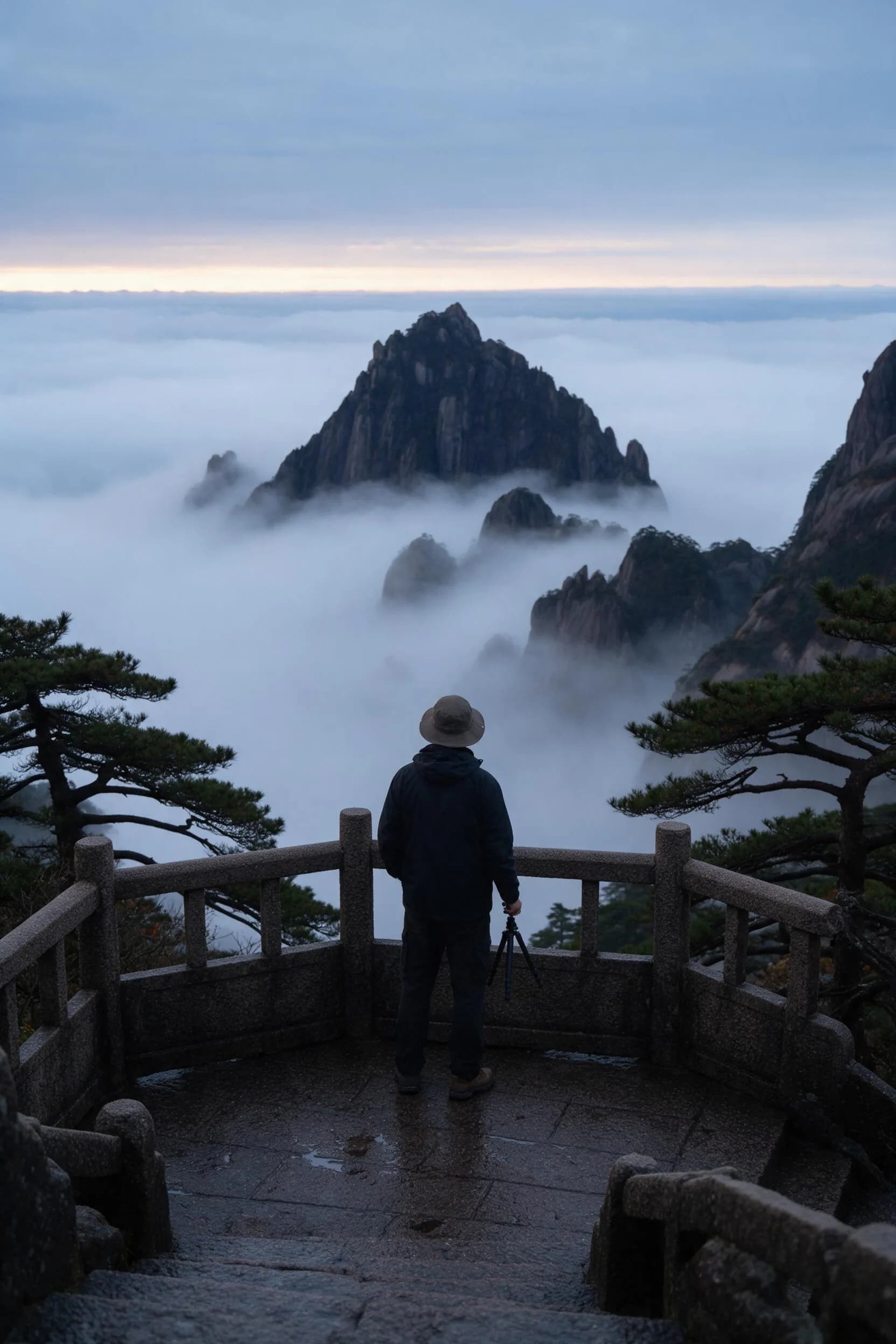
For photographers, Huangshan is a cloud machine: warm, wet air cools into a flat inversion after a passing front, and the granite peaks turn into islands. This three-day plan puts you on the summit across two dawns, times the cable cars and shuttles around the light, and keeps one wet-weather day in reserve.
Three days is the right length for Huangshan and the sea of clouds, and the condition is simple: sleep two nights on the summit. The cloud sea appears on about 52 mornings a year, mostly from December to April, so one dawn is a gamble and two dawns roughly double your odds. Book on the official mini-program a day ahead.
Huangshan does not make its cloud sea so much as trap it. After a front passes, cold air settles into the valleys while warmer air rides above; the peaks punch through the inversion and become islands. The Bright Summit weather station's sixty-year log shows that 97 percent of cloud seas form from stratocumulus rather than ground fog — a level white lake, not mist. Winter and spring give the lowest, longest-lasting layers.
Here is the whole trip on one page. Read the rows for your days, then reserve the three things that sell out: the park ticket, the summit bed and the train seats.
| Day | Timing | Transport and route | Entry fees | Meal stop | |---|---|---|---|---| | Day 1 | Arrive by noon; sunset 5:15–5:45 p.m. | Rail to Huangshan North → Tangkou gateway shuttle (CNY 30) → park shuttle (CNY 19) → Yungu cableway up → walk to Beihai | Admission CNY 190 (three-day ticket) + Yungu cableway CNY 80 | Lunch in Tangkou; dinner at the summit hotel | | Day 2 | Up at 4:40 a.m.; back by 6:30 p.m. | Refreshing Terrace sunrise → West Sea Grand Canyon loop and Paiyun Pavilion → Bright Summit sunset | West Sea funicular CNY 100 (optional) | Summit breakfast; packed lunch from the hotel | | Day 3 | Dawn shoot; train after 1:00 p.m. | Bright Summit dawn → Yuping cableway down past the Greeting Pine → shuttle to Tangkou → rail out, or Tunxi Old Street | Yuping cableway CNY 90 | Noodles or dumplings on Tunxi Old Street | | Rain day | 9:30 a.m.–6:00 p.m. | Lower villages instead of exposed ridges: Hongcun and Xidi, or Tunxi Old Street and the Huangshan Museum | Hongcun CNY 94; Xidi–Hongcun combo CNY 180; museum free | Huizhou braised pork and wild-vegetable dumplings in Hongcun |
Day 1 is a transfer day with a payoff. Take a morning G-series train into Huangshan North, ride the shuttle to the Tangkou gateway, then switch to the park shuttle — private cars and taxis cannot reach the trailheads. The Yungu cableway lifts you above the fir line, and Beihai is a twenty-minute walk beyond the upper station, so drop your bag before the light softens. Shixin Peak above Refreshing Terrace is a clean warm-up. Stay for the last colour on the granite, eat at the hotel and sleep early; the alarm is before five.
Day 2 belongs to the cloud sea. Be at the railing at Refreshing Terrace thirty to forty minutes before sunrise: the colour arrives before the light, and the layer is often still forming. In the cloud season first light falls roughly between 6:00 and 6:55 a.m., which is exactly why day visitors miss it — the park gates open at 7:00 a.m. on ordinary weekdays and 8:00 a.m. in winter, so dawn belongs to guests already inside. After breakfast, walk the West Sea Grand Canyon loop and the Paiyun Pavilion rim, then finish on Bright Summit for the widest horizon. Summit hotel guests may stay inside the park overnight; everyone else must be out by closing, and the walking gates turn exit-only at 15:00, so never plan a late climb.
Day 3 gives you the second dawn that decides the trip. Shoot from Bright Summit, then descend by the Yuping cableway past the Greeting Pine, the 800-year-old symbol of the mountain. From Tangkou, a shuttle reaches Huangshan North in about an hour; if your train leaves later, fill the gap on Tunxi Old Street. Rail is the easy approach. The 265 km Hangzhou–Huangshan high-speed line puts Hangzhou East about 1 hour 26 minutes from Huangshan North, and G trains from Shanghai Hongqiao run roughly 2 hours 20 minutes to 3 hours on the 2026 timetable. Book on 12306 with your passport: the presale window is 15 days including the day of purchase, and the ticket is tied to your passport number.
When rain settles in, do not force the exposed ridges. Cableways suspend in high wind and lightning, and wet granite on the West Sea steps is genuinely dangerous. Swap the morning for the lower Huizhou villages that flatter the same landscape in soft light: Hongcun's Moon Pond and stone lanes, or Xidi's Ming archways, both about an hour from Tangkou. In town, Tunxi Old Street's ink and tea shops are free to browse, and the Huangshan Museum fills a wet afternoon. Mist is not a loss for a photographer — a valley that clears for ten minutes often beats a clean dawn.
Three habits make the difference. Carry a light tripod and a lens cloth, because the cloud layer throws spray and the temperature swing fogs glass fast. Meter for the bright cloud and let the peaks fall dark; a polarizer separates the white layer from the haze. And book the summit bed before anything else, since two dawns are the strategy and the weather is not yours to control. Send ChinaMira your dates and we will build the route around the terrace that is clear that morning.
Good to know
- Admission and three-day validity
- Regular season 21 January–19 December 2026: CNY 190 full, CNY 95 half price. The last published winter rate (20 December–20 January) was CNY 150 full, CNY 75 half, re-announced each December. One ticket covers three consecutive days including the first, with unlimited re-entry once you scan through the gate on day one. Real-name, timed, direction-based reservation on the official Huangshan Tourism Official Platform mini-program is mandatory.
- Cableways and funicular
- Regular season one way: Yungu CNY 80, Taiping CNY 80, Yuping CNY 90, West Sea Grand Canyon funicular CNY 100. Winter rates are CNY 65, CNY 65, CNY 75 and CNY 80. All are suspended in high wind, heavy snow, lightning or icy conditions.
- Park hours and last entry
- 2 March–30 November: 07:00–17:10 Monday to Friday, 06:30–17:40 weekends and short holidays. 1 December–1 March: 08:00–16:40. Walking-trail ticket gates close at 15:00 and turn exit-only. Summit hotel guests may stay inside the park overnight; day visitors must leave by closing and cannot re-enter before the next morning's opening.
- Getting there and shuttles
- Huangshan North station to the Tangkou south-gate transfer centre: buses from 07:00 to 20:00, roughly every 20–40 minutes, about an hour, CNY 30; north gate 12:40, CNY 36. In-park transfer buses run 06:40–16:30 uphill and 07:10–17:40 downhill on weekdays (06:10–17:00 and 06:40–18:10 at weekends), 07:40–16:00 and 08:10–17:10 in winter, with rolling departures you board with a ticket. The park shuttle to the cableway stations costs CNY 19.
- Rail booking with 12306
- Shanghai Hongqiao to Huangshan North: G trains take about 2 hours 20 minutes to 3 hours; Hangzhou East to Huangshan North about 1 hour 26 minutes on the 265 km Hangzhou–Huangshan high-speed line (2026 timetable). Sell tickets on 12306 from 15 days before departure, including the day of purchase. Register with your passport and carry it: the e-ticket is tied to the passport number and scanned at the gate.
- Cloud-sea odds and photo spots
- About 52 cloud-sea days a year, concentrated December–April, per the Bright Summit weather station's 60-year record; 97 percent form from stratocumulus. Shoot dawn at Refreshing Terrace (North Sea) and Bright Summit (Heavenly Sea), afternoon at Paiyun Pavilion (West Sea), and cloud-lift from Yuping Tower (South Sea) and Bai'e Ridge (East Sea).
Frequently asked questions
Can I see the sea of clouds on a day trip to Huangshan?
Not at dawn. The gates open after first light for most of the year, so the classic sunrise shot only works if you sleep on the summit; a day trip can still catch afternoon cloud pouring between the cliffs from Paiyun Pavilion, but you are betting on one short window instead of two.
Do I need to reserve Huangshan tickets, and can I re-enter the park?
Yes. The scenic area runs real-name, timed, direction-based reservations, so book on the official Huangshan Tourism Official Platform mini-program before you travel and carry the same passport. Your ticket allows unlimited re-entry, but only after you scan through the gate on day one; a reservation you never check in with does not activate that right.
What happens if it rains during my Huangshan days?
Rain is not the enemy here. Mist and low cloud are what make the peaks look like islands, and a clearing between showers often beats a clear day. Avoid exposed ridge walking instead, because cableways stop in high wind and lightning, and move to Hongcun, Xidi or Tunxi Old Street until the weather shifts.
Which viewpoints are best for photographing the sea of clouds?
Refreshing Terrace is the classic North Sea dawn spot, a short walk from the Beihai hotels; Bright Summit gives the widest horizon; Paiyun Pavilion is best in late afternoon when cloud pours into the West Sea; and Yuping Tower or Bai'e Ridge covers the South and East Seas. A 35mm lens and a polarizer handle most of it.
How do I book the train to Huangshan as a foreign visitor?
Use the official 12306 app or website and register with your passport number, then buy as soon as sales open. There is nothing to collect at the station: your passport is the ticket and is scanned at the gate, so travel with the same passport you booked under.