
Wonder Story
When Is the Best Time to Visit Hukou Waterfall on the Yellow River?
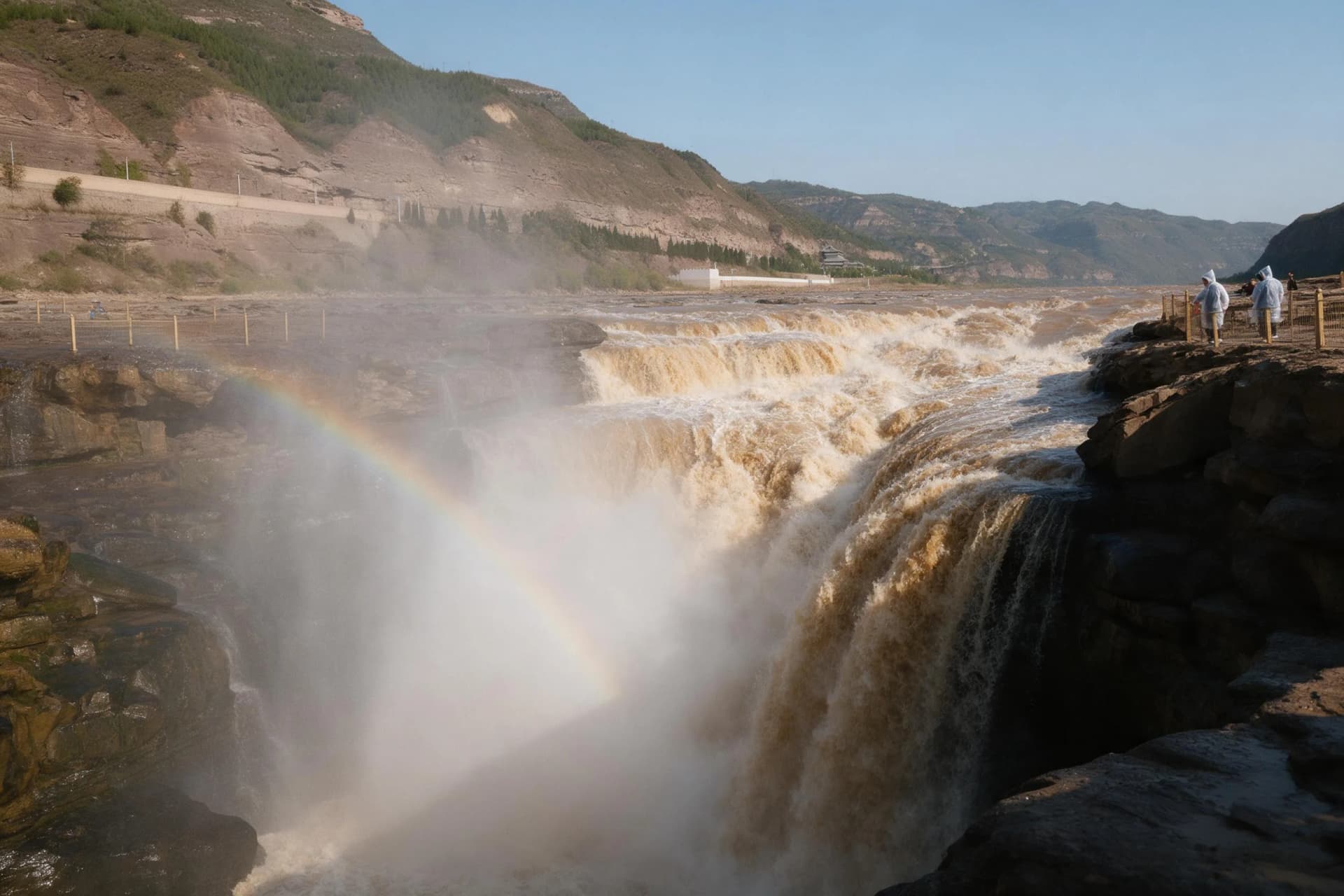
Hukou is where the Yellow River, 300 meters wide, is forced through a gap of 20 to 30 meters and drops more than 20 meters into the Jinxia Grand Canyon. This is the story of the sound, the yellow water and the two-province ticket, with the flood months, prices, hours and road times you need to stand at the rail on the right morning.
Late March through April for the peach-blossom flood, and September through October for the autumn flood, are the two best windows at Hukou Waterfall on the Yellow River. Tickets cost CNY 80 per adult since June 1, 2026, cover both the Shanxi and Shaanxi banks for two days, and add CNY 16 for the round-trip shuttle.
You hear Hukou before you see it. The road north from Xi'an climbs through the loess plateau, and long before the gate there is a low, continuous roar in the air, like a train that never arrives. Then the ground opens into the Jinxia Grand Canyon and the river appears — flat, wide and deceptively calm at roughly 300 meters across. Within a few hundred meters the channel is squeezed between rock walls to 20 to 30 meters, the current accelerates, and the whole river pours over a hard lip more than 20 meters high. Locals named it Hukou, "flask mouth," because the river empties into the gorge the way water leaves a teapot. Stand at the rail and the spray reaches your face before your camera is out.
The color is the other shock. The river earns its name here: it carries fine loess silt picked up across the plateau, and in flood season it pushes through at up to about 1,000 cubic meters a second, so thick and fast that the gorge seems to be pouring concrete. Mist climbs out of the trough and hangs over the platforms; one of the eight classic views is simply called "smoke from the deep waters." In early June 2026, after heavy rain upstream, visitors watched a half-clear, half-muddy seam run through the falls, where a clearer tributary met the silty mainstream and refused to mix.
Timing matters more than the forecast. The peach-blossom flood arrives from late March into April, when ice on the upper river melts; the autumn flood follows from September through October, when summer rain has loaded the river and the falls run widest and loudest. Rainbows are most reliable in that autumn window, especially between 9 and 11 a.m. July and August are the biggest and most brutally yellow. December through February brings the upside-down ice peaks, frozen spray sheathing the cliffs — and in the coldest weeks sections of the site can close, so check before you commit.
Both banks sit in the same scenic area, but they are two different experiences. The Shanxi side, at Jixian in Linfen, stands almost on top of the falls: head-on, close, soaked in spray, with a stairway called the Dragon Cave that drops to the base for a small extra fee of about CNY 20 so you can look straight up into the falling water. The Shaanxi side, at Yichuan in Yan'an, sits back and to the side, trading raw proximity for a wide panorama of the gorge, with Mengmen Mountain and the long rock channel of Shili Longcao downstream. Since June 1, 2026, the two provinces sell one ticket, valid two days, so you can cross the Qilangwo bridge and see both.
Practical planning is simple once you know the rules. Opening hours run roughly 7:00 to 18:30 from April 1 to October 7 and about 8:00 to 17:30 from October 8 to March 31, with the Shanxi side adjusting slightly at the edges of the season. A round-trip shuttle inside the site costs CNY 16, tickets are sold by real name, so bring your passport, and the walking between viewpoints is easy and mostly flat — an hour or two along the gorge rim rather than a hard hike. Wear shoes with grip, carry a light waterproof shell, and put your phone in a dry bag; the spray is not decorative. Plan two to three hours at the water.
Getting there takes commitment, because Hukou sits far from any high-speed rail line. By road it is roughly 300 to 350 kilometers from Xi'an, a drive of 3.5 to 4.5 hours; direct buses leave Xi'an's Fangzhicheng station at 8:00 a.m. and 1:20 p.m., cost about CNY 120, and take around 4.5 hours. From Yan'an the distance drops to about 160 kilometers, roughly two hours by car or by the bus from Yan'an South station for about CNY 110. Most travelers make it a long day trip from Xi'an or, better, an overnight in Yan'an or Jixian so they arrive as the morning light hits the mist.
Go for more than the photograph. Eight kilometers from the falls stands Kainanpo, the cramped wartime headquarters of the Second War Zone from 1940 to 1945, cut into the yellow hills. On the riverbank, performers stage the Yellow River Cantata, the 1939 choral work still sung here with the falls as percussion, and the old "boats sailing on dry land" tradition returns when the current is too violent to cross. ChinaMira can build the day around the flood calendar, book a private driver from Xi'an or Yan'an, add the Terracotta Army or Yan'an's revolutionary sites, and time your arrival for the morning rainbow; the current ticket, hours and shuttle prices sit in the fact sheet below. Tell us your dates and we will put you at the rail when the river is at its loudest.
Good to know
- Tickets and shuttle
- CNY 80 per adult since June 1, 2026, valid two days on both the Shanxi and Shaanxi banks; CNY 16 round-trip shuttle; Dragon Cave on the Shanxi side about CNY 20 extra.
- Opening hours
- Roughly 7:00-18:30 from April 1 to October 7 and 8:00-17:30 from October 8 to March 31, with the Shanxi side adjusting slightly at the edges of the season.
- Best months
- Late March to April for the peach-blossom flood, September to October for the autumn flood, with rainbows most likely between 9 and 11 a.m. in autumn.
- Getting there
- About 300-350 km and 3.5-4.5 hours by road from Xi'an, with direct buses at 8:00 a.m. and 1:20 p.m. for about CNY 120; about 160 km and two hours from Yan'an, buses about CNY 110. No high-speed rail station at the falls.
- Scale of the falls
- The river runs about 300 meters wide upstream, narrows to 20-30 meters at the lip and drops more than 20 meters, with flood flows reaching about 1,000 cubic meters per second.
- Status and recognition
- Named a national geopark in 2002 and a 5A scenic area in July 2022; an image of the falls appears on the older fourth series of the CNY 50 banknote.
Frequently asked questions
What is the best time of year to see Hukou Waterfall?
Late March through April for the peach-blossom flood, when melting upstream ice swells the river, and September through October for the autumn flood, when the falls run widest and loudest. Rainbows are most reliable from September to November, especially between 9 and 11 a.m., and the busiest summer months of July and August deliver the heaviest yellow water.
How much does it cost to visit Hukou Waterfall in 2026?
CNY 80 per adult since June 1, 2026, when the two provinces began selling one ticket that is valid for two days and covers both the Shanxi and Shaanxi banks. Add CNY 16 for the round-trip shuttle inside the site, and about CNY 20 if you want to descend the Dragon Cave stairway on the Shanxi side. Children under 1.2 meters and visitors aged 60 and over usually enter free with ID, so bring your passport.
How do I get to Hukou Waterfall from Xi'an?
It is roughly 300 to 350 kilometers, a drive of 3.5 to 4.5 hours. Direct buses leave Xi'an's Fangzhicheng station at 8:00 a.m. and 1:20 p.m., take about 4.5 hours and cost around CNY 120. From Yan'an the trip shortens to about 160 kilometers and two hours, with buses from Yan'an South station costing roughly CNY 110. There is no high-speed rail station at the falls, so plan on road time.
Which side of Hukou Waterfall is better, Shanxi or Shaanxi?
Since June 1, 2026, a single CNY 80 ticket covers both for two days, so you can compare them yourself by crossing the Qilangwo bridge. The Shanxi side at Jixian gives a close, head-on soaking and the Dragon Cave descent for about CNY 20 extra. The Shaanxi side at Yichuan sits back for a wide panorama of the gorge, Mengmen Mountain and Shili Longcao. Many travelers choose the Shanxi side for drama, the Shaanxi side for photographs.
Can you visit Hukou Waterfall in winter?
Yes: December through February the site generally opens about 8:00 and closes about 17:30, and the payoff is the upside-down ice peaks, with frozen spray sheathing the cliffs and the river running low and gray-green. It is genuinely cold, paths can be icy, and in the coldest weeks sections may close, so check conditions the day before and dress in layers. Spring's peach-blossom flood follows from late March.