
Wonder Story
Wuyishan and the Nine-Bend River: China's 9.5 km Bamboo Raft and Peak Hike
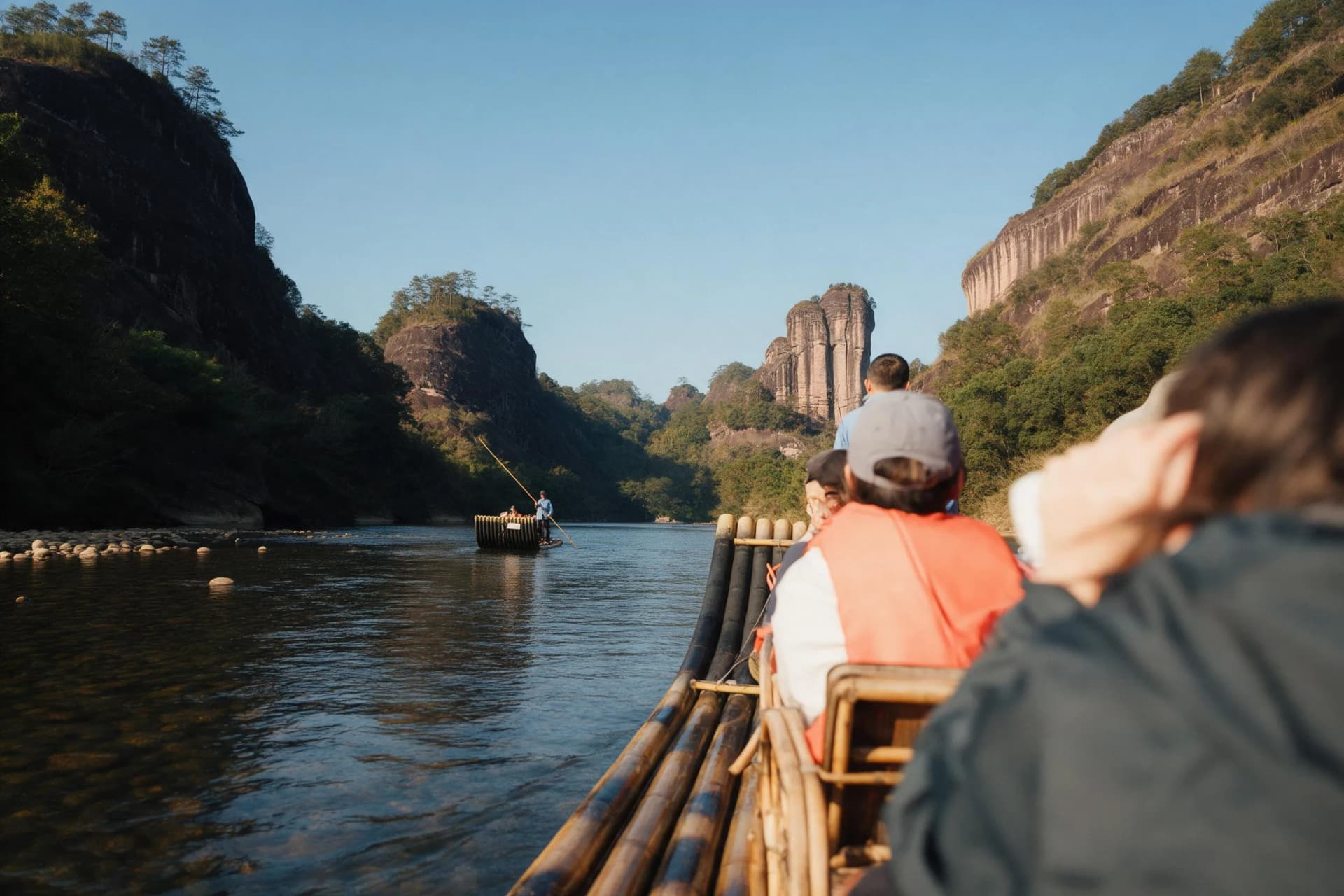
The Nine-Bend River is the spine of Wuyishan, a 9.5-kilometer bamboo raft ride through Danxia sandstone gorges that costs CNY 130 and takes about 90 minutes. This story covers how to book it, what the 848-step climb up Tianyou Peak feels like, when the tea months and clear water arrive, and how to pair the float with the trails.
Wuyishan's signature trip is a 90-minute bamboo raft down the Nine-Bend River, and in 2026 it costs CNY 130 per person from Xingcun wharf to Wuyi Palace, but only if you reserve three to seven days ahead. The main gate is free, yet the shuttle and the raft are not, and morning rafts sell out fast.
The raft leaves from Xingcun wharf, upstream, where the water runs shallow enough to see the stones. Eight passengers to a raft, a boatman at each end working a long bamboo pole, and no engine noise at all, just the pole tapping rock and the hiss of water over gravel. For the next 9.5 kilometers the river folds back on itself nine times, and every bend carries a name, a shape and a story the boatmen have told a thousand times. Jade Maiden Peak stands alone against the sky near the second bend. At the first bend, Great King Peak closes the gorge behind you as the raft slides up to the landing below Wuyi Palace. Zhu Xi, the Song-dynasty philosopher who taught in this valley, wrote ten boat songs about these bends in the 12th century, and you can still hear their rhythm in the way locals name the water.
The landscape explains itself as you drift. Wuyishan is red sandstone and conglomerate, a Danxia landform lifted from an ancient basin and then carved by water into cliffs, caves and isolated towers. The scenic core covers about 64 square kilometers, and in 1999 UNESCO inscribed Mount Wuyi as a mixed cultural and natural World Heritage Site, honoring both the geology and the human story layered onto it. That story runs deep. Zhu Xi's academy at Wuyi Jingshe helped make this valley a birthplace of Neo-Confucianism, while the same sheltered ravines grow the rock oolong and black teas, Da Hong Pao among them, that carried the name Wuyi far beyond Fujian. The town also bills itself as the starting point of the Wanli Tea Road, the overland route that once moved Bohea tea north toward Russia.
Most travelers come for the raft and leave remembering the walking. Tianyou Peak, at 408.8 meters, is the classic climb: 848 stone steps, steep and exposed in the middle section, roughly 60 to 90 minutes to the top, with the reward of looking straight down at the rafts threading the river you just floated. The Rock Tea Trail, a 4.5-kilometer path between the Da Hong Pao cliff and Water Curtain Cave, takes two to three hours and passes tea terraces, old cliff inscriptions and the protected mother trees that gave the most famous rock tea its name. If you want a harder day, Tiger Roaring Rock is steeper than Tianyou, and One-Line Sky squeezes you sideways through a crack in the sandstone. There is no cable car anywhere in the scenic area, so the ups are yours.
Here is what the day actually costs. The main scenic-area gate ticket is free, a policy that began in 2024 and has continued, but free does not mean ticketless. You reserve a zero-yuan, real-name entry slot through the official China Wuyishan WeChat mini-program up to seven days ahead, and foreign visitors should carry the passport used for the booking, since the gate now checks identity and has no walk-up sales window. Inside the park, private cars are banned, so the shuttle bus is not optional: CNY 70 for one day, 85 for two days, 95 for three days, with unlimited rides from about 6:30 a.m. to 5:30 p.m. The Nine-Bend River raft is a separate CNY 130 per person and is the one thing that genuinely disappears. A one-day shuttle-plus-raft combo runs CNY 200, and the two-day version is CNY 215.
Time your visit around water and light rather than around a weekend. September through November is the cleanest bet, with lower humidity, stable water and soft morning sun on the cliffs. March through May brings green hills and drifting mist, but the rainy stretch from April into June can suspend rafting at short notice when the river rises, and July and August are hot, humid and crowded. Winter is cold and quiet, and the peaks occasionally wear a thin cap of snow. Aim for a raft slot between 8 and 10 a.m. if the booking system allows it, when the light rakes across the sandstone instead of flattening it. Whatever month you choose, secure the raft before you secure the hotel.
Getting here is easier than the mountain address suggests. High-speed trains stop at Wuyishan North Station, about 15 kilometers and 25 minutes from the Sangu resort area, with taxis at roughly CNY 30 to 35 or the number 7 bus for CNY 2. Do not confuse it with Wuyishan East Station, which sits in neighboring Jianyang district, 40 kilometers and about 70 minutes away by the K1 bus. Wuyishan Airport is only about 7 kilometers from the resort. On entry rules, US passport holders are not on China's unilateral visa-free list, so a standard round-trip tourist visit still needs a visa. The exception is transit: Wuyishan Airport was added in December 2024 to the ports covered by China's 240-hour, or 10-day, visa-free transit, which lets US citizens flying on to a third country stay within Fujian province without a visa.
That is the trip we build most often here: a bamboo raft at first light, a slow climb up Tianyou Peak while the valley is still cool, an afternoon on the Rock Tea Trail, and enough unstructured time in the Sangu resort to eat well and sleep early. A ChinaMira travel designer can lock in your raft slot the moment reservations open, arrange entry and shuttle tickets under the right names, match you with a hotel that handles raft bookings for guests, and add a tea-farm visit or a wander through the old tea-trading lanes of Xiamei. Tell us when you can travel and how much climbing you want, and we will tell you honestly whether your dates land in raft season. Start planning your Wuyishan trip, and bring shoes with grip.
Good to know
- Nine-Bend River raft
- CNY 130 per person for the 9.5 km run from Xingcun wharf to Wuyi Palace wharf, about 90 minutes, up to eight passengers per raft. Reserve 3-7 days ahead; tickets release daily at 8 a.m. and morning slots sell out fast. Suspended when the river runs high.
- Scenic-area entry
- Free (CNY 0) since 2024 and continuing in 2026, but a real-name reservation through the official China Wuyishan mini-program is mandatory and can be made up to 7 days ahead. The free ticket covers Tianyou Peak, Da Hong Pao, One-Line Sky, Wuyi Palace, Water Curtain Cave and Tiger Roaring Rock.
- Shuttle bus and combos
- CNY 70 for one day, 85 for two days, 95 for three days, unlimited rides roughly 6:30 a.m. to 5:30 p.m. Private cars are banned inside the scenic area. Shuttle-plus-raft combos cost CNY 200 for one day and CNY 215 for two.
- Best months
- September-November for stable water and clear light; March-May for green, misty hills. April-June rain can suspend the raft; July-August is hot, humid and crowded; December-February is cold, quiet and often clear.
- Trails and walk times
- Tianyou Peak: 408.8 m, 848 steps, 60-90 minutes up. Rock Tea Trail: 4.5 km between the Da Hong Pao cliff and Water Curtain Cave, 2-3 hours. Tiger Roaring Rock is steeper; One-Line Sky means squeezing through a rock crack. No cable car anywhere in the park.
- Arrival and visa-free transit
- Wuyishan North Station is 15 km and 25 minutes from the Sangu resort (taxi CNY 30-35; bus No. 7, CNY 2). Wuyishan East Station is 40 km away, about 70 minutes by K1 bus (CNY 10). Wuyishan Airport is 7 km and 15 minutes from the resort and, since December 2024, is a designated port for 240-hour (10-day) visa-free transit, open to US citizens continuing to a third country.
Frequently asked questions
How much does the Nine-Bend River bamboo raft cost, and how long does it take?
CNY 130 per person buys the 9.5-kilometer raft ride from Xingcun wharf to Wuyi Palace wharf, and the trip runs about 90 minutes. Rafts carry up to eight passengers, so solo travelers are usually paired with others. The raft is not included in the free scenic-area gate ticket, and a one-day combo with the shuttle bus costs CNY 200.
When is the best time of year to ride the Nine-Bend River raft?
September through November is the best window, with stable water, lower humidity and clean morning light, followed by March through May for green hills and mist. The rainy stretch from April into June can suspend rafting at short notice, and July and August are hot, humid and crowded. December through February is cold, quiet and often clear.
Do I need to reserve Wuyishan tickets and the raft in advance?
Reserve three to seven days ahead for the raft, because tickets are released daily at 8 a.m. on the official China Wuyishan mini-program and popular morning slots can sell out within about 30 minutes. The scenic-area gate ticket is free but still requires a real-name, zero-yuan reservation, bookable up to seven days ahead. Shuttle buses cost CNY 70 for one day, 85 for two and 95 for three.
How far is Wuyishan North Railway Station from the Nine-Bend River?
Wuyishan North Station is about 15 kilometers from the Sangu resort area and the scenic-area gates, a 25-minute taxi ride costing roughly CNY 30 to 35, or about 40 minutes on the number 7 bus for CNY 2. Allow another 20 to 40 minutes by shuttle from the gate to the raft dock at Xingcun, and arrive 30 minutes before your booked raft time.
Can US citizens visit Wuyishan without a China visa?
For 240 hours, or 10 days, US passport holders can enter China visa-free under the transit policy, and Wuyishan Airport was added as a designated port in December 2024. The catch is that you must be traveling onward to a third country or region, and your stay is limited to Fujian province. For a standard round trip from the United States, you still need a tourist visa.