
Wonder Story
Is Xiapu Mudflats at Dawn Worth the 4:30 a.m. Alarm in 2026?
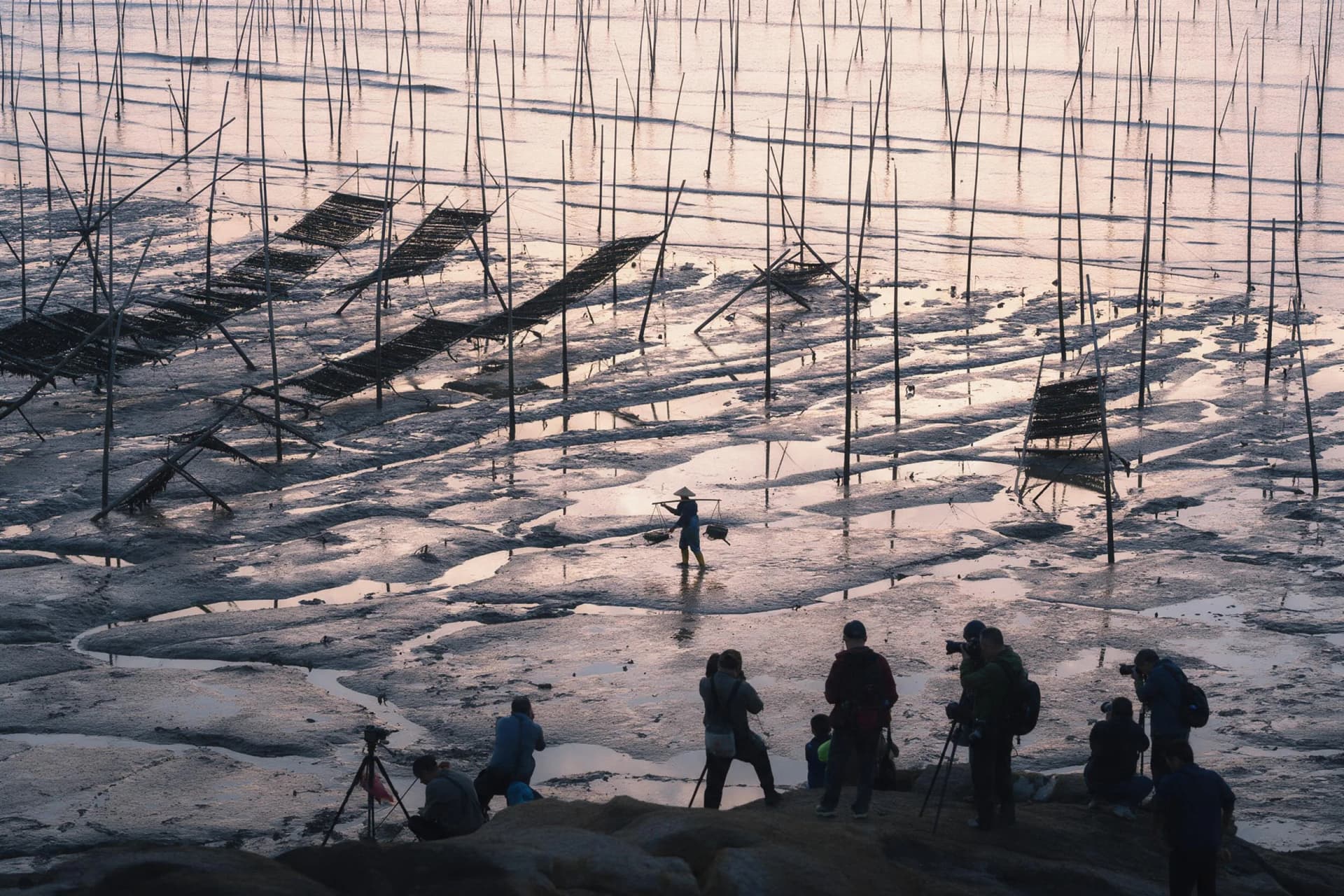
Xiapu's mudflats at dawn are China's great tidal light show: bamboo poles, nori racks and mirror-flat water that change with every tide. This guide covers the best months, sunrise times at Beiqi and Dongbi, how to read the lunar tide calendar, the clifftop walks that link the viewpoints, train fares, and what a photography day really costs.
Yes — Xiapu's mudflats at dawn are worth a 4:30 a.m. alarm, but only inside the right tide window. Go in April–June or October–December, be in position at Beiqi 30–45 minutes before sunrise, and budget for free viewpoints plus about CNY 400–600 a day for a photography car.
The tide, not the clock, writes the schedule. Xiapu sits where the East China Sea funnels through island gaps and drains enormous volumes of water twice a day. Spring tides fall around the first and fifteenth days of the lunar month, and the three days on either side expose the sharpest "tiger-skin" textures; the tide then shifts roughly 40–50 minutes later each day. The spring range here can exceed 7 meters, so the same bay reads as a mirror at dawn and a cracked clay map by noon. Half-tide is the sweet spot for pattern and reflection; a full low tide at first light gives the glassy, gullied flats that made Xiapu famous. Download a tide app and treat it as your itinerary.
Beiqi is the classic first dawn. The mudflat lies a short drive from Xiapu town, entry is free, and a low ridge gives you an elevated line over the bamboo poles. Time it properly: sunrise is about 5:04 a.m. in mid-June, 5:35 a.m. in mid-April, 6:01 a.m. in late October and 6:40 a.m. in mid-December, with useful color from civil twilight 20–25 minutes earlier. In practice that means leaving your hotel around 4:15 a.m. in summer and 5:15 a.m. in late autumn. A taxi or chartered car is the only practical way to arrive on time, because public buses do not run that early.
What you are photographing is work. Xiapu's tideland covers about 70,000 hectares along roughly 480 kilometers of coastline, one of China's largest tidal-flat systems, and most of it is farmed. Kelp and nori racks stitch the shallows, bamboo poles lean into the current, and crews are already out at first light. The county is also known for its "model fishermen": Xinhua reported more than 200 residents working full- or part-time as paid subjects, with one veteran charging about CNY 100 an hour and earning CNY 300–400 a day. Xiaohao, where cast nets arc against the sun, and Shajiang's S-Bay, where a bamboo waterway curls through the flats, exist because real aquaculture keeps them alive.
Dawn here is a walking story, which is why we file Xiapu under hiking rather than pure photography. The Sansha Light and Shadow boardwalk traces the cliff above the water and links several overlooks; it sits about 3.3 kilometers from Xiaohao Beach, while Dongbi village is 6.2 kilometers from the same beach and rewards a ridge walk with a wide sunset panorama. Farther inland, Yangjiaxi's banyan and maple paths run through misty woods that photographers have worked for decades. Two cautions belong on every packing list: the flats are slick with algae, so wear shoes with real grip, and the ridge paths have little shade, so carry water even on a gray morning.
Dongbi shows how fast this coast has changed. Its first homestay opened in August 2017; by 2026 the village counted more than 80 homestays and about 1,000 beds, according to local government figures reported by China Daily. Sansha township, which includes Dongbi, recorded more than 4.6 million tourist visits in 2025. That growth warns about timing: on a spring-tide weekend in the nori season, the best platform fills before the sky turns pink. A chartered car with a tide-aware driver costs CNY 400–600 a day and is worth it, because drivers know which viewpoint will work that morning.
Weather decides which version of Xiapu you get. April to June is the kelp harvest, when green racks float over misty water and the light is soft; October to December is the nori season, with big tides and the most stable clear mornings. July to September is typhoon season and can scrub a trip in a day. The county averages 19.3°C across the year, from a January mean of 9.9°C to 28.7°C in July, and takes 1,395 millimeters of rain, with August the wettest month at 210 millimeters — so build one flexible morning into any short trip.
Reaching Xiapu is straightforward. Xiapu Railway Station sits 4 kilometers northeast of the county center, a taxi ride of no more than CNY 20, with buses 8, 9 and 32 linking town to the platforms. High-speed trains cover the 1 hour 6 minutes from Fuzhou for CNY 53 in second class, the 2 hours 40 minutes from Xiamen North for CNY 130, and just 20 minutes from Ningde for CNY 21. Fuzhou Changle International Airport is about 2.5 hours away by road. Base yourself in Xiapu town for convenience or in Sansha or Dongbi for the shortest pre-dawn drives.
Two nights is the honest minimum, three is better: one dawn at Beiqi, one sunset and ridge walk at Dongbi, and one spare morning for whichever tide the sea offers. The fact sheet below gathers the fares, sunrise times and tide rules in one place. Tell ChinaMira your dates, and we will read the lunar calendar, book a tide-aware driver and a sea-view room, and build a Fujian coast route that starts with the alarm clock and ends with the light.
Good to know
- Getting there
- Xiapu Railway Station is 4 km northeast of the county center; a taxi costs up to CNY 20 and buses 8, 9 and 32 run from town. Fuzhou to Xiapu takes 1 hour 6 minutes and CNY 53 in second class; Xiamen North takes 2 hours 40 minutes and CNY 130; Ningde is 20 minutes and CNY 21. Fuzhou Changle airport is about 2.5 hours away by road.
- Tide timetable
- Semidiurnal tides, with spring tides around the 1st and 15th days of the lunar month and the sharpest textures in the 3 days on either side. High and low water shift 40–50 minutes later each day. The spring tidal range here exceeds 7 meters. Half-tide favors pattern and reflection; a low tide at dawn gives the mirror.
- Sunrise by season
- Beiqi's sunrise ridge is free; be in position 30–45 minutes early. Sunrise falls about 5:04 a.m. in mid-June, 5:35 a.m. in mid-April, 6:01 a.m. in late October and 6:40 a.m. in mid-December, with usable color from civil twilight 20–25 minutes before.
- Best months and weather
- April to June brings the kelp harvest and misty green flats; October to December brings the nori harvest, bigger tides and steadier light. July to September is typhoon season. The annual mean is 19.3°C, from a January mean of 9.9°C to 28.7°C in July, with 1,395 mm of rain a year and August the wettest month at 210 mm.
- Viewpoints and walking
- Free sunrise and sunset spots include Beiqi (sunrise), Dongbi (sunset) and Xiaohao. Shajiang's S-Bay shows the bamboo waterway, and Huazhu looks toward the Fuyao Islands. The Sansha Light and Shadow boardwalk is 3.3 km from Xiaohao Beach; Dongbi is 6.2 km from the same beach. The flats are slick, so wear shoes with grip.
- Costs on the ground
- Viewpoint entry is free. A chartered car with a tide-aware driver costs CNY 400–600 a day, a hired model fisherman runs about CNY 100 an hour, and a two-day private photography tour starts near US$320 per person. Pack a 70–200mm lens and a tripod for the dawn light.
Frequently asked questions
When is the best time to see the Xiapu mudflats at dawn?
April to June and October to December are the two best windows. April to June is the kelp harvest, with misty green flats; October to December brings the nori harvest, bigger tides and clearer mornings. July to September is typhoon season, while January averages 9.9°C and is quiet but cold.
How much does a Xiapu mudflats trip cost?
Entry to the main dawn flats is CNY 0, so the real costs are transport and time. A chartered car with a tide-aware driver runs CNY 400–600 a day, a model fisherman for your photos costs about CNY 100 an hour, and a two-day private photography tour starts near US$320 per person.
What time should I arrive at Beiqi for sunrise?
Arrive 30–45 minutes before sunrise, which means about 4:35 a.m. in mid-June, when the sun rises at 5:04 a.m., and 5:20 a.m. in late October, when it rises at 6:01 a.m. Civil twilight gives usable color 20–25 minutes earlier, and a low tide at first light creates the mirror reflections.
How do I get to Xiapu from Fuzhou or Xiamen?
High-speed trains take 1 hour 6 minutes from Fuzhou (CNY 53 in second class) and 2 hours 40 minutes from Xiamen North (CNY 130), or 20 minutes and CNY 21 from Ningde. Xiapu Railway Station is 4 kilometers from town, a taxi ride of no more than CNY 20, and buses 8, 9 and 32 also serve it.
How many days do you need in Xiapu for the mudflats and trails?
Two nights is the minimum and three is better: one dawn at Beiqi, one sunset and ridge walk at Dongbi, plus a spare morning for the tide. The walks are short but spread out, from 3.3 kilometers between Xiaohao Beach and the Sansha boardwalk to 6.2 kilometers from Xiaohao Beach to Dongbi, so a driver saves hours.