
Attraction
The Bund, Shanghai Photography Spots 2026: Two Light Clocks
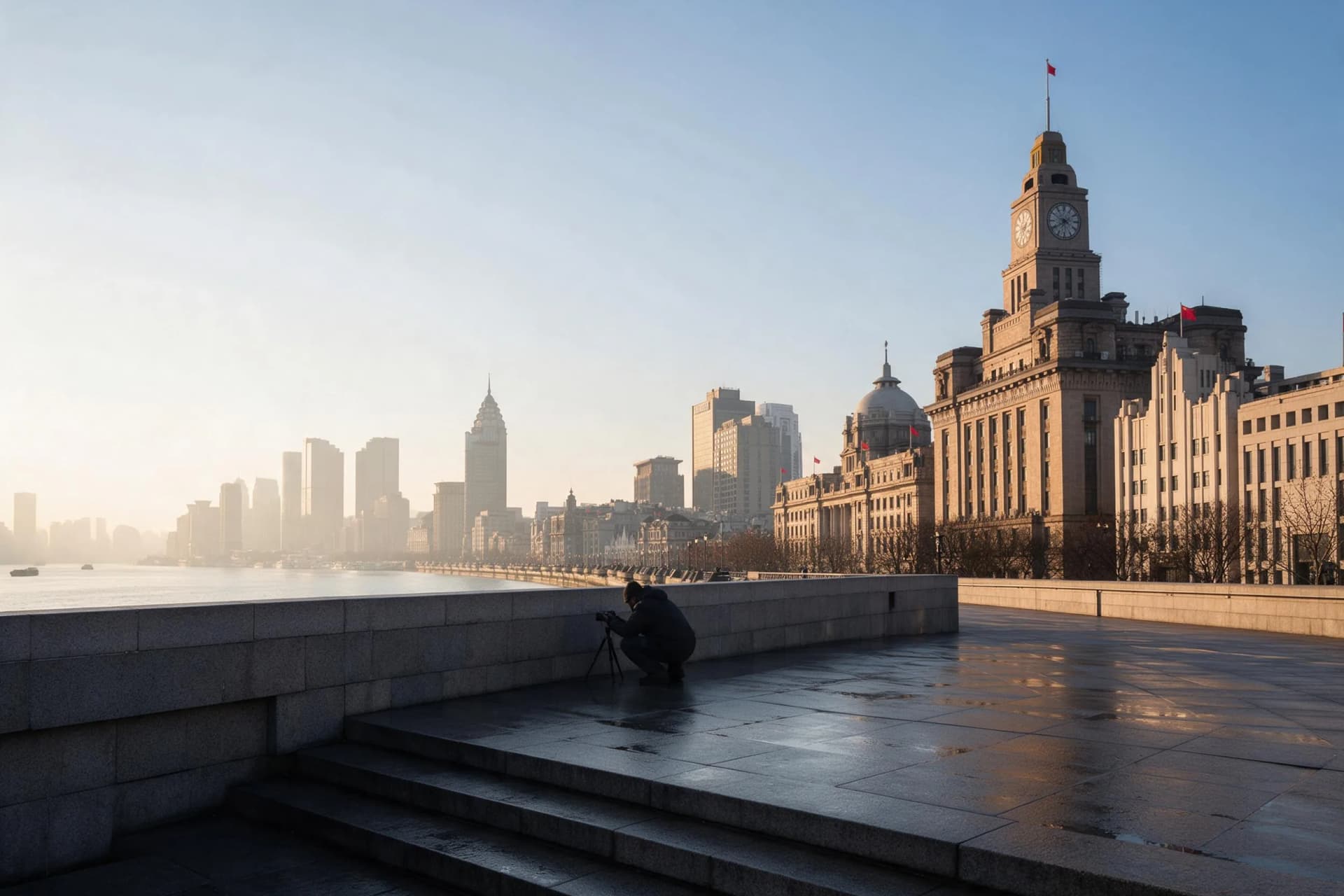
The Bund is Shanghai's one landmark where the light runs on two clocks: the river runs north to south and the promenade faces east, so dawn front-lights the historic facades while evening belongs to Pudong's glass towers. This guide maps six viewpoints by their windows, with the ferry timetables, observatory tickets and camera settings that make each frame work.
The Bund's best photography runs on two clocks: shoot the west-bank facades at dawn from the raised promenade near Chen Yi Square, then return for the Pudong skyline at blue hour. The promenade is free and open 24 hours; on January 1, 2026, sunset is 17:03, so claim a railing spot by 16:40.
The Bund faces east across the Huangpu, and the river runs north to south, so one promenade gives two opposite light directions. At dawn the sun rises over Pudong and front-lights the stone facades behind you; at dusk it sets behind the Bund, leaving the last warm light to Lujiazui's glass towers. Sunrise swings from 04:52 on June 1 to 06:53 on January 1, and sunset from 19:03 on July 1 to 16:52 on December 1. Blue hour, roughly 25 to 40 minutes after sunset, is the reliable skyline window.
Walk 200 to 300 meters south of the Chen Yi statue to the raised platform between Chen Yi Square and the Custom House clock tower. Shoot north toward Waibaidu Bridge at first light, or east for Lujiazui. The promenade is free and ungated, 1.5 kilometers from Waibaidu Bridge to East Yan'an Road, with no last entry, so you can stay through blue hour and past midnight. At dawn set 35mm, f/8, ISO 100 and 1/125 to 1/250 second, exposing over the stone; at blue hour brace on the railing at f/8 to f/11, ISO 100, for 2 to 15 seconds.
Two bridges at the north end frame the skyline better than the promenade does. Waibaidu Bridge, completed in 1908 as China's first fully steel-riveted bridge, has a low truss you can shoot through, with the Lujiazui towers stacked behind it. A hundred meters west, Zhapu Road Bridge frames the classic view: Waibaidu's curve in front, the river bending toward Pudong, and the Bund's domes along the right edge. Both are free and open all night; come at dawn for empty decks, or 20 minutes after sunset when the bridge lights balance the towers.
North Bund Riverside is the quiet alternative. Ride Metro Line 12 to International Cruise Terminal and walk the free riverside green space, a level promenade looking south at both banks at once, the Bund's stone wall on the right and Lujiazui on the left. Sunset is the point: on October 1, 2026 the sun drops at 17:41, and the sky holds color while both skylines switch on. Bring a 24-70mm and a graduated filter; the contrast between a bright western sky and the dark river defeats most phones.
Cross the river for the reverse view. From the Pudong promenade near Dongchang Road Pier, the Bund's 52 facades line up as one lit wall, doubled in the water, with no fence and far fewer people. The commuter ferry is the cheapest crossing: CNY 2 per pedestrian, about eight to ten minutes, the upper deck's bow or stern giving the cleanest frame. The Dongjin Line from Jinling East Road to Dongchang Road runs 07:00 to 18:30; the Dongfu Line from Fuxing East Road runs 07:00 to 22:00 as the night crossing; the Taigong Line links North Bund to Lujiazui from about 06:00 to 21:50. Pay at the self-service gate with coins, a transport card or the Alipay bus QR code.
For the river's bend from above, buy a ticket to Top of Shanghai on the 118th floor of Shanghai Tower, 546 meters up. The deck opens 08:30 to 22:00 with last admission at 21:30; the adult gate price is CNY 180, student and 60-plus tickets are CNY 120, children from 1.0 to 1.4 meters pay CNY 90, and under-ones go free. Bring the passport you booked with. The honest limits: you shoot through glass, the Bund reads small at this height, and the deck is busiest from 17:00. Press a jacket to the glass for a long braced exposure.
Timing beats gear here. The promenade is busiest from 19:00 to 22:00, worst at weekends and holidays; claim a railing spot 40 minutes before sunset, or come on a weekday morning, when it belongs to tai chi, dog walkers and joggers. The landscape lighting follows the season: 18:00 to 22:00 on the winter timetable, 19:00 to 23:00 in summer, and the 2026 National Day period from September 30 to October 7 extended to 23:00.
Pack for a city, not a mountain. A 24-70mm covers the promenade and bridges, a 70-200mm compresses the skyline, and a light tripod earns its place at dawn. A polarizer deepens the river on bright days but darkens a pale winter sky. Rain is an ally: wet granite becomes a mirror, and a low angle at 24mm, f/4, ISO 400 and 1/30 second turns the facades into a second skyline. On a phone, tap the brightest tower, drag the exposure down and brace on the railing for a one- to four-second night-mode frame.
Two banks, two clocks, one river: the Bund rewards a photographer who plans around light rather than a checklist. Tell ChinaMira your dates and whether you shoot on a phone or a full kit, and we will shape the days around sunrise, blue hour and the ferry timetable, with the observatory slot booked and a hotel near the railing. Start with our full Bund guide, our Shanghai three-day itinerary, our month-by-month China guide, our Hong Kong photography guide for a second city of light, and our photography journeys.
Good to know
- Bund basics
- Free, no gate and open 24 hours, with no last entry. The promenade runs 1.5 km from East Yan'an Road in the south to Waibaidu Bridge in the north and is lined with 52 historic facades; Metro Line 2 or 10 to East Nanjing Road, then a 10-minute walk east.
- Light windows, 2026
- January 1: sunrise 06:53, sunset 17:03. June 1: sunrise 04:52, sunset 18:54. July 1: 04:54 and 19:03. October 1: 05:48 and 17:41. Blue hour lasts about 25 to 40 minutes after sunset.
- Bund landscape lighting
- Winter timetable 18:00-22:00, summer timetable 19:00-23:00; the 2026 National Day period from September 30 to October 7 ran 18:00-23:00. The floodlights switch off at the end of the window.
- Shanghai Tower, Top of Shanghai
- 118th floor, 546 m; open 08:30-22:00 with last admission at 21:30. Adult CNY 180, student and 60-plus CNY 120, children 1.0-1.4 m CNY 90, under 1 m free; Metro Line 2 or 14 to Lujiazui, then a 5-minute walk.
- Huangpu ferries
- CNY 2 per pedestrian one way, about 8-10 minutes across. Dongjin Line (Jinling East Road to Dongchang Road) 07:00-18:30; Dongfu Line (Fuxing East Road to Dongchang Road) 07:00-22:00; Taigong Line about 06:00-21:50. Self-service gates take coins, transport cards or the Alipay bus QR code.
- Crowd timing
- The promenade is busiest from 19:00 to 22:00 and worst on Friday to Sunday and public holidays; the calmest window is 06:00 to 08:00 on a weekday. Arrive 40 minutes before sunset to hold a railing spot.
Frequently asked questions
What is the best time of day to photograph the Bund?
Dawn is the quietest and gives the historic facades direct, warm front light; blue hour is the classic skyline window, when the Lujiazui towers are lit but the sky still holds color. If you can only pick one, choose blue hour on a weekday, then return at sunrise for the architecture.
Where can I photograph the Bund skyline for free?
The Bund promenade, North Bund Riverside (Metro Line 12 to International Cruise Terminal), the Pudong riverside near Dongchang Road Pier, and both Waibaidu and Zhapu Road bridges cost nothing and need no ticket. North Bund and the Pudong side are the least crowded.
Is the Shanghai Tower observation deck worth it for Bund photos?
It is the only public spot that shows the river's bend from above, but you shoot through glass and the historic facades look small at that height. Book a slot before last admission, press a jacket to the glass to cut reflections, and treat it as a wide cityscape rather than a Bund close-up.
How do I use the Huangpu ferry for photography?
Board at Jinling East Road or Fuxing East Road and ride to Dongchang Road; the upper deck's bow or stern gives the cleanest view of both banks. Pay at the self-service gate with coins, a transport card or the Alipay bus QR code, and take the Dongfu Line for a night crossing once the Dongjin Line stops.
What phone settings work for the Bund at night?
Stand at the railing and brace both elbows or rest the phone on the granite. Tap the brightest tower, drag the exposure down about two stops so the sky keeps its blue, lock focus, and shoot with the main lens in night mode; skip digital zoom, which turns the lit facades to mush.