
Wonder Story
Huangshan and the Sea of Clouds: When a Mountain Becomes an Ocean
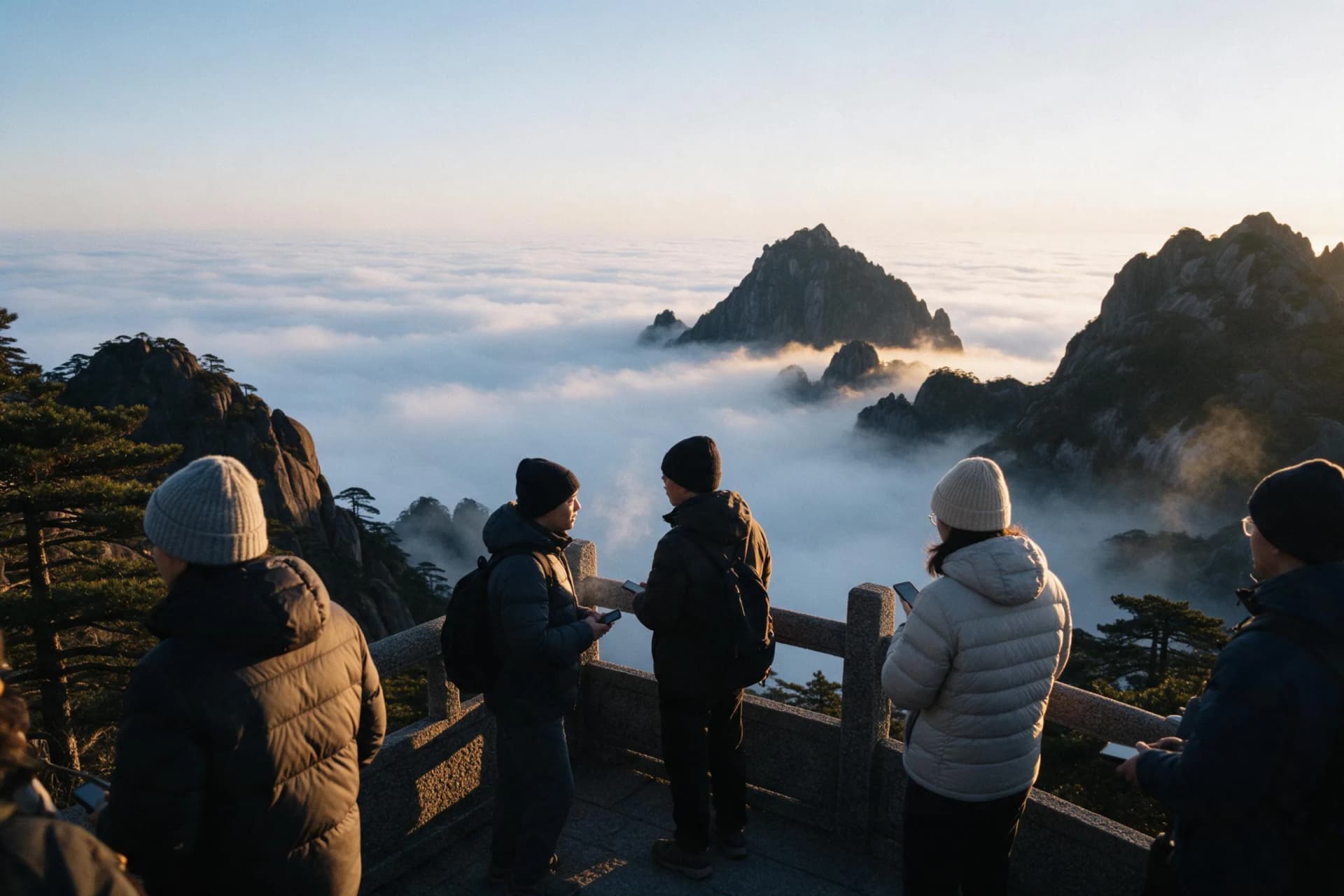
Huangshan's sea of clouds is not a guarantee but a weather event — a temperature inversion that turns the valleys of Yellow Mountain into a white ocean beneath the peaks. Here is how it forms, where to stand, and when the odds are best.
You climb in the dark, and you wait. It is 4:50 a.m. on a cold November morning at Refreshing Terrace, a stone platform bolted to the shoulder of Lion Peak, and the only sounds are wind combing through pine needles and the low murmur of strangers in borrowed coats. Then the eastern ridge turns gray, then rose, and the valleys below begin to fill with white — slowly, like milk poured into a bowl. By full sunrise the cloud has risen to your knees, the granite peaks stand above it as islands, and every photograph of Huangshan you have ever doubted suddenly makes sense.
This is the sea of clouds — yunhai — the first of Huangshan's four wonders and the reason people haul themselves up thousands of stone steps before dawn. Despite the name, it is entirely weather: a temperature inversion that traps a layer of cloud below the summits. On a clear, calm night, moist air in the valleys cools faster than the air above it. When humidity climbs toward saturation, fog forms down there; after sunrise, as the ground warms, some of that fog lifts and pools into a flat white sea whose top sits lower than the peaks. Light wind helps it hold together; a strong wind tears it apart. That is why the cloud sea is never promised, only possible.
Official figures put a visible sea of clouds on roughly forty to fifty days a year, and the scenic area publishes a daily probability alongside its weather forecast — worth checking the night before you commit to a pre-dawn climb. The odds are best from November through May, when cold fronts and dry, clear air favor inversions. Late autumn and winter mornings after rain or snow offer the classic combination: sharp peaks, hard blue sky above, and an ocean of cloud below. Spring brings mist and blossom, along with more rain; summer is hot, green, and thundery, with clouds that often swallow the view entirely.
Where you stand changes what you see. Huangshan's cloud sea is divided into five "seas," and each has a viewpoint locals trust. Bright Summit, at 1,860 meters the second-highest peak, sits at the center of them all — on a good morning, all five surround you. Refreshing Terrace on Lion Peak is the classic spot for the North Sea and sunrise; Cloud Dispelling Pavilion looks west over the cliff-edged West Sea and is superb in late afternoon after rain; Jade Screen Pavilion faces the South Sea; and White Goose Ridge catches the East Sea at first light. Give yourself two sunrises and two sunsets at different viewpoints if you can — the mountain is a different painting from each.
The mountain has been a subject for far longer than it has been a destination. Legend says the Yellow Emperor, Xuanyuan, cultivated the elixir of immortality here, and in 747 the Tang emperor Xuanzong renamed the peak Huangshan — Yellow Mountain — in his honor. Poets followed: Li Bai came and left verses, and in the seventeenth century the traveler Xu Xiake wrote that among all the famous mountains within the seas, none compared with Huangshan. The famous line usually attributed to him — that after the Five Sacred Mountains you need no others — is now understood to be a later composite, yet it still captures what visitors feel. Painters of the Huangshan School came too, and the ink landscapes of Mei Qing and Shitao were no exaggeration.
Above the cloud line, the rest of Huangshan's strangeness comes into focus. Pines twist out of bare granite, their roots gripping cracks in the rock; boulders carry names like Monkey Gazing at the Sea and Flying Stone; and in winter, supercooled fog freezes onto every branch as rime ice, turning the forest into white coral. At the foot of the mountain, the fourth wonder — the hot springs — has been soothing stone-step legs for centuries. Winter, when crowds thin and rime and cloud seas arrive together, may be the mountain's best-kept secret, provided you bring real winter layers.
A few practical notes. Three cableways — Yungu, Yuping, and Taiping — do most of the climbing, but they suspend operation in high winds, so build slack into your day and never plan a flight for the same evening. Summit hotels are limited; book months ahead if you want a bed near a sunrise viewpoint, and bring a headlamp and shoes with grip for polished, wet stone. Buy your scenic-area and cableway tickets online in advance with your passport, and check the official sea-of-clouds probability before you set the alarm. The West Sea Grand Canyon loop, if it is open and your knees agree, is the finest walk on the mountain.
Standing above that white ocean is one of travel's great small miracles, and it comes down to being in the right place on the right morning. ChinaMira can put you there — a summit room reserved early, a guide who reads the forecast and knows which platform the locals choose, private transfers from Huangshan North Station, and a route that folds the cloud sea into the villages, tea hills, and hot springs around it. Tell us your dates and how far you like to walk, and we will build the trip around the season with the best odds. The clouds do the rest.
Good to know
- Entrance ticket and 3-day validity
- Winter, 20 December 2025 to 20 January 2026: CNY 150 full / CNY 75 half price. Regular season, 21 January to 19 December 2026: CNY 190 full / CNY 95 half. Since 20 December 2025 one ticket is valid for three consecutive days including the first, with unlimited re-entry once you have scanned through the gate on day one. Real-name reservation on the official 'Huangshan Tourism Official Platform' mini-program is mandatory, and entry is by passport or ID at the reserved time and gate direction.
- Cableways and funicular
- Three cableways — Yungu, Yuping and Taiping — plus the West Sea Grand Canyon funicular. Winter (20 December 2025-20 January 2026): Yungu and Taiping CNY 65 one way, Yuping CNY 75, West Sea CNY 80. Regular 2026 season: CNY 80, CNY 90 and CNY 100. They operate roughly 08:00-16:40 in winter and 07:00-17:10 Monday-Friday (from 06:30 at weekends and short holidays) between 2 March and 30 November, and are suspended in high wind, heavy snow, lightning or icy conditions.
- Opening hours and last entry
- 2 March-30 November: 07:00-17:10 Monday to Friday, 06:30-17:40 at weekends and short holidays. 1 December-1 March: 08:00-16:40. Walking-trail ticket gates close at 15:00 and turn exit-only afterwards, so start climbing before early afternoon. Transfer buses from Tangkou run about 06:40-16:30 uphill and 07:10-17:40 downhill in the long season, and 07:40-16:00 / 08:10-17:10 in winter. Hours are re-announced for Spring Festival, May Day and National Day golden weeks.
- Sea-of-clouds odds
- The Bright Summit weather station's 60-year record averages about 52 cloud-sea days a year, concentrated from December to April, when winter and spring cloud layers are most frequent, longest-lasting and most dramatic. About 97% of Huangshan cloud seas form from stratocumulus and only 3% from ground fog lifting into the valleys. Two nights on the summit — one for the sunrise you plan, one for the one you do not — is the single best way to raise your chances, since no forecast guarantees the sea.
- Viewpoints and peaks
- Sunrise: Refreshing Terrace in the Shixin Peak area (North Sea) and Bright Summit at about 1,860 m (Heavenly Sea). Afternoon: Paiyun Pavilion above the West Sea Grand Canyon, where cloud pours between the cliffs. Yuping Tower faces the South Sea and Bai'e Ridge the East Sea. Lotus Peak, the highest at 1,864 m, is in a closed rotation-rest period; Tiandu Peak, the West Sea Grand Canyon and the west gate can close temporarily in thunderstorms, strong wind, snow or ice.
- Getting there and around
- Huangshan North high-speed railway station connects to the Tangkou south-gate transfer centre by shuttle roughly every 20-40 minutes from 07:00 to 20:00 for CNY 30, taking about an hour; the north gate service departs at 12:40 for CNY 36, and Hongcun via Xidi costs CNY 30 in about 1.5 hours. From Tangkou the scenic-area shuttle is the only vehicle allowed up to the trailheads and cableway stations, so budget for the transfer plus the cableway on both ascent and descent.
Frequently asked questions
When is the best time to see the sea of clouds at Huangshan?
A 60-year record from the Bright Summit weather station puts the average at about 52 cloud-sea days a year, and the frequency peaks from December to April, when winter and spring inversions sit lowest and last longest. Cold, clear mornings after a passing front give the flat, lake-like cloud layer; spring adds mist that rises off the valleys after rain. Book two nights on the summit so you get two dawns, and be at the railing 30-40 minutes before sunrise — the colour arrives before the light.
How much are Huangshan tickets and cable cars in 2026?
In winter, from 20 December 2025 to 20 January 2026, the entrance ticket is CNY 150 (half price CNY 75); Yungu and Taiping cableways are CNY 65 one way, Yuping CNY 75 and the West Sea Grand Canyon cable car CNY 80. From 21 January to 19 December 2026 the regular ticket is CNY 190 (CNY 95 half), Yungu and Taiping are CNY 80, Yuping CNY 90 and the West Sea funicular CNY 100. Buy through the official 'Huangshan Tourism Official Platform' mini-program.
Do I need to reserve Huangshan tickets in advance, and can I re-enter the scenic area?
Yes. The scenic area runs real-name, timed, direction-based reservations, so book on the official Huangshan Tourism Official Platform WeChat mini-program before you travel and carry the same passport. One ticket is valid for three consecutive days including the first day, with unlimited re-entry — but you must scan through the gate on day one. If you only reserve and never check in, the multi-entry right is never activated, so plan your first morning properly.
How do I get from Huangshan North railway station to the mountain?
Huangshan North high-speed station is about an hour from the Tangkou south-gate transfer centre. Direct shuttle buses run roughly every 20-40 minutes between 07:00 and 20:00 and cost CNY 30 per person; the north-gate service leaves at 12:40 for CNY 36. Shuttles also run to Hongcun via Xidi for CNY 30 in about 1.5 hours. At Tangkou you must switch to the scenic-area shuttle — private cars and taxis cannot drive up to the trailheads or cableway stations.
Where are the best viewpoints for the sea of clouds, and how hard is the walking?
Refreshing Terrace, a 15-20 minute walk from the summit hotels, is the classic sunrise spot looking toward Shixin Peak; Bright Summit, at about 1,860 m, gives a full horizon over the 'Heavenly Sea'. Paiyun Pavilion above the West Sea Grand Canyon is best in late afternoon when cloud pours between the cliffs, and Yuping Tower faces the South Sea. Expect tens of thousands of stone steps over two days; the Yungu, Yuping and Taiping cableways cut the worst climbs but stop in high wind, and Lotus Peak (1,864 m) is currently closed in a rotation-rest cycle.