
Can You Take a Medical Device Through China Security in 2026?
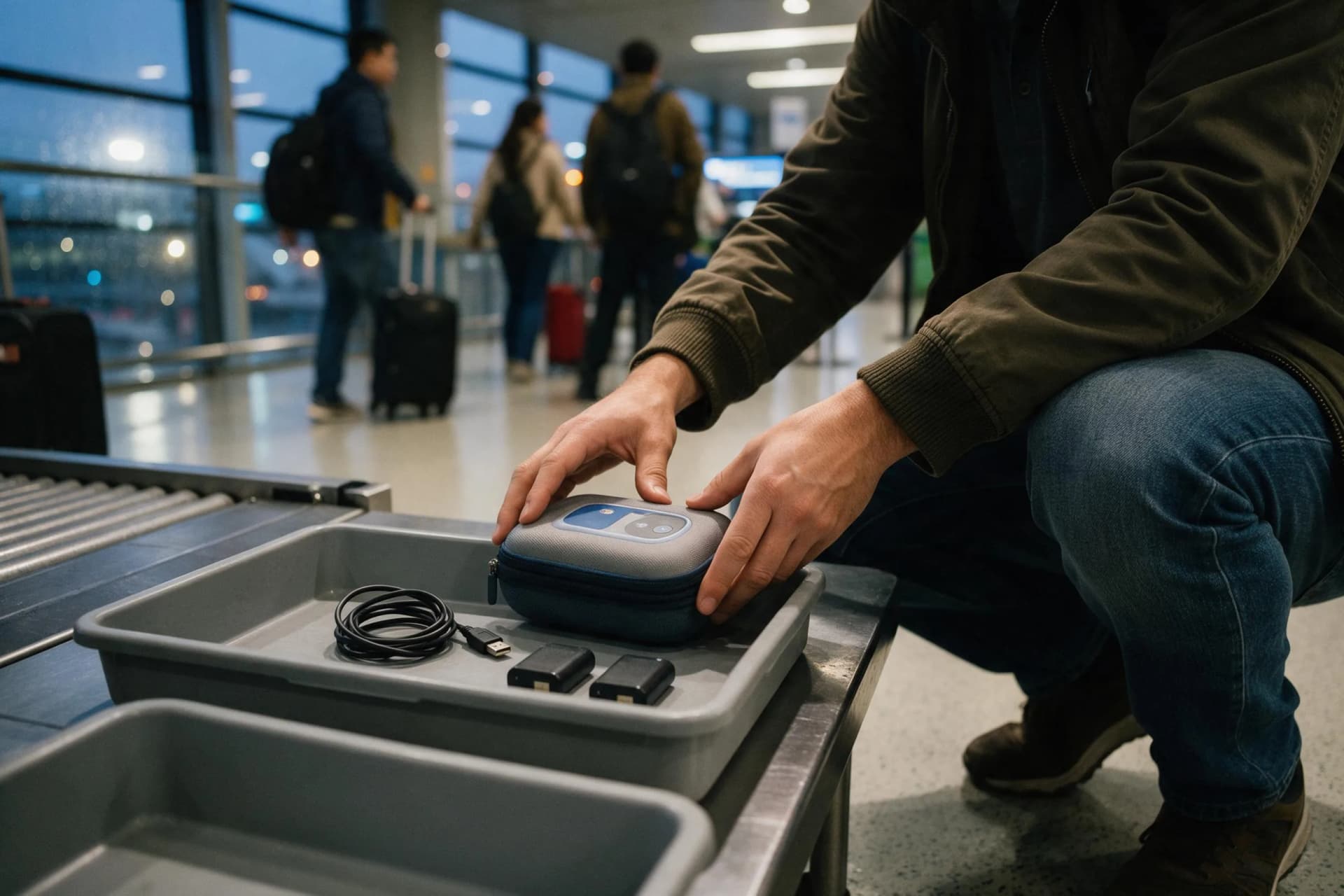
Traveling to China with a medical device in 2026 is practical when you prepare for three separate checks: security, airline approval and power. This guide uses a Shanghai Pudong departure to explain 100 Wh battery limits, 220V adapters versus transformers, rail screening, the paperwork to keep accessible and a backup plan for a device that must not lose power.
Traveling to China with a medical device is usually possible in 2026 if it is for personal use, its batteries are intact and labeled, and any lithium battery above 100 Wh has airline approval. On November 27, 2026, pack spares in your carry-on, arrive 3 hours early and verify rules with your airline.
The first decision is whether the device belongs in the cabin or the hold. Keep it with you whenever it is small enough to do so, along with its charger, cables and manufacturer-approved spare batteries. A CPAP, insulin pump, portable oxygen concentrator or other powered device raises three separate questions: may the airline carry the model, may you use it in flight, and what battery configuration does it allow? Ask the named carrier at least 48 hours before departure; some medical-clearance processes take longer, and written approval is stronger than a verbal reassurance. The device maker should confirm whether it can be screened, switched off or disconnected during travel.
Make Shanghai Pudong International Airport the mental model. For a 2026 international departure, a 3-hour buffer is reasonable if you need extra screening or airline paperwork, although terminal and carrier cutoffs change. Keep the device in its own padded case with the model and serial number immediately visible. Put it in a tray when instructed, but do not let loose batteries, keys or coins enter the same tray. Ask before sending a critical device through any equipment the manufacturer has warned against. Paperwork supports a request; security staff still make the final screening decision.
The battery threshold deserves its own checklist. Under international dangerous-goods practice commonly applied to flights, lithium-ion cells up to 100 Wh may usually travel as spare batteries in carry-on baggage, 100–160 Wh normally needs the airline's approval, and anything above 160 Wh is generally not allowed for passengers. Spare cells must stay accessible, with terminals taped or each battery in a protective pouch. Do not assume an airline approval automatically clears China Railway: station screening is separate. At Shanghai Hongqiao or another major hub, keep the battery label available for inspection and verify current China Railway guidance through 12306 at least 24 hours before departure.
China's mains supply is 220V at 50Hz, with Type A, C and I sockets appearing in hotels, airports and stations. Read the input line printed on the device's power supply. A charger marked 100–240V and 50/60Hz usually needs only a certified plug adapter. A 120V-only device needs a transformer, not a pin adapter, and the transformer must be approved for continuous medical use at the device's labeled wattage. For a compressor or motorized device, the manufacturer should confirm startup demand and waveform. Do not run critical equipment through a cheap universal converter, an ungrounded adapter or a hotel's loosely fitted socket.
Plan power by the longest stretch without a reliable outlet: the flight, taxiing, immigration, baggage claim and ground transfer, then add a 2-hour cushion. Aircraft seat power may not work throughout the trip, and a train socket can be unavailable because of seat position or equipment. Carry manufacturer-approved batteries sized for that entire window, not merely the scheduled flight. An ordinary USB power bank is not a medical power source unless the device maker explicitly allows it. Use the device's original or approved charger, place it on a hard surface and stop charging if the plug, cable or battery becomes unusually hot.
Build a small, waterproof document pack: an English clinician's letter explaining the medical need; the device model and serial number; a readable battery watt-hour label; the relevant page of the manufacturer's transport instructions; and the airline's written approval or case-reference number. Ask the clinician to include whether the device must remain switched on and whether a companion can manage it. For an implanted device, insulin pump or other body-worn equipment, tell security before screening and ask for the manual alternative described by the manufacturer and local officers. Never disconnect a life-sustaining device just to speed up a queue.
Problems are easier to solve before the tray than at the gate. If an officer questions the battery, stay calm, show the documentation and ask for a supervisor or airline representative; do not dismantle the device or hide a battery. If a carrier rejects a large spare, ask whether a compliant smaller battery, a different flight or a ground-transport option exists. A critical-device trip also merits a traveling companion, a nonstop route when possible, and an insurer or assistance service that knows the device's requirements. Those choices matter more than saving one connection.
Before booking, create a one-page clearance sheet listing the device, its wattage and input voltage, every battery's Wh rating, the charger, the airline approval deadline and the nearest charging opportunity. Send it to the named airline and, when relevant, the rail operator; keep copies offline and on your phone. Then pack the device and protected spares in your carry-on, leave the transformer where it can be inspected, and build a backup plan that does not depend on a station outlet. ChinaMira can help shape the transport plan once the equipment and approval questions have clear answers.
Good to know
- Airport battery thresholds
- For 2026 flights, plan around 100 Wh: carry-on spares at or below 100 Wh normally need no airline approval; above 100 Wh through 160 Wh requires airline approval; above 160 Wh is generally prohibited for passengers. Confirm the operating carrier's written rule.
- Shanghai airport buffer
- Arrive 3 hours before a 2026 international departure from Shanghai Pudong when carrying a medical device; verify the airline cutoff and terminal 24 hours ahead.
- China power specification
- Mainland electricity is 220V at 50Hz, commonly through Type A, C or I sockets. A 100–240V, 50/60Hz power supply needs only a certified plug adapter.
- Backup power window
- Size manufacturer-approved batteries for the flight plus ground transfer and a 2-hour delay. Aircraft seat power and train outlets are useful but not guaranteed.
- Documentation pack
- Carry 5 items: clinical necessity letter, model and serial number, battery Wh label, manufacturer transport instructions, and written airline approval or reference number.
- Shanghai Hongqiao rail check
- Allow 75–90 minutes before departure as a 2026 planning buffer, then verify that day's station cutoff. Ask 12306 at least 24 hours ahead about the specific device and battery setup.
Frequently asked questions
Can I take a CPAP machine on a flight to China?
A CPAP is commonly allowed as carry-on personal medical equipment, but the operating airline must confirm its rules for your model, onboard use and spare batteries before departure. Keep the machine and protected spares in the cabin, and obtain written clearance for any lithium battery above 100 Wh.
Will China airport security X-ray an insulin pump?
Tell the security officer about the pump before screening and show the manufacturer's travel instructions. Ask for the manual alternative your device maker describes, but expect airport staff to make the final screening decision. Do not disconnect the pump merely to pass through a scanner.
Can I use a US medical device on 220V power in China?
Only if its power supply is marked for China's 220V, 50Hz supply or the manufacturer approves a suitable voltage transformer. A plug adapter changes pin shape only. A 120V-only device must never be connected through a simple travel adapter.
Are medical device batteries allowed on China high-speed trains?
Bring the device, spare batteries and readable documentation in accessible hand luggage, then confirm the current rules with China Railway and the departure station before travel. Airline clearance does not automatically settle rail screening, and station procedures can vary.
What documents should I carry for a medical device in China?
Carry five items: an English clinician's letter, the device model and serial number, a readable battery Wh label, the manufacturer's transport instructions, and the airline's written approval or case-reference number. Keep a paper copy and an offline phone copy.
Keep exploring
Sources & verification
Sources used for this guide
Time-sensitive travel details can change. Reconfirm opening hours, prices and entry rules before departure.
- 1caac.gov.cncaac.gov.cn
- 2icao.inticao.int
- 3shanghaiairport.comshanghaiairport.com
- 412306.cn12306.cn
- 5iec.chiec.ch
Local operating context
ChinaMira Travel Team contributes local route and operating knowledge from China. This team byline identifies a real operating group rather than a fictional individual author.
Plan this trip
Turn this guide into a practical itinerary
Send us the article as context. A ChinaMira specialist can check the route, dates, transport, tickets and the details that need local confirmation.