
Where Are the Best Huangshan Sea of Clouds Photography Spots in 2026?
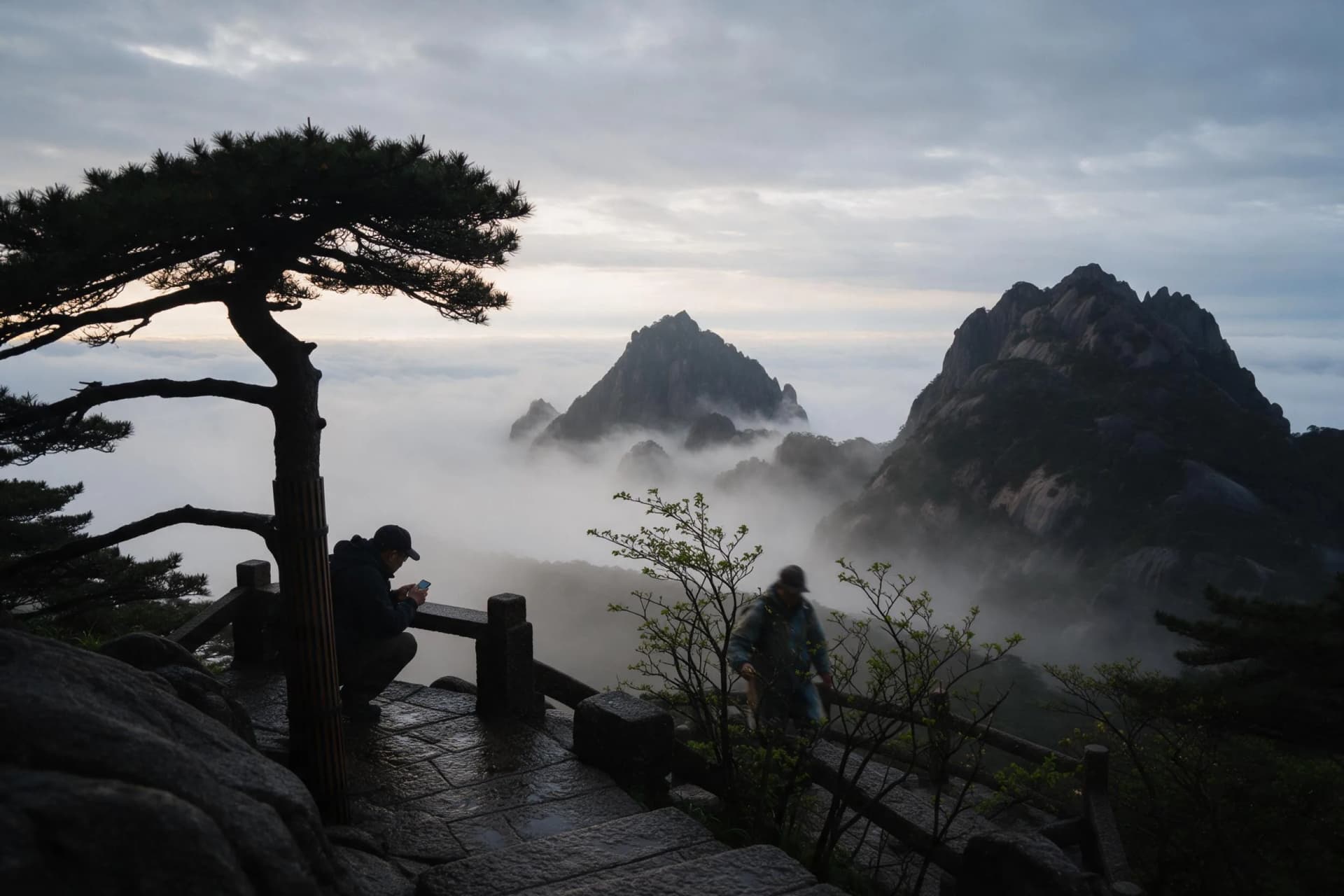
Huangshan’s best cloud-sea photographs come from matching a viewpoint to the light, not from collecting every platform. This field guide ranks five public spots—Refreshing Terrace, Dawn Pavilion, Bright Summit, Monkey Gazing at Sea and Cloud-Dispelling Pavilion—by sunrise or sunset window, crowd pressure, access ticket and exact 35mm-camera or phone settings. It assumes two summit nights and gives a practical weather-first plan for 2026.
For sunrise cloud seas on Huangshan, start at Refreshing Terrace, use Dawn Pavilion as the close alternative, Bright Summit as the weather fallback, Monkey Gazing at Sea after sunrise and Cloud-Dispelling Pavilion before sunset. Plan two summit nights in 2026; buy scenic-area entry plus a cableway ticket only if riding.
The cloud sea is a moving structure, so pick a platform by cloud height and wind. The evening before, compare the summit forecast with the live mountain webcam at about 18:00. A cloud top below the ridge and clear upper sky favors an east-facing terrace; cloud already pouring over the rim suits a side-on view through pines; solid fog makes a sunrise composition unreliable. Keep the summit night and use the first afternoon break instead.
Refreshing Terrace (Qingliangtai), in the Beihai summit hotel cluster, is the first choice for a broad east-facing sunrise. It looks toward successive granite towers, making it useful for cloud rivers and layered silhouettes. Work from 30 minutes before official sunrise through about 60 minutes after: cool shadow detail comes first, then cloud texture. Arrive 45–60 minutes early for the railing. The view is inside the paid scenic area; no separate platform ticket is sold.
Dawn Pavilion (Shuguang Ting), east of the Beihai hotel area, is the close alternative when Refreshing Terrace is shoulder-to-shoulder. Pines and ridges create a more enclosed composition, so use a 50–85 mm view rather than an ultrawide panorama. Aim from 20 minutes before sunrise through 40 minutes after, and arrive by the start of blue hour. It uses the same scenic-area admission; do not cross a rope barrier to find a cleaner angle.
Bright Summit (Guangmingding), at 1,860 m, is the safest choice when cloud direction is uncertain. Its open 360-degree position lets you check several horizons, especially when one side is fogbound and another has a break. Use the 45 minutes before sunrise through 90 minutes after, or the 45 minutes before sunset through 15 minutes after. The broad top absorbs crowds better than a narrow terrace, but its final stairs are exposed. No extra viewpoint fee applies.
Monkey Gazing at Sea (Houzi Guanhai), near Lion Peak, looks toward the formation of that name and the gullies below. It is not the first-light sprint: its strength is 30–90 minutes after sunrise, when low side light separates trunks, rock faces and cloud. A 70–200 mm lens compresses those layers better than a phone’s main lens. Tour groups build after the first cableway arrivals; shoot early, then yield the railing. Scenic-area entry covers access.
Cloud-Dispelling Pavilion (Paiyun Ting), on the West Sea rim, belongs to the other half of the day. Arrive 60 minutes before sunset if using a tripod, then work from 30–45 minutes before sunset until roughly 15 minutes after as cloud spills through the canyon and distant ridges alternate between light and haze. Scenic-area entry covers the pavilion. The West Sea ground railway is a separate ticket for descending, not for this rim view. Check barriers: canyon routes can close.
Treat the five viewpoints as assignments, not a tick-list. With two summit nights, use one dawn at Refreshing Terrace or Dawn Pavilion, the next at Bright Summit or Monkey Gazing at Sea, and place Cloud-Dispelling Pavilion on the intervening evening. Start walking 45–60 minutes before first light with a headlamp. If a platform is full, stepping back often creates a stronger pine-framed view than fighting for the front rail.
For a camera, carry 16–35 mm for the cloud basin, 24–70 mm as an all-purpose ridge lens and 70–200 mm for compressed layers if weight allows. Start near f/8–f/11, ISO 100–400 and judge shutter speed from the histogram. A 1/30–1/125 second exposure keeps moving cloud texture; a 2–4 second tripod exposure can smooth it only when the air is still. Set white balance around 5200–5600 K and bracket three to five frames at one-stop intervals.
On a phone, use the main 1x lens or 2.5x telephoto and avoid high digital zoom. Tap the brightest cloud edge, lock focus and exposure, then pull exposure down by roughly 0.7–1.3 EV; recover shadows later in RAW if available. Use the grid, disable cosmetic filters and bracket manually when the sky clips. Brace the phone on a ledge or small tripod, and wipe the lens between exposures because summit mist quickly softens every light.
Check wind, visibility, rain and trail notices before leaving the hotel, and carry a rain shell, gloves and a dry cloth. In winter, ask whether ice grips are needed. Stay behind barriers, descend if lightning arrives and never let a photograph compete with the last safe route back. Use the linked weather-window guide to choose dates, the transfer guide to protect your summit arrival and the budget guide to compare summit lodging with Tangkou. Send ChinaMira your dates and gear so we can turn this sequence into a dawn plan.
Good to know
- Best light windows
- Refreshing Terrace: 30 minutes before to 60 minutes after sunrise. Bright Summit: 45 minutes before to 90 minutes after sunrise and 45 minutes before to 15 minutes after sunset. Cloud-Dispelling Pavilion: 30–45 minutes before to 15 minutes after sunset.
- Ticket to carry in 2026
- Dated scenic-area admission is required; high season runs March 1–November 30 and low season December 1–February 28. Cableways need separate one-way tickets; the five listed public viewpoints require no extra photo-platform ticket.
- Five-viewpoint sequence
- 1 Refreshing Terrace and 2 Dawn Pavilion for first light; 3 Bright Summit for a 360-degree fallback; 4 Monkey Gazing at Sea 30–90 minutes after sunrise; 5 Cloud-Dispelling Pavilion for the final 45 minutes before sunset.
- Crowd timing
- Arrive 45–60 minutes before sunrise or 60 minutes before sunset. Expect the greatest front-row pressure 20 minutes before sunrise and larger groups after the first cableway lifts arrive.
- Camera baseline
- Try f/8–f/11, ISO 100–400, 1/30–1/125 second for textured cloud and a 3–5 frame bracket at 1-stop intervals. Use 16–35 mm for the basin and 70–200 mm for compressed layers.
- Phone baseline
- Use 1x or 2.5x, expose 0.7–1.3 EV below the bright cloud edge, lock focus and exposure, enable RAW where possible and avoid high digital zoom.
Frequently asked questions
Which Huangshan viewpoint is best for sunrise cloud photos?
Refreshing Terrace is the strongest first choice for a broad sunrise view, while Dawn Pavilion is the closer alternative when it is crowded. On an uncertain morning, Bright Summit gives the widest weather fallback.
Do I need a separate ticket to photograph from these viewpoints?
Carry the dated scenic-area admission pass. Cableways require separate one-way tickets if you ride, but the five public viewpoints in this guide have no additional photo-platform ticket.
What camera settings work best for Huangshan’s sea of clouds?
Start around f/8–f/11, ISO 100–400, and expose from the histogram. Use 1/30–1/125 second for textured moving cloud, set white balance near 5200–5600 K, and bracket three to five frames at one-stop intervals.
How early should I arrive to avoid viewpoint crowds?
Reach a sunrise platform 45–60 minutes before official sunrise and a sunset platform about 60 minutes before sunset. Front-row competition is usually strongest in the final 20 minutes before sunrise.
Can I photograph sunrise on a day trip from Tangkou?
No, not reliably. The cableways do not operate early enough for a summit sunrise, so sleep within the paid scenic area the night before. A Tangkou room works for a daytime visit, not first light.
Keep exploring
Sources & verification
Sources used for this guide
Time-sensitive travel details can change. Reconfirm opening hours, prices and entry rules before departure.
- 1huangshan.gov.cnhuangshan.gov.cn
- 2whc.unesco.orgwhc.unesco.org
- 3cma.gov.cncma.gov.cn
Local operating context
ChinaMira Travel Team contributes local route and operating knowledge from China. This team byline identifies a real operating group rather than a fictional individual author.
Plan this trip
Turn this guide into a practical itinerary
Send us the article as context. A ChinaMira specialist can check the route, dates, transport, tickets and the details that need local confirmation.