
Attraction
Zhangjiajie Glass Bridge: A 430-Meter Walk Above the Grand Canyon Floor
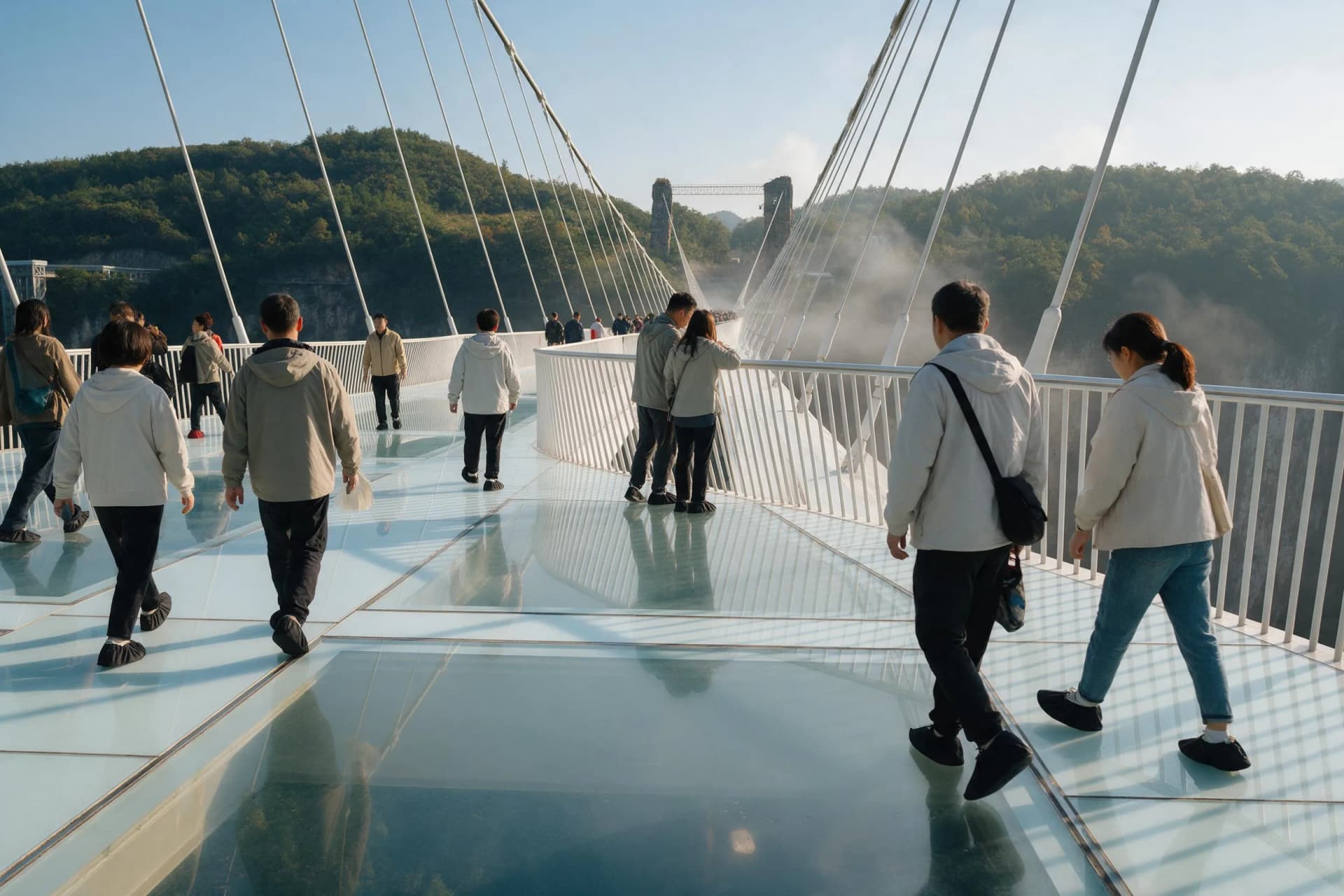
The Zhangjiajie Glass Bridge hangs 300 meters above the canyon floor on a 430-meter glass deck in Hunan. This guide walks you through its short, dramatic history, what Route B tickets cost, how timed entry works, the bungee jump below the deck, and the canyon trails waiting on the far side.
The first step is the one you remember. You shuffle forward in a pair of soft cloth shoe covers, the deck gives the faintest flex, and then you look down and the world drops away. Three hundred meters below you, a pale river threads the bottom of the gorge and the treetops look like moss. Someone behind you laughs too loudly. Someone else grips the white cable and refuses to move. The Zhangjiajie Glass Bridge is not subtle, and that is the point.
The bridge itself is a clean piece of engineering. It stretches 430 meters across Zhangjiajie Grand Canyon in Cili County, northwestern Hunan, on a deck only about 6 meters wide, suspended roughly 300 meters above the canyon floor. Its official name, Yun Tian Du, means Cloud Sky Crossing. More than 120 triple-layered glass panels, each about 5.1 centimeters thick, sit in a steel frame carried by four pillars anchored at the cliff edges. The deck is built to hold up to 800 people at once, and the scenic area caps daily visitors at 8,000.
For a landmark this young, the bridge has a genuinely dramatic history. It was designed by the Israeli architect Haim Dotan, who wanted the structure to seem almost invisible against the cliffs. It opened on August 20, 2016, as the world's longest and tallest glass-bottomed bridge, and the crowds arrived faster than anyone had planned. On September 2, 2016, just thirteen days later, officials closed it because crowds overwhelmed the site, with far more arrivals each day than the 8,000 expected. It reopened on September 30, 2016, with a firmer booking system. The longest-glass-bridge record has since passed to a newer span in Hebei, but this is still the one travelers picture. There is an older story underneath, too: this is Tujia country, and mountain communities here have always crossed the gorge by rope, plank and suspension bridge. The glass deck is simply the newest link in a very old habit.
Buying the right ticket is the most common mistake. To walk the bridge you need Route B, the Grand Canyon ticket that includes it, at CNY 175 per adult. Add the adventure package — zipline, slide and the other extras bundled together — and the price rises to CNY 298. Children aged 14 to 18 and visitors aged 60 to 65 pay CNY 88 for the basic route, and over-65s pay CNY 63; children under 14 enter free. Bought alone, the adventure combo runs about CNY 120, the zipline around CNY 138, and the bungee jump CNY 1,998. Entry is time-slotted and limited to 8,000 people a day, so reserve online at least one day ahead through the official channel and bring the passport you booked with.
Route B is more than a bridge crossing. From the tourist center you cross the glass span first, then pass a glass plank section before choosing your way down: the sightseeing elevator for an easy descent, or the canyon slide for a faster one. The route continues to Rainbow Square, past Tianhe Waterfall and a low cave known as Touching Cave, then a roughly 3-kilometer walk along the canyon floor to a short boat ride across Shenquan Lake and the exit. Allow three to four hours at an unhurried pace. Families usually prefer the elevator route — about two hours of walking that still reaches the waterfall and lake.
Timing shapes the visit. The gate typically opens at 8:00 a.m. and stops admitting at 4:00 p.m., and the bridge may close without notice in high wind, heavy rain or during maintenance, so treat any schedule as weather-dependent. April, May, September and October are the kindest months, with clear air and comfortable walking temperatures; July and August are hot, wet and busy; December through February is quiet and cold, sometimes with snow on the rim. Spring mist is beautiful from the rim but can erase the canyon floor entirely; know that before you pay for a glass view. Arrive at opening if you want photographs without a crowd in them.
Practical details matter here. Only a phone with a cover and a small purse or waist bag are allowed on the deck; larger bags go to the left luggage office for CNY 5 per small bag and CNY 10 per large one, and the cloth shoe covers are free at the bridge entrance. High heels and metal-spiked shoes are banned, and so is running or leaning on the rail. Wear non-slip shoes and bring long pants if you plan to ride the canyon slide. The canyon sits in Cili County, roughly an hour by road from Zhangjiajie National Forest Park and about ninety minutes from downtown Zhangjiajie, so a private transfer or guided day trip beats juggling local buses.
Standing on the far side, with your heart rate settling and the boat waiting at Shenquan Lake, the bridge stops feeling like a stunt and starts feeling like a doorway. That is the trip ChinaMira likes to build: a timed bridge slot booked before you fly, a guide who explains the Tujia history of the gorge while you wait, a driver who knows which gate moves fastest on a wet morning, and the Avatar mountains or Tianmen Mountain folded into the same short stay. The fact sheet below gathers the numbers in one place. Tell us your dates, and we will build the crossing around them.
Good to know
- Tickets
- Route B, the Grand Canyon ticket that includes the Glass Bridge, costs CNY 175 per adult or CNY 298 with the adventure package. Children 14-18 and visitors 60-65 pay CNY 88, over-65s CNY 63, and under-14s enter free.
- Opening hours
- Typically 8:00 a.m. to 4:00 p.m., with 4:00 p.m. the last entry. The bridge closes in high wind, heavy rain or during maintenance, so confirm the day's window when you book.
- Size and capacity
- 430 meters long, about 6 meters wide and roughly 300 meters above the canyon floor, with more than 120 triple-layered glass panels. Capacity is 800 people on the deck at once and 8,000 visitors per day.
- Getting there
- Zhangjiajie Grand Canyon, Cili County, Hunan: about 1 hour by road from Zhangjiajie National Forest Park and about 90 minutes from downtown Zhangjiajie.
- Adrenaline extras
- Bungee jump CNY 1,998 for ages 16 and over, zipline about CNY 138, adventure combo about CNY 120. All are separate from the Route B ticket.
- Time to allow
- Three to four hours for the full Route B crossing, canyon walk and Shenquan Lake boat; the elevator route with children or seniors takes about two hours.
Frequently asked questions
How much does it cost to walk the Zhangjiajie Glass Bridge?
CNY 175 per adult buys Route B, the Grand Canyon ticket that includes the glass bridge, and CNY 298 adds the adventure package of zipline, slide and other extras. Children aged 14 to 18 and visitors aged 60 to 65 pay CNY 88 for the basic route, over-65s pay CNY 63, and children under 14 enter free.
What are the opening hours, and how do I reserve a timed slot?
8:00 a.m. to 4:00 p.m. is the usual window, with 4:00 p.m. the last entry, and the bridge closes in high wind, heavy rain or during maintenance. Entry is time-slotted and capped at 8,000 visitors a day, so reserve online at least one day ahead with your passport details and arrive near opening to avoid the midday crush.
Is the bungee jump worth it, and what does it cost?
CNY 1,998 per jump, for visitors aged 16 and over, from a platform about 260 meters above the canyon floor that the operator calls the world's highest bridge bungee. It is not included in the Route B ticket, is usually paid on site, and can be suspended in wind or rain; the zipline, at roughly CNY 138, is the milder adrenaline option.
When is the best time of year to visit the glass bridge?
April, May, September and October give the clearest light and the easiest walking, with daytime temperatures usually between 15 and 25 degrees Celsius. July and August bring heat, heavy rain and the largest crowds, while December through February is quiet and cold, with occasional snow closures. Spring mist can hide the canyon floor completely.