
Wonder Story
The Li River: China's Most Beautiful Cruise Through Guilin's Karst Peaks
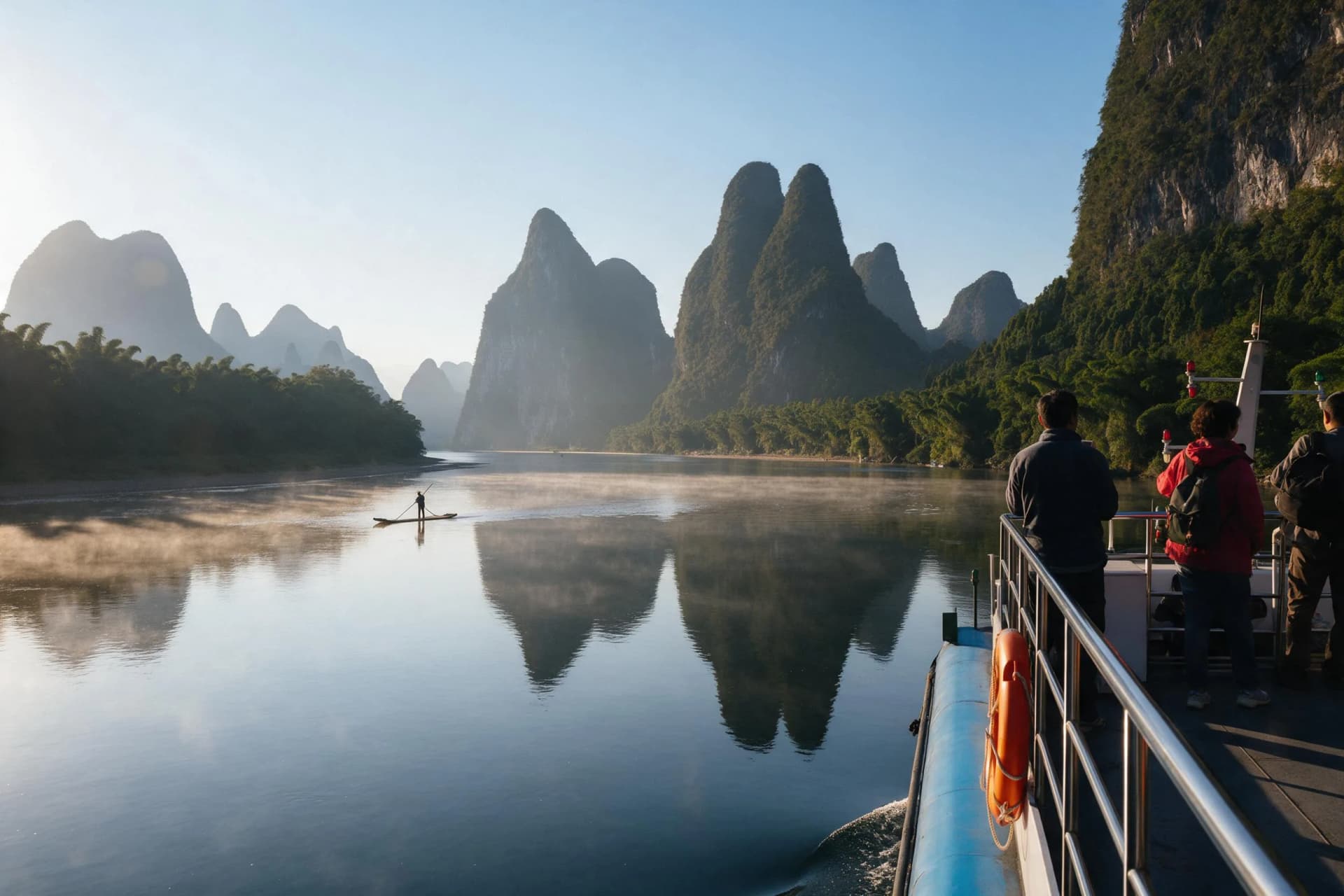
The Li River cruise is the classic four-hour run from Guilin to Yangshuo, past limestone towers, bamboo rafts and the bend printed on China's 20-yuan note. This guide covers boat classes and prices, the piers, the mist and clear-light seasons, what to photograph from the deck, and how to spend a night in Yangshuo before heading back.
Every Li River cruise begins with a small betrayal: for the first forty minutes, the view is ordinary. The boat pulls away from Zhujiang or Mopanshan pier outside Guilin, slides past low green banks, and the passengers who rushed to the rail drift back to their seats. Then the limestone starts. One tower, then five, then a whole drowned mountain range standing in the water, and the deck goes quiet. I have watched this happen a dozen times, and it never stops being the best part: the moment a river full of strangers realizes they are not on a boat tour at all. They are moving through a landscape that has been painted, printed and photographed for a thousand years.
The cruise is a one-way run from Guilin down to Yangshuo, and your boat class decides which pier you leave from. Three-star boats depart from Mopanshan Pier for CNY 215 per adult; four-star boats leave from Zhujiang Pier for CNY 360, with better seating, more open deck and a buffet lunch. Both sail the same famous stretch of river. Departures cluster between 9 a.m. and noon, and the passage takes three and a half to five hours depending on how fast the water is moving. Book through the official ticket office or a licensed operator, and check the pier printed on your confirmation before you arrange a transfer, because the two piers sit on different roads about 27 and 28 kilometers from Guilin Railway Station.
If you came for photographs, the calendar matters more than the boat. Aim for a September-to-November departure: the water is stable, the air is clear, and the late-morning sun rakes across the peaks instead of flattening them. April to June is the mist season, when cloud hangs between the towers and the river turns silver-gray; the pictures are moodier and the rain is real, so bring a shell and a dry cloth. Winter brings low water, and from January through March boats sometimes start downriver at Yangdi instead of Guilin because the full route is too shallow. Take the earliest departure you can get, stand on the top deck, and let the weather be part of the picture rather than a reason to stay in the cabin.
The single most famous frame on the whole river is the one printed on the back of China's 20-yuan note: the bend at Xingping, where Yellow Cloth Shoal spreads a wide reflection beneath a cluster of peaks. Cruise boats slow there, and every phone on board rises at once. The trick is to shoot the whole scene rather than the crowd. Step to the stern, use the boat's wake as a leading line, and wait for a bamboo raft to cross the reflection. A little earlier on the same stretch, Nine Horse Mural Hill presents a limestone wall that is said to hide nine horses in its markings; guides will ask you to find them, and the game is worth playing.
The peaks themselves are the real story, and they are far older than they look. This is karst country: soluble limestone laid down as seabed, then dissolved by rainwater into towers, caves and sinkholes over millions of years. Local names lean on the shapes, so you pass a hill that reads as a camel, another as a brush rest, another as a sleeping general. Near Yangdi you may see cormorant fishermen posing on bamboo rafts; the birds are real, the fishing is mostly for cameras now, and a small tip is the honest way to handle it.
On board, the day has its own rhythm. Lunch is served about halfway, the upper deck fills through the middle hours, and the light softens as the river nears Yangshuo. Pack less than you think: one camera or phone, a lens cloth, a hat, a light rain shell, and cash for the odd raft or snack. Travelers with children or grandparents usually find the four-star boats easier, thanks to indoor seating and shade, while photographers who want an open rail often prefer the three-star boats, where the crowd at the rail is thinner. Do not spend the whole trip behind the screen. Put the phone down for the last hour.
The boat docks in Yangshuo, and the town is a different animal: busy, walkable and very good after dark. Stay at least one night. West Street is the obvious evening, but the better mornings are on the Yulong River, where bamboo rafts drift between rice paddies about thirty minutes from town, and in the old stone lanes of Xingping, which keeps a quieter version of the same scenery. Buses and trains both run back toward Guilin, so you can return the next day instead of doubling back on the water.
Tell ChinaMira your dates and what you want from the river, whether that is the mist of spring, the clear light of October, a shaded seat for a parent who does not walk far, or a deck rail at first light. We will match you to the right boat class and pier, arrange the transfer, and build the rest of Guilin around the water. We book the cruise, the Yangshuo overnight and the Longji rice terraces as one trip, and we check the season before we fix your dates. Come for one of the most beautiful cruises in China. Stay because the river keeps changing on you.
Good to know
- Boats and tickets
- Three-star boats leave from Mopanshan Pier at CNY 215 per adult; four-star boats leave from Zhujiang Pier at CNY 360, with more deck space and a buffet lunch. Children 1.2-1.5 m pay about CNY 108 (three-star) to CNY 180 (four-star).
- Timing and piers
- One-way Guilin to Yangshuo, three and a half to five hours depending on water speed, with departures between 9 a.m. and noon. Mopanshan Pier is 27 km and Zhujiang Pier 28 km from Guilin Railway Station, on different roads.
- Best months
- September-November for stable water and clear light; April-June for mist and green hills; July-August hot, wet and crowded; December-February cool and quiet, with low water possible.
- Water levels
- January-March low water can shorten the route so boats start at Yangdi instead of Guilin; May-July high water occasionally suspends sailings. Confirm the route and pier when you book.
- The 20-yuan view
- The banknote scene is the Xingping bend at Yellow Cloth Shoal, roughly two-thirds of the way to Yangshuo. Nine Horse Mural Hill comes earlier on the same stretch.
- Booking
- Reserve through the official Li River ticket office or a licensed operator, carry the passport you booked with, and check which pier your confirmation names before arranging a transfer.
Frequently asked questions
How much does the Li River cruise from Guilin to Yangshuo cost?
CNY 215 per adult buys a three-star boat from Mopanshan Pier, and CNY 360 buys a four-star boat from Zhujiang Pier; both cover the same scenic stretch, and the four-star fare adds more deck space and a buffet lunch. Children measuring 1.2 to 1.5 meters pay a reduced fare of about CNY 108 to CNY 180, and operator service fees, pier transfers and extra lunch items push the total above the base ticket.
How long is the Li River cruise, and when do the boats depart?
Three and a half to five hours is the published range for the one-way Guilin-to-Yangshuo run, depending on water speed, with departures clustered between 9 a.m. and noon. In the low-water months of January through March the full route is sometimes too shallow, so boats start at Yangdi instead of Guilin, while high water from May through July can occasionally suspend sailings entirely.
When is the best time of year to cruise the Li River?
September to November gives the clearest and most reliable conditions, with stable water and clean light for photographs. April to June is the mist season, when cloud settles between the karst towers and the river photographs in soft gray; July and August are hot, wet and crowded, and December through February is cool, quiet and prone to low water that can shorten the route.
Where is the 20-yuan note view, and is it on the cruise route?
Roughly two-thirds of the way through the four-hour Guilin-to-Yangshuo cruise, the boat reaches the bend at Xingping, where Yellow Cloth Shoal mirrors the cluster of karst peaks printed on the back of China's 20-yuan note. Boats slow there, so keep a camera ready and shoot from the stern for the cleanest reflection; Nine Horse Mural Hill comes a little earlier on the same stretch.