
Huangshan Travel Guide: Peaks, Pines and the Sea of Clouds
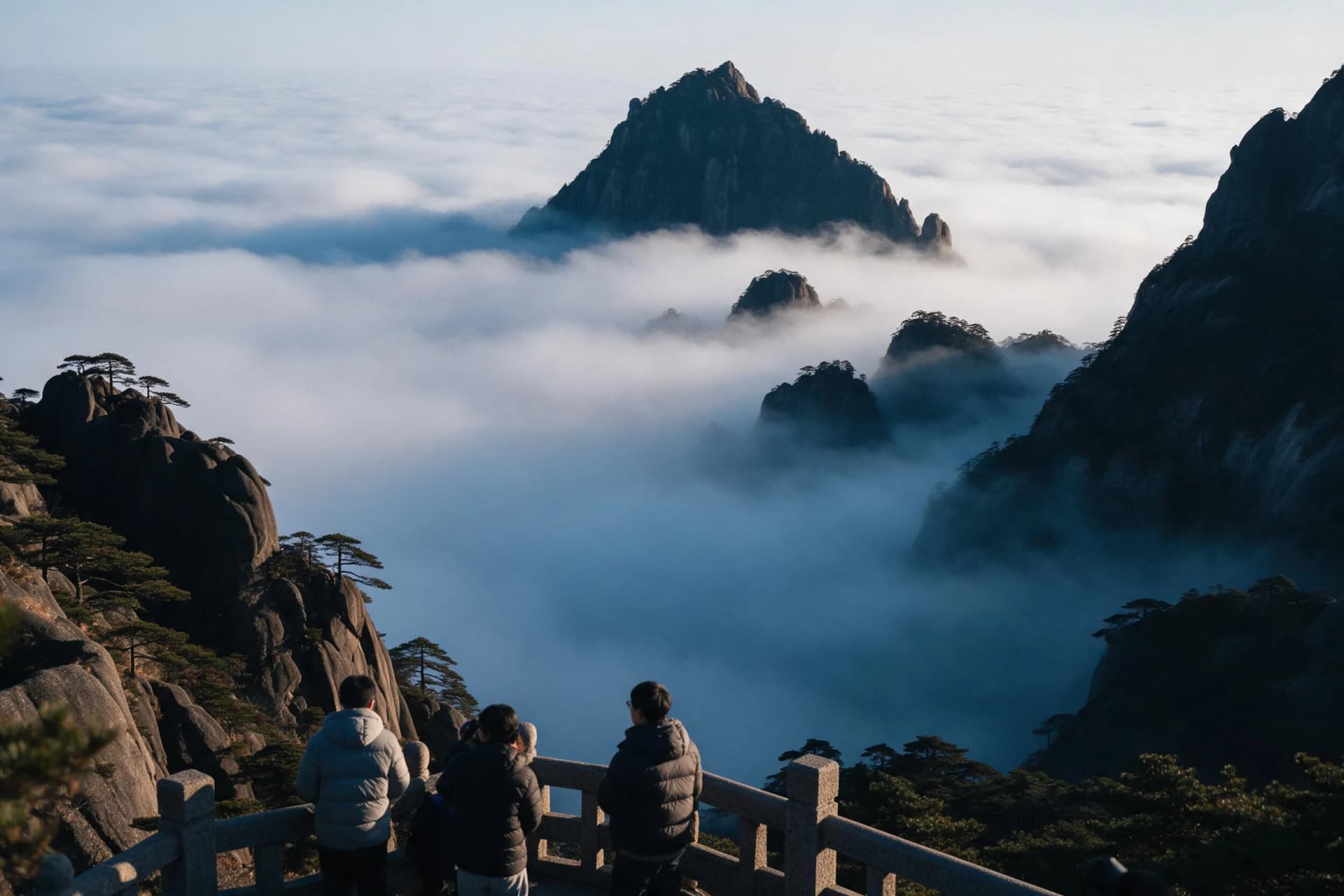
Huangshan, the Yellow Mountain, is China's most painted landscape: granite peaks, wind-shaped pines above a sea of clouds, and the white-walled Huizhou villages of Hongcun and Xidi at its feet. This guide covers when to go, how to ride the cable cars, where to sleep for sunrise, what tickets cost, and how to pair the mountain with Anhui's food and history.
The cable car lifts off from Yungu Station, and within a few minutes the world you drove through — tea fields, tiled roofs, a road full of tour buses — drops away into cloud. The doors open high on the ridge and Huangshan begins: black granite needles stacked like brushstrokes, pines growing sideways out of bare rock, and stone steps climbing into white. Nobody talks for the first minute. Everyone is doing the same slow turn, trying to find the view they have seen in a hundred ink paintings. Then you realize you are standing inside it.
Huangshan means Yellow Mountain, and it sits in southern Anhui, about 400 kilometers southwest of Shanghai. The scenic area is a compact knot of more than seventy named peaks, the highest of them Lotus Peak at 1,864 meters, though it is periodically rested and closed for ecological recovery. Bright Summit, at 1,860 meters, is the highest point most visitors reach. In 1990 UNESCO inscribed Mount Huangshan as a mixed cultural and natural World Heritage Site, a rare double listing that recognizes both the geology and the centuries of poetry and painting the landscape inspired.
Four wonders define the mountain. First the pines, gnarled and flattened by wind and ice, most famously the thousand-year-old Guest-Greeting Pine leaning out over the walkway near Yuping. Second the rocks, granite forms that Chinese tradition names after animals and gods — Monkey Gazing at the Sea, Flower Blooming on a Rock. Third the hot springs at the foot, used for centuries and still soaking tired legs. Fourth the sea of clouds, the phenomenon that turns the valleys into a white ocean and the peaks into islands. Winter adds a fifth pleasure: snow and rime ice, when the pines turn to white coral.
Getting there is easier than most people expect. High-speed trains run to Huangshan North Railway Station in roughly three hours from Shanghai and about ninety minutes from Hangzhou, and the station connects by bus or taxi to Tangkou, the town at the scenic area gate, about an hour away. From Tangkou, shuttle buses climb to the cable car bases. If you are coming from further afield, fly into Huangshan Tunxi International Airport, or take the train from Beijing or Guangzhou and treat the ride as part of the trip.
You do not have to be a hiker to love this mountain, but you do have to respect the stairs. Three cableways — Yungu, Yuping and Taiping — remove most of the climbing, and each one runs on its own schedule and closes in high wind. A classic two-day route rides Yungu up, walks the ridgeline past Beginning-to-Believe Peak, sleeps near the summit, catches sunrise at Refreshing Terrace or Bright Summit, then descends through the West Sea Grand Canyon and out by the Taiping cableway. The canyon loop adds several hours of steep, magnificent stair work. Hiking poles and grippy shoes matter more than fitness here.
Where you sleep changes what you see. Summit hotels are basic, expensive and worth it: staying up high means you are at altitude before dawn instead of queuing for the first cable car in the dark. Budget travelers base themselves in Tangkou, where rooms are cheaper and the food is better, and accept a later start. Book summit beds weeks ahead in autumn and winter, and expect shared dormitories or small twins rather than resort comfort.
Below the mountain, the Huizhou villages are the reason many travelers extend their stay. Hongcun, laid out in the shape of an ox with a moon pond at its heart, and nearby Xidi are both UNESCO World Heritage Sites, filled with whitewashed walls, horse-head gables and carved wooden halls. In Huangshan city itself, Tunxi Ancient Street is a lively strip of tea shops, inkstone sellers and snack stalls. Eat Anhui cuisine while you are here: braised stinky mandarin fish, bamboo shoots with cured pork, and hairy tofu straight off the griddle.
Time your visit with the weather you want. October and November bring the clearest skies and turning leaves. December through February offers the best odds of a sea of clouds and the fewest crowds, at the cost of real cold and icy steps. Spring is misty and green, summer is warm, wet and busy. Avoid the October National Day holiday and Chinese New Year if you can. Bring layers, rain gear, a power bank, cash or a working payment app, and patience with the crowds at the classic viewpoints.
Huangshan is not a checkbox stop. It is a mountain you climb early, eat simply on, sleep badly on, and remember for years. Let ChinaMira handle the logistics — summit rooms the moment they open, train seats, a route matched to your knees and your camera, and the villages and hot springs folded in around the climb. Tell us your dates and how far you like to walk, and we will build the trip. Reach out today and start planning your Yellow Mountain.
Good to know
- Best time to visit
- October to November for clear skies and autumn color; December to February for the best chance of a sea of clouds
- Scenic area tickets
- About USD 27 for the scenic area, plus roughly USD 11-14 one way for each cable car; book online in peak season
- Getting there
- High-speed rail to Huangshan North, about 3 hours from Shanghai and 90 minutes from Hangzhou, then bus to Tangkou
- Where to sleep
- Summit hotels for sunrise views, or Tangkou at the gate for cheaper rooms and better food
- Don't miss nearby
- UNESCO villages Hongcun and Xidi, plus Tunxi Ancient Street and Anhui cuisine in Huangshan city
- Good to know
- Lotus Peak closes periodically for ecological recovery; cable cars stop in high wind, so keep a flexible plan
Frequently asked questions
How many days do you need for Huangshan?
Two days and one night is the sweet spot: ride up on day one, sleep near the summit, catch sunrise, then descend through the West Sea Grand Canyon. Add a third day for Hongcun and Xidi villages.
Can you visit Huangshan without hiking much?
Yes. The Yungu, Yuping and Taiping cableways lift you most of the way up, and summit viewpoints such as Bright Summit are a short walk from the stations. Expect stairs, so bring poles and solid shoes.
When is the best time to see the sea of clouds?
Winter offers the best odds, roughly from November through February, when cold fronts settle the cloud layer below the ridgelines. Spring mist after rain is a strong second, and mornings right after a storm are ideal.
What should you pack for Huangshan?
Layer up: a warm mid-layer, windproof shell, rain cover, grippy shoes, walking poles, a headlamp for pre-dawn walks, snacks, water and a power bank. Summit hotels are basic, so bring what you need.
Keep exploring
Plan with ChinaMira
Turn this into a trip
Use this guide as a starting point — we can handle the route, guides, trains and the visa invitation letter.