
Travel Guide
Dali in Three Days: Old Town, Erhai Lake and Cangshan
Three days is the sweet spot in Dali: enough for the old town's lanes and courtyards, a sunrise on Erhai Lake, a Bai village morning, and one big mountain day on Cangshan. This itinerary lays out each day in order, with the transport, tickets, timings, and booking notes that make the route run smoothly.
You feel Dali before you see it. The train from Kunming slides out of the last tunnel, the valley opens, and there it is: a long grey wall of mountain on one side, a flat silver lake on the other, and a small walled town pinned between them. A short ride earlier you were in a provincial capital; now the air smells of pine, wet stone, and charcoal smoke. I have made this trip three times, and the small shock of arrival never fades. Three days is the right dose — long enough to stop checking the clock, short enough that every morning still feels like a discovery.
Give your first day to the old town and nothing else. Dali Ancient Town has no gate ticket; you pay only for what you enter. Its Ming-era walls and gate towers still frame a grid of lanes laid out centuries ago, so start at the South Gate while the stalls are opening, climb Wuhua Tower for the roofscape, then follow Renmin Road and the smaller lanes off it — Fuxing Road for coffee and courtyards, Guangwu Road for quiet stone. In late afternoon, walk 1.5 kilometres north to the Three Pagodas of Chongsheng Temple, where the oldest pagoda stands against the mountain and the brick turns amber for about half an hour before closing. Ticket prices are in the fact sheet. End with dinner inside the walls.
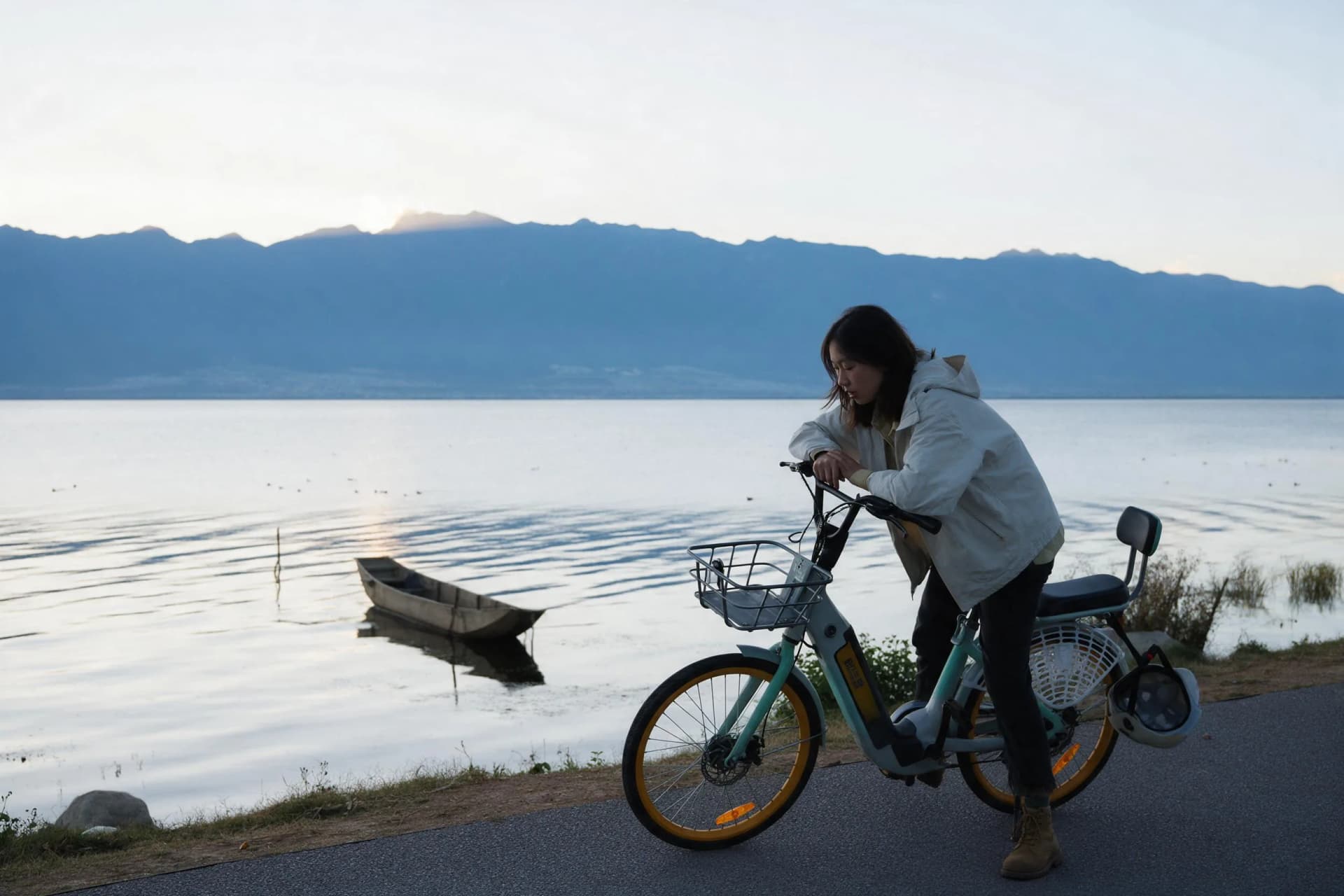
Day two belongs to Erhai Lake, and it starts early. Reach the shore at Longkan or Caicun by first light — around 6:45 in spring and autumn — when the water is glassy, a few fishermen are already out, and Cangshan shifts from grey to rose to gold. Then rent an e-bike and ride a stretch of the ecological corridor, the low path that hugs the shoreline past reed beds and small piers. Do not try to circle the whole lake; its length is in the fact sheet, and the pleasure here is repetition, not distance. Break for lunch in a lakeside village, then push north to Xizhou for the late-afternoon market and an indigo tie-dye workshop where you can print your own cloth. Sleep by the water if you can.
Save your last full day for the mountain. Cangshan is not one peak but a range of nineteen, and the easiest way up is by cableway: the Zhonghe line lands at a temple complex, while the Gantong line climbs higher and faster. From the top station the Jade Belt trail, or Yudai Yunyou Road, runs roughly eleven kilometres across the mountainside at about 2,600 metres, threading waterfalls and pine forest with the lake laid out below. Walk as far as feels good and turn back; the path is gentle but the altitude is real. Fares and the scenic-area ticket are in the fact sheet, and it pays to ride up before mid-morning, when cloud often swallows the ridge. Come down for a late lunch and a last slow dinner.
Food is half the reason to come, and Dali eats differently from the rest of China. On the lane just behind the South Gate, a grandmother grills thin sheets of stretched milk curd over charcoal and finishes them with rose jam for about eight yuan — ask for rushan and eat it standing. In Xizhou, follow the smell of the oven to the flatbread the town is famous for, and let the vendor talk you into the savory one. Our Dali food guide maps the stalls, courtyards, and dishes worth a detour; use it to plan one proper Bai dinner beside the lake. Say bu la if you cannot handle chili.
Dali rewards a slower rhythm than most Chinese destinations. Mornings are clear and quiet, tour buses arrive mid-morning and thin out again by late afternoon, so front-load the famous sights and keep the middle of the day for markets, tea, and the lake path. The dry months listed in the fact sheet bring the sharpest mountain views, while summer afternoons can turn wet quickly, so carry a light shell. The sun is strong even when the air is cool. Cash is rarely needed — Alipay and WeChat Pay work almost everywhere.
Base yourself in Dali Ancient Town for the first night, where dinner and the evening lanes are a step from your door. For the lake day, moving to a guesthouse in Longkan, Caicun, or Xizhou buys you sunrise without an early taxi. Trains from Kunming and onward to Lijiang fill up in peak season, so reserve seats and any Erhai cruise a day or two ahead, and reach the cableway at opening. If you are continuing north, our Lijiang guide picks up where Dali leaves off, and the high-speed rail guide explains how to book and ride the network.
Three days in Dali is not a checklist; it is a pace. Walk the walls at dawn, eat where the smoke is, let a bike or a boat put the lake at eye level, and give the mountain one unhurried morning. If you would rather not assemble the pieces yourself, tell us your dates and what you love, and our ChinaMira specialists will build the Dali stretch around them — trains booked, rooms chosen, a table reserved by the water. Start with our Dali travel guide, then send us your dates.
Good to know
- Getting there
- High-speed rail from Kunming takes about 2–2.5 hours and costs around CNY 155 in second class; Dali station is roughly 19 km from the old town, reached by city bus or taxi.
- Best months
- March–May and September–November for dry, clear days and sharp mountain views; June–August is the rainy green season, and winter nights are cold.
- Tickets to budget for
- Three Pagodas CNY 75; Cangshan scenic area CNY 35 plus Zhonghe cableway CNY 60 round-trip or Gantong CNY 115 round-trip; Erhai cruise CNY 142.
- Where to base
- Dali Ancient Town for lanes and food; Longkan, Caicun, or Xizhou on the lake for sunrise without an early taxi.
- Erhai shoreline loop
- The lakeside road runs about 130 km; pick one 20–40 km stretch by e-bike or bike rather than circling the whole lake.
- Altitude and sun
- Dali sits near 1,970 m and Cangshan's ridge tops 4,100 m; UV is fierce year-round, so pack a hat and sunscreen.
Frequently asked questions
Is three days enough for Dali?
Yes. Three days covers Dali Ancient Town, a sunrise on Erhai Lake, a Bai village such as Xizhou, and a Cangshan mountain day without rushing. Add a fourth day only if you want the full lake loop or a Lijiang extension.
Do I need to book the Cangshan cable car and Erhai cruise in advance?
In peak season, yes. Buy train seats and the Erhai cruise a day or two ahead, and ride the Cangshan cableway early before cloud builds. Current fares are listed in the fact sheet, and skip-the-line planning is part of our service.
How do I get around Dali without a car?
City buses, taxis, and e-bikes cover everything on this route. Bus 8 links Dali station and the old town, taxis are metered in town, and the lakeside corridor is best explored by rented e-bike. A Chinese ride-hailing app makes late returns easy.
What should I pack for a Dali itinerary?
Layers, a sun hat, sunglasses, sunscreen, and comfortable walking shoes. Mornings on the lake and evenings in the old town are cool even in summer, and Cangshan is several degrees colder than the valley floor.