
Attraction
Reed Flute Cave: Guilin's Underground Palace of Stone and Light
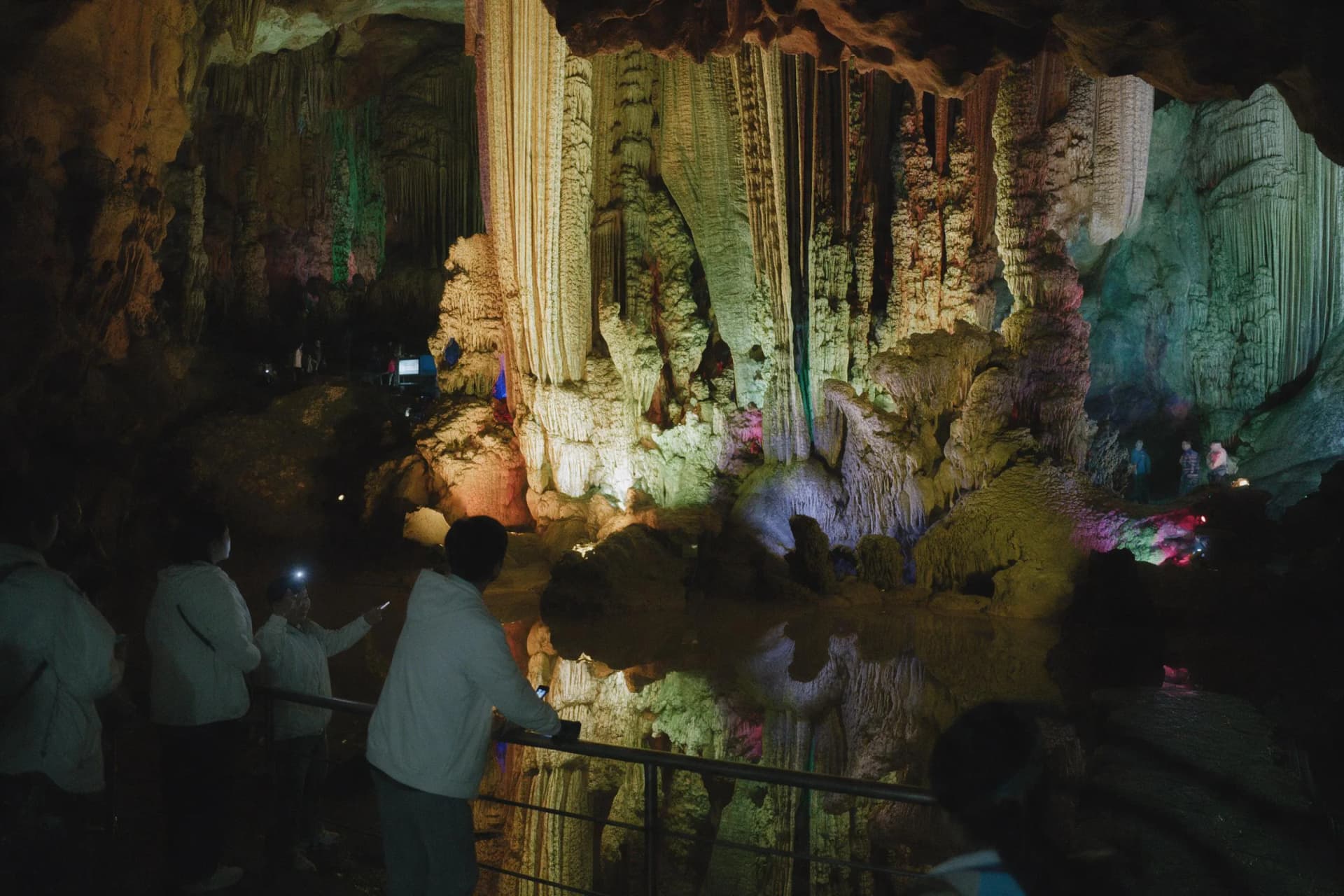
Reed Flute Cave is Guilin's most famous underground attraction — a 240-meter limestone cavern five kilometers northwest of downtown, lit in color and built around the vast Crystal Palace chamber. This warm, story-driven guide covers the cave's 1,200-year history, the rock formations you will actually recognize, and every practical detail: ticket prices, seasonal hours, the entrance most visitors get wrong, how to get there by bus or taxi, and the best time of day and year to have the Crystal Palace nearly to yourself.
The first thing you notice at Reed Flute Cave is the temperature. Guilin may be sweltering outside, but the moment you step through the arched entrance onto the damp stone path, the air settles into a cool, mineral-smelling 18 to 20 degrees Celsius that never changes. The second thing you notice is the light — amber, jade, rose, and deep blue washing over curtains of stone that have been growing in the dark for hundreds of thousands of years. Chinese poets were writing about this cave more than twelve centuries ago.
The cave sits about five kilometers northwest of downtown Guilin, at the foot of a green hill on the western bank of the Peach Blossom River. It takes its name from the reeds growing outside, the kind locals cut and fashioned into simple flutes — you will still see them for sale near the exit, a few yuan each. Inside, water and time have done the real work. Rainwater, made faintly acidic as it filtered through soil, dissolved the limestone over a vast span of millennia and left behind a 240-meter-long cavern packed with stalactites, stalagmites, stone columns, and thin calcite curtains. The walking route is roughly 500 meters, gently graded and one-way.
What makes Reed Flute Cave unusual among China's show caves is how long people have been coming. More than 70 ink inscriptions survive on its walls — poems and travelogues left by visitors, the oldest dated to 792 AD during the Tang dynasty, when the cave was already a destination. Later generations called it the Palace of Natural Arts. It was largely forgotten in the modern era and served as a refuge from Japanese bombing during the Second World War. On February 4, 1962, it opened to the public, and it has since welcomed more than 45 million visitors and over 300 foreign heads of state and government — Richard Nixon walked the route in 1976.
The route unfolds in timed batches, with a guide leading each group and narrating in Mandarin, roughly every fifteen to twenty minutes. You pass a cluster of stalactites lit to look like lions catching a sunrise, then a pair of formations named Pines in the Snow — one of the few where the resemblance needs no help from a story, because the white is mineral, not lighting. A dense stand of stalagmites called the Virgin Forest genuinely reads like a canopy. Flower and Fruit Mountain borrows its name from the Monkey King's home in Journey to the West, and the tiered Dragon Pagoda near the end appears on the most postcards.
Then the path opens into the Crystal Palace, and the cave stops being a cave and becomes a hall. Roughly 3,000 square meters, some 93 meters wide and 18 meters high, it is flat-floored and high-ceilinged enough that it hosted state banquets in the 1960s, with acoustics good enough for the occasional unamplified concert. It arrives about two-thirds of the way through, exactly when tired groups tend to speed up — don't let yours rush you here. The lighting has been upgraded in generations, and the current system adds projected imagery and a sound-and-light program across the dome.
Practical planning is straightforward. Adult tickets run about 90 yuan on-site and slightly less if you book online in advance through the official channel or an authorized ticketing app — reserve by the day before and bring your passport or ID. Opening hours run roughly 7:30 a.m. to 6:00 p.m. from May through October and about 8:30 a.m. to 5:00 p.m. from November through April, with last entry around thirty minutes before closing. The interior is dim, so most phone photos blur unless you brace the camera against a railing. Wear closed, non-slip shoes, since the path is damp in places, and carry a light layer whatever the forecast says.
Getting there is easy. A taxi or ride-hailing car from the city center takes fifteen to twenty minutes, and city bus 3 or 213 drops you at the cave stop. One caution worth repeating: navigating to the "Reed Flute Cave Visitor Center" puts you at the sightseeing-train ticket counter, farther from the cave than it looks on a map — head instead for the entrance ticket office, where a short stairway leads up to the real gate. Go early. Crowds build through the morning and peak around 2 p.m., and because the route runs one direction only, a slow group ahead holds up everyone behind. April, May, September, and October are the kindest months in Guilin, and the cave is a perfect rainy-day plan.
When you climb back into the daylight, give yourself fifteen minutes on the wooden boardwalk that follows Fanglian Pond back toward the parking area — open sky, dripping bamboo, a small waterfall, and the green karst hills you came to Guilin for. If you are hungry, Lujia Village, a small tofu-focused settlement about 1.7 kilometers away, is the local answer to lunch. With half a day rather than an hour, Reed Flute Cave pairs beautifully with Elephant Trunk Hill, Diecai Hill, or Fubo Hill along the Li River. Our ChinaMira travel designers can lock in your entry window, arrange a private English-speaking guide so the stories behind the stone actually land, and fold the cave into a full Guilin day without a wasted minute. Tell us your dates, and we will build the underground morning around you.
Good to know
- Cave basics
- A 240-meter-long limestone cavern about 5 km (3 miles) northwest of downtown Guilin, on the west bank of the Peach Blossom River. The one-way walking route is roughly 500 meters, the widest point is 93 meters across, and ceilings reach 18 meters. Inside, the temperature sits at a constant 18-20 degrees C all year.
- History in brief
- More than 70 ink inscriptions survive on the walls, the oldest dated to 792 AD in the Tang dynasty. The cave opened to the public on February 4, 1962, and has since drawn more than 45 million visitors and over 300 foreign heads of state and government, including Richard Nixon in 1976.
- Crystal Palace and highlights
- The Crystal Palace chamber covers about 3,000 square meters — 93 meters wide and 18 meters high — and hosted state banquets in the 1960s. Watch for Pines in the Snow, the Virgin Forest, Flower and Fruit Mountain and the Dragon Pagoda, now shown with projected imagery and a sound-and-light program.
- Tickets and booking
- Adults pay about CNY 90 at the gate and slightly less when booking online a day ahead through the official channel. Minors aged 6-18 and visitors over 70 pay around CNY 45, and children under 1.2 meters enter free. Reserve by the day before in peak season (April-May and September-October) and carry your passport or ID.
- Opening hours and best time
- May-October: roughly 7:30 a.m.-6:00 p.m. November-April: about 8:30 a.m.-5:00 p.m. Last entry is around 30 minutes before closing, and guides lead groups every 15-20 minutes. April, May, September and October are the mildest months; arrive at opening, since crowds build through the morning and peak near 2 p.m.
- Getting there
- City bus 3 or 213 drops you at the cave, and a taxi or DiDi from central Guilin takes 15-20 minutes for about CNY 20-35. Set your destination to the entrance ticket office rather than the 'Reed Flute Cave Visitor Center', which leaves you at the sightseeing-train counter instead of the real gate.
Frequently asked questions
How much does it cost to visit Reed Flute Cave?
Adult tickets run about CNY 90 at the gate, and booking online a day ahead through the official channel or an authorized ticketing app usually shaves off a few yuan. Minors aged 6-18 and visitors over 70 pay roughly CNY 45, while children under 1.2 meters enter free — bring your passport or ID to claim any discount.
What are Reed Flute Cave's opening hours?
From May through October the cave opens roughly 7:30 a.m. to 6:00 p.m.; from November through April it runs about 8:30 a.m. to 5:00 p.m., with last entry around 30 minutes before closing. Entry moves in guided batches every 15-20 minutes, so arriving in the first hour after opening is the calmest option.
How long should I spend at Reed Flute Cave?
Allow about two hours: the one-way walking route inside is roughly 500 meters and takes 45-60 minutes with the guided group, and the wooden boardwalk along Fanglian Pond outside deserves another 15 minutes. Because groups set off every 15-20 minutes, add a short buffer at the gate.
How do I get to Reed Flute Cave from downtown Guilin?
City bus 3 or 213 stops at the cave, while a taxi or DiDi from the center takes 15-20 minutes for roughly CNY 20-35. Navigate to the entrance ticket office, not the 'Reed Flute Cave Visitor Center' — that pin drops you at the sightseeing-train counter, farther from the real gate than the map suggests.
When is the best time to visit Reed Flute Cave?
April, May, September and October bring Guilin's kindest weather, and the cave is an ideal rainy-day plan because it holds a constant 18-20 degrees C inside. Go right at opening — about 7:30 a.m. in summer, 8:30 a.m. in winter; crowds build through the morning and peak near 2 p.m., so the first batch can leave the Crystal Palace nearly empty for you.