
Attraction
Xi'an Muslim Quarter: Great Mosque, Food Alleys and 2026 Prices
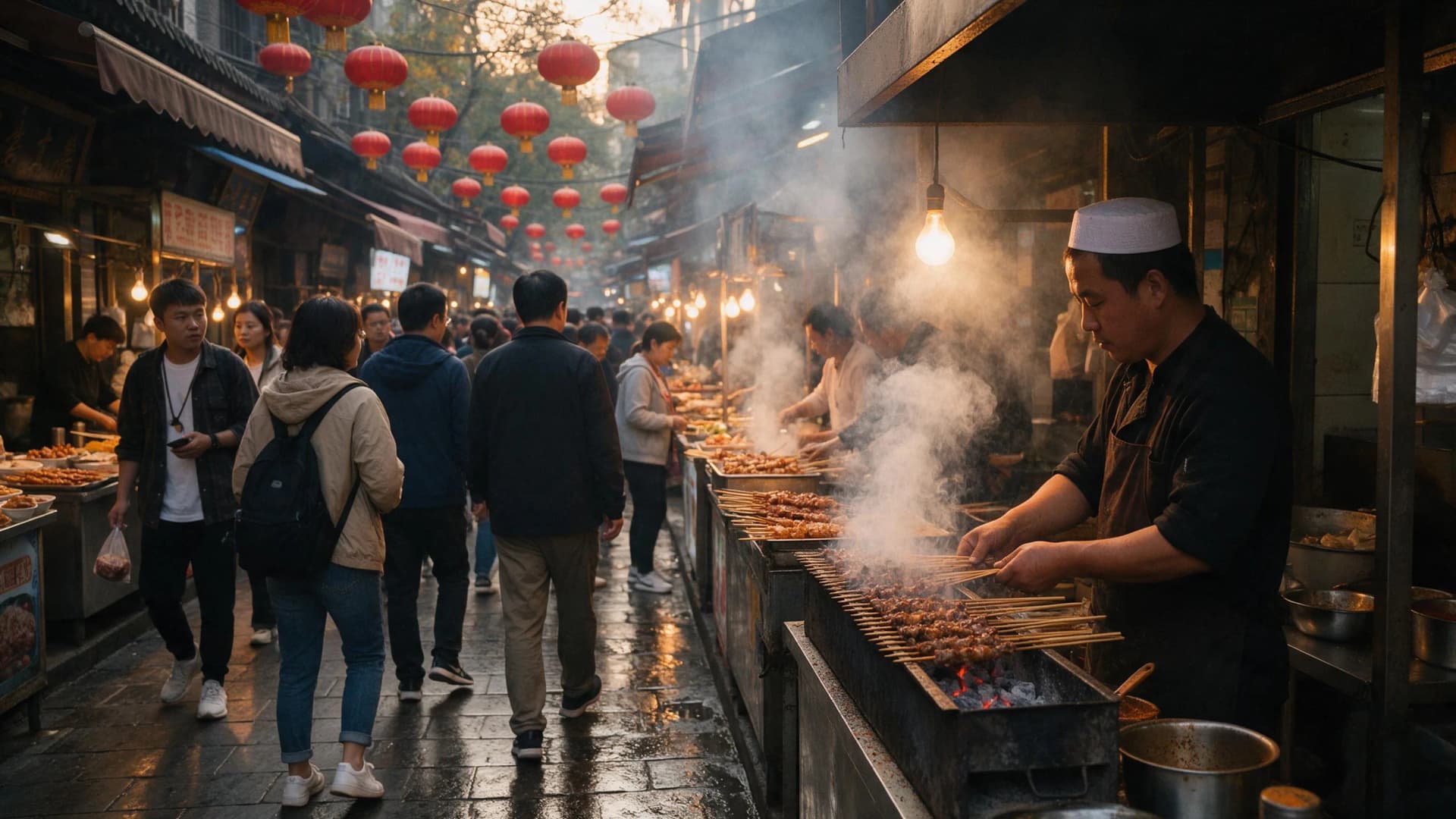
Xi'an's Muslim Quarter is a living Hui neighborhood, not a heritage set piece: ten mosques, thousands of residents, and a lattice of lanes that never closes. This guide walks Beiyuanmen, Dapiyuan and the Sajinqiao morning market, explains the Great Mosque, and shows how to arrive by metro, airport bus or high-speed rail.
The Muslim Quarter is worth three hours of your first Xi'an evening, and walking it costs nothing. The lanes behind the Drum Tower are public streets with no gate and no closing time; the Great Mosque inside them charges CNY 25 from March to November and CNY 15 in winter, with the last entry at closing.
Chang'an, as Xi'an was called, was the eastern terminus of the Silk Road, and the Arab and Persian merchants who settled here in the Tang dynasty formed the Hui community that still owns these lanes. The neighborhood runs from Shehui Road in the east to Zaoci Lane in the west, with West Avenue on its southern edge and Hongfu Street to the north. It holds ten mosques and roughly 60,000 residents, more than half of them Hui, according to a 2010 count. By the Qing dynasty the quarter had settled into a pattern locals call the Three Mosques and Thirteen Blocks.
Beiyuanmen is the neon spine, the lane most visitors mean when they say Muslim Street, and after 18:00 it turns into a slow river of people, smoke and lantern light. Push one street west to Dapiyuan for the older, better cooking, and north to Sajinqiao, which is a morning market rather than a night bazaar. Beiguangji Street sells the sweets: cold cakes, sesame pastries and bowls of sweet fermented-rice soup. The lanes are residential, so keep your voice down after dark, step aside for scooters, and remember that people live above the shops.
You eat standing up, and cheaply. A lamb skewer or a roujiamo — the Hui version is beef or lamb, never pork — costs CNY 5 to 20, and the great sit-down ritual is yangrou paomo, a bowl of dark lamb broth you fill yourself with flatbread torn into pea-sized pieces, for about CNY 25 to 40. Also look for liangpi cold noodles, steamed soup dumplings eaten with a spoon, and youcha mahua, fried dough twists served in oil tea. Everything is halal; the whole quarter is. Carry small notes or set up Alipay or WeChat Pay, because most stalls no longer handle much cash.
The reason the quarter exists sits at the end of Huajue Lane: the Great Mosque, traditionally founded in 742 during the Tang dynasty and rebuilt in its current form in 1392 under the Ming. It covers 1.23 hectares across five courtyards and more than twenty buildings, a garden of pavilions and carved stone rather than domes and minarets, and it remains an active place of worship. Non-Muslims may walk the courtyards but not the prayer hall, and women should cover shoulders and legs; shorts, vests and short skirts are refused at the gate. Friday mornings are reserved for prayers, so plan an afternoon visit.
Come for the light and the appetite. Late afternoon is the sweet spot: the lanes are still workable, the food stalls have fired up, and the mosque catches the low sun. Xi'an sunset falls near 18:10 in mid-October, near 17:40 in mid-December and near 20:00 in mid-June. In summer the mosque stays open until 20:00, so you can be inside for golden hour; in December and January it closes at 18:00, about twenty minutes after sunset. You must leave the mosque at closing — there is no lingering in the courtyards — but the lanes outside belong to the city and stay lively long after.
Getting there is simple. Metro Line 2 stops at Bell Tower, a five-minute walk from the Drum Tower and the head of Beiyuanmen; the first trains reach the station at 06:23 and 06:24, the last pass at 00:19, and peak frequency is about every two and a half minutes. From Xi'an North, Line 2 covers the run in about 23 minutes. The airport shuttle to Bell Tower costs CNY 25 and leaves the airport from 08:50 until 01:00, roughly every 30 to 50 minutes; coming back, it runs 08:20 to 20:20. G trains from Beijing West reach Xi'an North, 1,216 kilometers away, in four hours ten minutes to six hours forty-three minutes, with second-class seats around CNY 480 to 593 on the July 2026 timetable. Book on the 12306 app or website with the same passport you travel on, up to 15 days before departure, and collect nothing — your passport is your ticket at the gate.
Two practical notes. First, photography is welcome but faces deserve a question first, especially of the older Hui residents who have watched the lane change around them. Second, this is a religious neighborhood as well as a market, so dress and behave accordingly, particularly around prayer times. If you are here during Ramadan, expect some daytime closures at smaller eateries and a quieter, more thoughtful atmosphere after dark.
That is the Muslim Quarter: not a museum street but a working neighborhood that happens to serve the best cheap food in Xi'an. Give it an evening, follow your nose off the main drag, and pay the small ticket at the mosque rather than looking for a way around it. ChinaMira can put an English-speaking guide beside you, build a food crawl through Dapiyuan and Sajinqiao, and slot the visit into a bigger Xi'an plan — start with our Xi'an city guide, then pair it with the Terracotta Army, the China food guide and our China photography journeys. Tell us your dates and we will hold the table.
Good to know
- Great Mosque tickets and hours
- CNY 25 March to November, CNY 15 December to February. Open 09:00-20:00 March to November and 09:00-18:00 December to February, and closed to visitors on Friday mornings for prayers.
- Metro Line 2 to Bell Tower
- First trains 06:23 (toward Changninggong) and 06:24 (toward Caotan); last trains 00:19 both directions; peak frequency about 2.5 minutes; single fares CNY 2-7; Xi'an North to Bell Tower about 23 minutes.
- Airport shuttle to Bell Tower
- CNY 25 from Xianyang Airport, departing 08:50-01:00 (west line) and 09:20-00:40 (north line) every 30-50 minutes, about 80 minutes; city to airport 08:20-20:20.
- High-speed rail
- Beijing West to Xi'an North: 1,216 km, 4h10m-6h43m, second class CNY 480-593 (July 2026 timetable). Book on 12306 with your passport up to 15 days ahead; your passport is your ticket at the gate.
- Street-food prices
- Skewers, roujiamo and snacks CNY 5-20; a sit-down bowl of yangrou paomo about CNY 25-40; every stall takes Alipay or WeChat Pay.
- Sunset and closing
- Sunset near 18:10 mid-October, 17:40 mid-December and 20:00 mid-June. The lanes are public streets open 24 hours; the Great Mosque admits visitors only until closing, with no after-hours access.
Frequently asked questions
Is the Xi'an Muslim Quarter worth visiting?
Yes, and it does not need a full day. Give it two to three hours, or a whole evening if you plan to eat your way from Beiyuanmen into Dapiyuan. It is a living Hui district, not a rebuilt heritage street, and it is at its most atmospheric after 18:00, when the lanterns come on and the grills start smoking.
What should I eat in the Xi'an Muslim Quarter?
Start with yangrou paomo, the lamb-and-flatbread soup you assemble yourself, then work through roujiamo, liangpi cold noodles, steamed soup dumplings and lamb skewers. Beiguangji Street is best for sweets. Everything is halal, so the roujiamo here is beef or lamb, and noodle and vegetable dishes suit most diets.
When is the Muslim Quarter least crowded?
Mornings before about 10:00 are calmest, and Sajinqiao is at its best then; the lanes fill from late afternoon and are shoulder to shoulder after 18:00. Weekdays are easier than weekends, and the days around Chinese New Year and the first week of October are the busiest of the year.
How do I get to the Muslim Quarter from Xi'an North Railway Station?
Take Metro Line 2 to Bell Tower and follow the signs for the Drum Tower; the walk into Beiyuanmen takes about five minutes. Buy a single-journey ticket from the machine or tap Alipay or WeChat Pay at the gate, and keep your passport with you, because long-distance rail tickets are tied to it.
Do I need to book the Great Mosque in advance?
No — buy at the gate on the day, with cash or a mobile payment app, and expect a short queue on weekend afternoons. Non-Muslim visitors may explore the courtyards but not the prayer hall, and shoulders and legs should be covered. The mosque is closed to visitors on Friday mornings for prayers.