
Travel Guide
What to Pack for China's Airports, Trains and Metros in 2026?
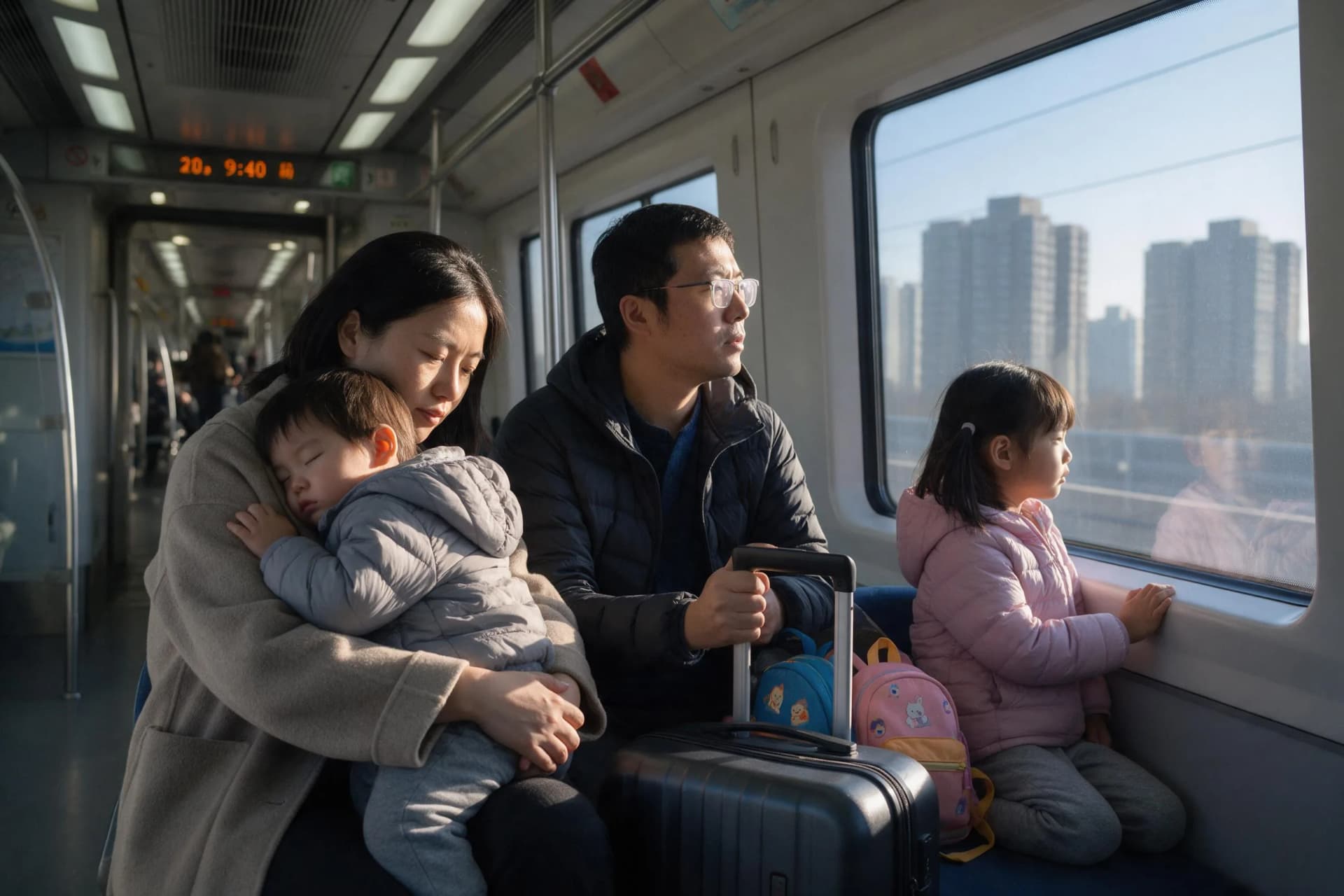
Packing for China is really packing for the journey between places: airport expresses, maglevs, city-center rail stations, metros and taxis, each with its own size and power rules. This guide pairs the arrival fares and transfer times with the carry-on limits, power bank rules and daypack items that keep a family moving from the gate to the guesthouse.
Pack for the journey, not just the destination: in 2026 a family can land in Beijing, ride the CNY 25 Capital Airport Express into town in about 25 minutes, then roll onto a high-speed train with 20 kg of free carry-on each. One 20-inch soft bag and a daypack per person is the whole system.
How you land decides what you carry. Beijing Capital (PEK) is the value arrival: the Capital Airport Express is a flat CNY 25, runs about every 10 minutes, and reaches Dongzhimen in about 25 minutes or Terminal 2 in about 30, from 6:00 a.m. to 10:30 p.m. Daxing (PKX) sits 46 km south, so its express matters more: CNY 35 standard or CNY 50 business, 19 to 25 minutes from Caoqiao, every 8 to 10 minutes. A taxi from Capital to Tian'anmen runs CNY 100 to 140 for 30 km; from Daxing, roughly CNY 180 to 250 for 50 km.
Shanghai hides the country's fastest transfer. The maglev covers the 30 km from Pudong (PVG) to Longyang Road in a published 7 minutes 20 seconds for CNY 50, or CNY 40 with a same-day boarding pass; Metro Line 2 reaches People's Square for about CNY 7 in about an hour. The Airport Link Line joins Hongqiao and Pudong in 40 minutes for CNY 26, with fares from CNY 4. Hongqiao sits 13 km from downtown, a 30-minute, CNY 100 to 150 taxi ride, while a Pudong taxi downtown is about CNY 180.
Rail arrivals put you in the city center, which changes the packing math: Beijing South and Shanghai Hongqiao both sit on the metro. China Railway allows 20 kg of free cabin luggage per adult, 10 kg per child and 35 kg for diplomats, with a single item measuring up to 130 cm in total on high-speed EMU trains, 160 cm on older trains, and 20 kg maximum per bag. One 20-inch spinner plus a soft daypack clears every limit, fits the overhead rack and survives a station escalator. Book on 12306 with your passport, then scan that passport at the gate.
Power banks are the one item that can strand you. Since July 2025, China Railway permits a single power bank rated at no more than 100Wh per passenger, and station security checks capacity rather than the 3C mark. Domestic flights are stricter: since June 28, 2025, they ban power banks without a 3C label, with an unclear label, or from a recalled batch, and the bank must travel in the cabin. A 10,000 mAh bank is roughly 37Wh, comfortably inside both rules.
Once you are in town, local movement is cheap and mostly paperless. Beijing and Shanghai metro fares start at CNY 3 for trips up to 6 km, and downtown Shanghai buses cost CNY 2. Taxis flag down at CNY 13 for the first 3 km in Beijing and CNY 14 in Shanghai, then CNY 2.3 and CNY 2.7 a kilometer; Shanghai adds 30 percent from 11 p.m. to 5 a.m. DiDi, Amap and the ride-hailing buttons inside Alipay and WeChat accept foreign cards, and Shanghai's gates take tap-to-ride Visa and Mastercard.
Set up money and internet before the plane, because both are hard to fix at altitude. Bind a Visa, Mastercard, JCB, Diners Club or Discover card to Alipay and WeChat Pay: payments under CNY 200 carry no service fee, amounts above that cost 3 percent, and the limits are USD 5,000 per transaction and USD 50,000 a year. Carry CNY 300 to 500 in small notes as backup. For the internet, install an eSIM or enable international roaming before departure, and set up any VPN at home, since Google, WhatsApp and Instagram are blocked on the mainland.
The transit day has its own packing list, and families feel it first. Keep passports, a paper copy and your hotel's name and address in Chinese in one zipped pocket; add tissues, because many station restrooms supply no paper, and a refillable bottle, because hot-water dispensers are everywhere on trains and in stations. Slip-on shoes speed the security line, a folding stroller rides free on the railway, and a labeled multi-port charger plus a universal adapter covers 220V type A, C and I sockets. Give each child a small backpack with water, snacks and a light layer, then pack half of what you laid out.
China rewards travelers who pack for the moving parts. Start with our China high-speed rail guide to book the seats, our airport-to-city transfer guide to match your flight to the right train or taxi, and our DiDi guide so the first ride is the easy one. Read the packing guide for climate layers, set up payments with our Alipay versus WeChat Pay walkthrough, and browse family journeys for routes built around children. Tell ChinaMira your arrival airport, train times and children's ages, and we will build the trip around how you actually move.
Good to know
- Beijing airport expresses
- Capital Airport Express: flat CNY 25, Dongzhimen to Terminal 3 about 25 minutes and Terminal 2 about 30, every 10 minutes, 6:00 a.m. to 10:30 p.m. Daxing Airport Express: CNY 35 standard and CNY 50 business, Caoqiao to the terminal 19 to 25 minutes, every 8 to 10 minutes, 5:30 a.m. to 10:30 p.m. Monday to Saturday and to 11:00 p.m. Sunday.
- Shanghai airport transfers
- Maglev: 30 km from Pudong to Longyang Road in a published 7 minutes 20 seconds, CNY 50 one way or CNY 40 with a same-day boarding pass. Metro Line 2 to People's Square about CNY 7 and about 1 hour. Airport Link Line between Hongqiao and Pudong 40 minutes and CNY 26, with a minimum fare of CNY 4. Pudong taxi downtown about CNY 180; Hongqiao is 13 km out, CNY 100 to 150 in about 30 minutes.
- High-speed rail luggage
- Free cabin luggage is 20 kg per adult, 10 kg per child and 35 kg for diplomats; a single item may weigh up to 20 kg and measure 130 cm in total on high-speed EMU trains, or 160 cm on older trains. Foldable wheelchairs are exempt, and tickets are booked with a passport on 12306.
- Power banks: train vs plane
- China Railway allows one power bank rated up to 100Wh per passenger (guidance issued July 2025). Since June 28, 2025, domestic flights ban power banks without a clear 3C label or from recalled batches, and the bank must travel in the cabin. A 10,000 mAh bank is roughly 37Wh.
- Metro, bus and taxi
- Beijing and Shanghai metro fares start at CNY 3 for trips up to 6 km; downtown Shanghai buses cost CNY 2. Beijing taxis flag down at CNY 13 for the first 3 km then CNY 2.3 per km; Shanghai taxis start at CNY 14 then CNY 2.7 per km, with a 30 percent surcharge from 11 p.m. to 5 a.m. Shanghai has proposed a 2026 fare review that would raise average metro fares by about CNY 1.
- Payment and visa
- Alipay and WeChat Pay link Visa, Mastercard, JCB, Diners Club and Discover cards: no service fee under CNY 200, 3 percent above, with a USD 5,000 per-transaction and USD 50,000 annual limit. The 240-hour (10-day) visa-free transit, in force since December 17, 2024, covers eligible travelers flying onward to a third country.
Frequently asked questions
How much does it cost to get from Beijing or Shanghai airport to the city?
Beijing Capital's express is a flat CNY 25 to Dongzhimen in about 25 minutes, and Daxing's is CNY 35 to Caoqiao in 19 to 25 minutes. In Shanghai, the maglev covers 30 km from Pudong to Longyang Road in 7 minutes 20 seconds for CNY 50, or take Metro Line 2 for about CNY 7 in about an hour.
Can I take a power bank on Chinese trains and domestic flights?
On trains, one power bank rated up to 100Wh per passenger is allowed as of July 2025, and security checks capacity rather than the 3C mark. On domestic flights, since June 28, 2025, banks must carry a clear 3C label and travel in the cabin; a 10,000 mAh bank is roughly 37Wh.
How much luggage can I bring on a high-speed train in China?
China Railway allows 20 kg of free cabin luggage per adult and 10 kg per child, with a single item capped at 20 kg and 130 cm in total dimensions on high-speed EMU trains, or 160 cm on older trains. Folding strollers ride free, and you book with your passport on 12306.
What should I keep in my daypack on arrival day in China?
Pack passports with a paper copy, your hotel's name and address in Chinese, tissues, a refillable water bottle, a universal adapter for 220V type A, C and I sockets, and one 10,000 mAh power bank. Slip-on shoes speed the security line, and a folding stroller rides free on trains.
Do I need cash or a transit card in China in 2026?
Carry CNY 300 to 500 in small notes as backup, but plan on mobile payment: Alipay and WeChat Pay charge no fee under CNY 200 and 3 percent above, with a USD 5,000 per-transaction and USD 50,000 annual limit. Metro fares start at CNY 3 in Beijing and Shanghai.