
City Guide
Lhasa & Nyingchi Travel Guide: Tibet's Holy City and Green Valley
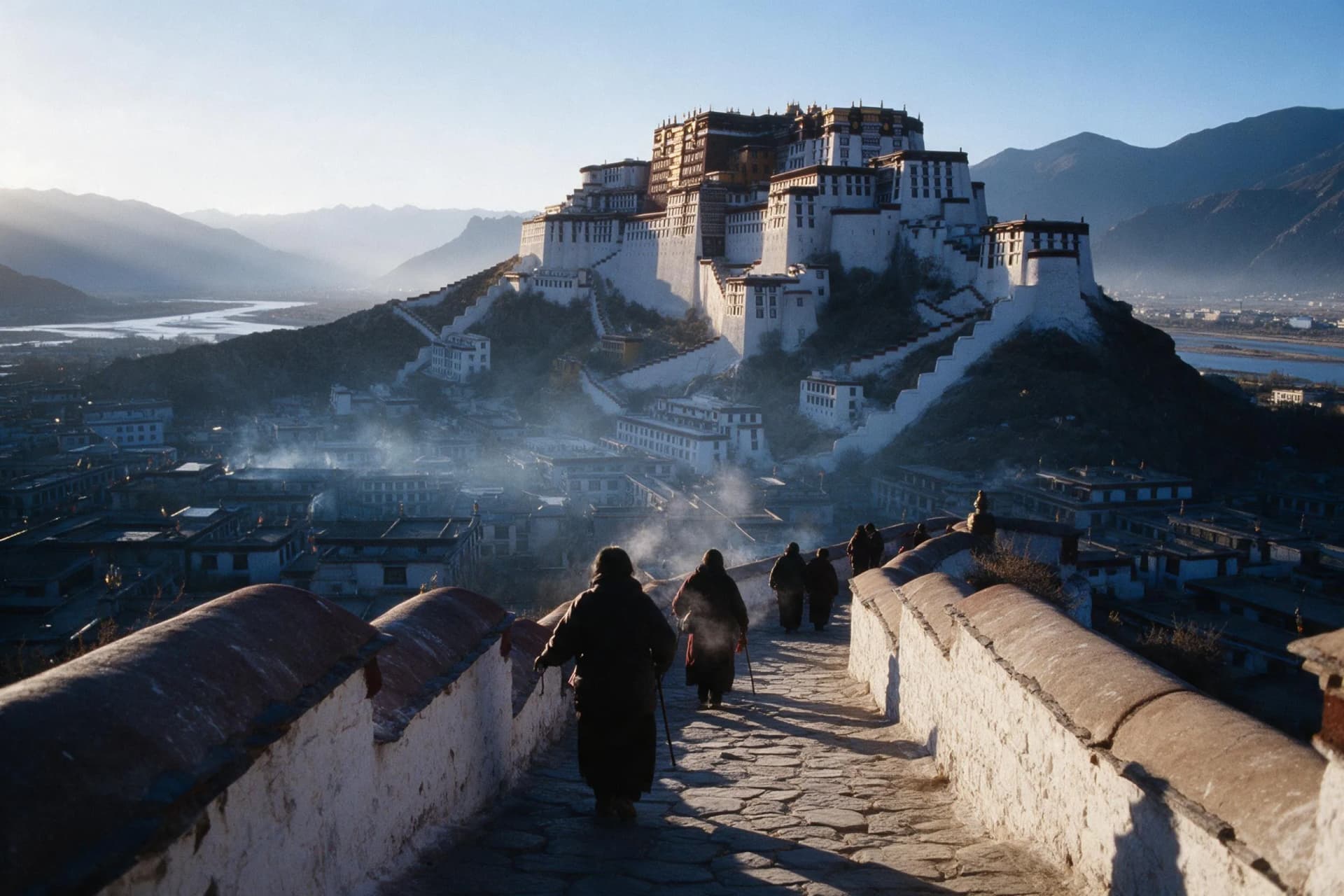
Lhasa and Nyingchi are two sides of Tibet: a high, holy city of palaces and pilgrimage at 11,975 feet, and a greener, gentler valley to the southeast where the Yarlung Tsangpo cuts the world's deepest canyon and wild peach trees bloom each spring. This guide covers what to see in each, how altitude and permits really work, the fast new railway between them, and the best months to go.
Your first hour in Lhasa teaches you something no photograph can. The plane banks over bare brown ridges, the cabin door opens onto air so thin and bright it feels filtered, and the city sits below at 11,975 feet (3,650 meters) above the sea. Walk slowly. On that first afternoon, the wisest thing you can do is almost nothing: check into your hotel, drink water, skip the beer, and let your body catch up with the altitude while you watch the light move across the hills. Lhasa rewards patience, and it punishes hurry.
Give your clearest morning to the Potala Palace. Built in the 17th century on the Red Hill and rising thirteen stories in white and deep crimson, it was the winter home of the Dalai Lamas and remains the symbol of Tibet. You climb long stone staircases between painted eaves and golden roofs, past chapels thick with the smell of butter lamps, and the altitude makes every landing a small victory. Tickets are timed and limited, so book through a licensed agency well ahead. Later, walk the Barkhor circuit around the seventh-century Jokhang Temple, joining pilgrims who spin prayer wheels and touch their foreheads to the doors. The temple shelters the Jowo Shakyamuni, Tibet's most revered image, and the surrounding lanes smell of juniper, yak butter, and sweet tea.
Lhasa's monasteries are living places, not museums. At Sera Monastery, founded in 1419, monks still gather in the courtyard in the afternoon to debate Buddhist logic with loud claps of the palms. At Drepung, once the largest monastery in the world, white buildings spill down the hillside like a small town. Between visits, eat simply and well: yak butter tea if you are brave, sweet tea if you are not, tsampa (roasted barley flour) mixed by hand, and steaming plates of momos.
Altitude is the one thing you cannot charm. Symptoms of acute mountain sickness — headache, nausea, dizziness, breathlessness at rest — usually ease after a day or two, but they deserve respect. Drink more water than feels necessary, avoid alcohol and heavy meals at first, keep your first days gentle, and tell your guide immediately if you feel worse rather than better. Foreign visitors also need a Tibet Travel Permit arranged in advance through a licensed agency, and a separate Alien's Travel Permit for travel beyond Lhasa, which includes Nyingchi. You cannot simply buy a ticket and go; you travel with an organized tour, and your documents are checked at road and rail checkpoints. Plan two to three weeks ahead.
The journey southeast to Nyingchi used to be a long, rough drive. Since the Lhasa-Nyingchi Railway opened in June 2021, it is a comfortable ride of roughly three and a half hours across about 435 kilometers of plateau, with Fuxing trains crossing gorges and the wide braided Yarlung Tsangpo River. You can also fly into Nyingchi Mainling Airport, though the train is far better for acclimatization because you descend gradually. Nyingchi sits around 9,800 feet (3,000 meters) — lower, warmer, and noticeably greener than Lhasa, which is why Tibetans call this region the Switzerland of Tibet.
Nyingchi is a land of water and forest. Basum Tso, also called Draksum Tso, is a jade-colored lake at roughly 12,000 feet, with a small island monastery reached by a short bridge and a ring of snow-dusted conifers around it. Farther east, the Yarlung Tsangpo Grand Canyon slices more than 16,000 feet deep in places — the deepest canyon on Earth — with the unclimbed, 25,531-foot peak of Namcha Barwa standing guard at its eastern end. From Sejila Pass on a clear day you can see Namcha Barwa across the valley; below it, Lulang Forest rolls out in green meadows and spruce. Add the Midui Glacier, one of the lowest and most accessible glaciers in Tibet, and you have a week's worth of landscapes.
Then there is spring. From late March into mid-April, wild Himalayan peach trees erupt across Nyingchi's valleys — pink clouds against snow peaks, green barley fields, and mud-walled farmhouses — and the region celebrates its Peach Blossom Festival. It is the most beautiful and most crowded season, so book hotels and permits early. Autumn, from September through October, is the other sweet spot: crisp air, golden larch, and the clearest mountain views of the year. May and June bring mild days and wildflowers; summer is green but wet, with afternoon rain and occasional road delays.
Pack for four seasons in one day. Mornings and evenings are cold even in summer, midday sun at this altitude burns quickly, and weather turns fast in the mountains. Bring layers, a warm hat, sunscreen, sunglasses, lip balm, and sturdy shoes for monastery stairs and lakeside paths. In winter, Lhasa is dry and often brilliantly sunny with far fewer travelers, though Nyingchi's high passes can close with snow.
A classic route gives you three or four nights in Lhasa to acclimatize and see the Potala, Jokhang, and monasteries, then the train to Nyingchi for three or four nights of lakes, canyon viewpoints, forest, and, in spring, peach blossoms. Let someone who knows the rules handle the permits and the timing, so that your only job is to walk slowly, look up, and let Tibet set the pace. Start planning your Lhasa and Nyingchi journey with ChinaMira, and go when the light is right.
Good to know
- Altitude
- Lhasa sits at 3,650 m (11,975 ft); Nyingchi is about 3,000 m (9,800 ft) and Basum Tso is 3,700 m (12,100 ft). Allow 24-48 hours in Lhasa before tackling monastery stairs, drink more water than feels necessary and skip alcohol for the first 48 hours.
- Tibet permits
- Foreign travellers need a Tibet Travel Permit arranged through a registered agency 15-20 days before departure, plus a separate Alien's Travel Permit for Nyingchi. Permits are checked at road and rail checkpoints, and a licensed guide accompanies you at the major sites.
- Entry tickets
- Potala Palace CNY 200 (May 1-Oct 31) and CNY 100 (Nov 1-Apr 30), closed Mondays from Dec 1, 2025 except public holidays; Jokhang Temple CNY 85; Sera and Drepung monasteries CNY 60 each. Potala entry is timed and capacity-capped.
- Lhasa-Nyingchi railway
- 435-436 km (270 mi) in 3 hours 48 minutes: the daily fast train leaves Lhasa at 07:45 and arrives in Nyingchi at 11:33. Second class CNY 129, first class CNY 206, business class about CNY 452; slower K6831 and K6833 services take 5 hours 1 minute and 5 hours 34 minutes.
- Getting to Lhasa
- Lhasa Gonggar International Airport (LXA) is about 62 km (38.5 mi) south of the city: the airport shuttle costs CNY 30 and takes around an hour, a taxi CNY 130-150 and about 45 minutes. Lhasa Railway Station is 9-10 km from the old city, a CNY 20-30 taxi ride.
- Best months
- Late March to mid-April for Nyingchi's peach blossoms; May and mid-September through October for mild, clear days; July is warmest at 20-28 degrees C. November-February is the sunniest and cheapest stretch, with Potala tickets at CNY 100 and about one precipitation day a month.
Frequently asked questions
Do I need a permit to visit Lhasa and Nyingchi as a foreigner?
Yes. Foreign travellers need a Tibet Travel Permit arranged through a registered agency, normally 15-20 days before departure, plus a separate Alien's Travel Permit for anywhere beyond Lhasa, Nyingchi included. You travel with an organised tour, a licensed guide accompanies you at the major sites, and documents are checked at road and rail checkpoints, so carry your passport everywhere.
Can I visit Tibet independently without booking a tour?
No. Independent travel is not permitted for foreign passport holders: you must book through a registered Tibetan travel agency, which sponsors your permit and supplies a licensed guide. You cannot board a Lhasa flight or train, or check into a hotel, without the permit already in hand, so plan roughly two to three weeks ahead.
How long is the train from Lhasa to Nyingchi and what does it cost?
The fastest daily service takes 3 hours 48 minutes over 435-436 km, leaving Lhasa at 07:45 and reaching Nyingchi at 11:33. Second class costs CNY 129, first class CNY 206 and business class about CNY 452. The route descends gradually and every carriage has piped oxygen, which is far kinder to your body than flying.
When is the best time to see Nyingchi's peach blossoms?
Late March to mid-April is peak bloom, when wild Himalayan peach trees fill Nyingchi's valleys and the region holds its Peach Blossom Festival. Book hotels and permits well ahead because this is the busiest window of the year. Mid-September to October is the other strong season, with golden larch and the clearest mountain views.
How much is a Potala Palace ticket and when is it closed?
Potala Palace tickets cost CNY 200 from May 1 to October 31 and CNY 100 from November 1 to April 30, and entry is timed and capacity-capped. Since December 1, 2025 the palace also closes on Mondays except for national public holidays, so book through the official platform as soon as your travel dates are fixed.