
Attraction
West Lake, Hangzhou: The Lake That Painted China
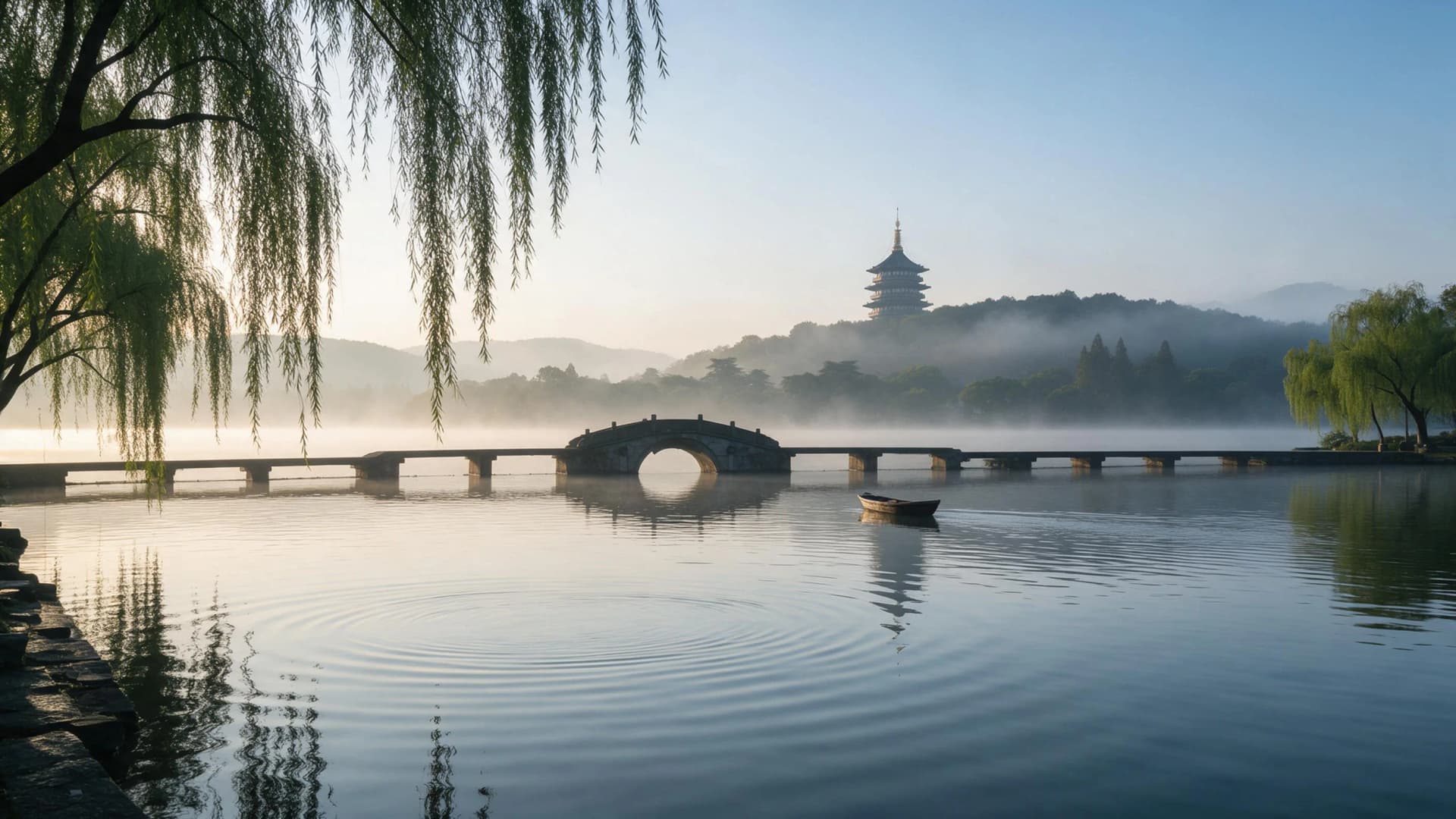
West Lake is the reason Hangzhou exists in the imagination of every traveler who has ever heard the phrase 'above there is heaven, below there are Suzhou and Hangzhou.' A UNESCO World Heritage cultural landscape since 2011, the lake is free, open around the clock, and ringed by causeways, pagodas, temples, and tea hills. This guide covers the Ten Scenes, the Su and Bai causeways, boat rides out to Three Pools Mirroring the Moon, the White Snake legend, the best seasons and hours, and how to see it without the crowds.
At 6:20 on an April morning, West Lake belongs to Hangzhou. Mist sits an inch above the water, the willows along the Su Causeway drip from overnight rain, and an old man walks the stone path with a brush as long as a broom, writing a poem in water on the paving stones. By the time the tour buses arrive, the poem will be gone and the lake will be different — brighter, louder, busier. This is the first rule of West Lake: the hour you choose matters as much as the season, and the early one is always the best.
West Lake lies on the western edge of Hangzhou in Zhejiang province, a freshwater lake of roughly 6.5 square kilometers with wooded hills on three sides and the city on the fourth. UNESCO listed this as the West Lake Cultural Landscape of Hangzhou in 2011. Better still: the lake and its causeways are free and open 24 hours a day. Only the pagodas, temples, gardens, and boats charge admission.
What looks natural is largely the work of poets. West Lake is shallow and silts up easily, and for more than a thousand years its survival depended on governors who dredged it. Bai Juyi, the Tang poet-governor, ordered the first great causeway in the 820s; Su Dongpo, the Song poet-governor, followed in 1089, using the excavated mud to build the 2.8-kilometer Su Causeway and planting it with willows and peach trees. The excess mud was piled into small islands. Almost every beauty spot here began as an engineering problem solved by someone with a good eye.
The classic way to read the lake is through the Ten Scenes of West Lake, poetic names fixed in the Southern Song dynasty in the 13th century and still in use today. Spring Dawn at Su Causeway. Melting Snow on Broken Bridge. Autumn Moon over the Calm Lake. Three Pools Mirroring the Moon. Evening Bell at Nanping Hill. Leifeng Pagoda in Evening Glow. Viewing Fish at Flower Harbor. Twin Peaks Piercing the Clouds. Lotus in the Breeze at Crooked Courtyard. No one sees all ten in a day, and you should not try — pick two or three and let them arrive at their correct hour.
Walk the causeways first. The Su Causeway runs north to south for 2.8 kilometers through the middle of the lake; the shorter Bai Causeway runs a kilometer along the north shore between Broken Bridge and Gushan Hill. Then get on the water. Shared cruises run to Xiaoying Island, home of the Three Pools Mirroring the Moon, a small islet ringed by stone lanterns that hold candles and appear as a second moon on still nights; hand-rowed wooden boats leave from several docks and are the better choice at sunset, when the boatman turns the bow toward Leifeng Pagoda and stops rowing.
West Lake carries stories the way the water carries light. The most famous is the Legend of the White Snake: the snake spirit Bai Suzhen takes human form, falls in love with the scholar Xu Xian, and meets him on Broken Bridge in the rain. The monk Fahai imprisons her beneath Leifeng Pagoda until the pagoda collapses in the legend. The original tower did fall, in 1924; the version standing today was rebuilt in 2002 with escalators inside, and its top gallery gives the finest view over the whole lake.
When you need a break from water, the hills deliver. Lingyin Temple, founded in 328, is one of China's great Buddhist monasteries, reached through a grove of cliffs at Feilai Feng carved with hundreds of Song-era Buddhas. Above the lake, the Longjing tea villages of Longjing and Meijiawu spread green terraces across the slopes where China's most celebrated green tea is still picked by hand; sit down for a cup poured with water just off the boil. Closer in, Flower Harbor is a garden of red carp and peonies, and the tomb of the general Yue Fei draws quiet crowds all year.
Go in spring or autumn. Late March and April bring peach blossom, cherry blossom, and the willows at their freshest; late September through November brings cool air, clear light, and the scent of osmanthus across the whole basin. Summer is hot and humid with lotus in flower; winter is raw and gray, with the rare gift of snow on Broken Bridge. Arrive at dawn or after 5 p.m., skip weekends and Chinese holidays, and take Metro Line 1 to Longxiangqiao, then walk west. Carry your passport for paid sites, set up Alipay or WeChat Pay in advance, and expect modest fees — about 40 RMB for Leifeng Pagoda and 55 RMB for the island cruise, with the lake itself free.
West Lake rewards the traveler who slows down. Two days here — a dawn on the causeway, a boat at sunset, a morning in the tea hills — will stay with you longer than a week of rushing. A ChinaMira travel designer can shape that time properly: a lakeside hotel within walking distance of the water, a private hand-rowed boat booked for golden hour, a tea plantation visit with the farmer, and Lingyin Temple before the gates fill. Tell us when you are coming, and we will put you on the lake at the best hour of its best season.
Good to know
- Entry and opening hours
- Free and open 24 hours, with no ticket gate on the lake, causeways or shoreline parks. Hangzhou removed West Lake's entrance fees in October 2002 and made the Ten Scenes and all lakeside green spaces free in April 2003, the first 5A scenic area in China to do so. The lake covers about 6.5 sq km, and the UNESCO-listed cultural landscape has a core area of 3,322.88 hectares.
- Boat fares (current 2026 prices)
- Island cruise to Xiaoying Island / Three Pools Mirroring the Moon: CNY 70 round trip, including the CNY 20 island admission (children 1.2-1.5 m half fare), sold 08:00-16:00. Round-the-lake hop-on hop-off line: CNY 6-8 per segment or CNY 70 for the full loop, 08:30-16:00. Hand-rowed six-seat wooden boat: CNY 150 per hour, then CNY 75 per half hour, 07:00-18:00 (last order 17:10). Self-drive boat at Broken Bridge: CNY 30 per half hour; row-yourself boat at No.6 Park: CNY 30 per hour.
- Paid sites: Leifeng Pagoda and Lingyin Temple
- Leifeng Pagoda entry is CNY 40 for adults; it is open 08:00-19:00 from 16 March to April, 08:00-20:00 from May to October and 08:00-17:30 from 16 November to 15 March. Since 1 December 2025 the entire Lingyin Feilai Feng Scenic Area (Lingyin, Yongfu and Taoguang temples included) is free, replacing the former CNY 75 combined charge; entry is by real-name reservation at least one day ahead, capped at 35,000 visitors on weekdays, 50,000 at weekends and 65,000 on holidays.
- Getting there
- Metro Line 1 to Longxiangqiao station, then about a 10-minute walk west to the east shore; Hangzhou East railway station is also on Line 1. High-speed trains from Shanghai Hongqiao reach Hangzhou East in roughly 45-70 minutes, second class from around CNY 46. Xiaoshan International Airport is about 30 km east of the lake and connects by Metro Line 19 plus Line 1.
- Best months and hours
- Late March to April for willow green, peach and cherry blossom; late September to November for osmanthus, cool air and clear light. June to August is hot, humid and lotus-filled, while snow on Broken Bridge is rare but spectacular. The calmest hours are 06:00-07:00 and after 17:00; weekends and Chinese public holidays (1-7 October, Lunar New Year) are the busiest.
- UNESCO listing
- The West Lake Cultural Landscape of Hangzhou was inscribed on the World Heritage List on 24 June 2011 at the 35th session of the World Heritage Committee in Paris, becoming China's 41st World Heritage site. It meets criteria (ii), (iii) and (vi), and its six components include the natural hills and water, the 'three sides of hills, one side of city' setting, the 'two causeways, three islands' layout, the Ten Scenes, historic sites and the lake's characteristic plants.
Frequently asked questions
Is West Lake free to visit, and can I walk around it at night?
Yes. The lake, its causeways and the shoreline parks are free and open 24 hours a day. Hangzhou began scrapping West Lake entrance fees in October 2002, when the South Line parks were opened and the lakeside walls removed, and extended free access to the Ten Scenes and all lakeside green spaces in April 2003 - making it China's first free 5A-level scenic area. Only the boats, pagodas, temples and a few gardens charge admission.
How much is the boat ride to Three Pools Mirroring the Moon?
As of February 2026 the shared island cruise to Xiaoying Island, home of Three Pools Mirroring the Moon, costs CNY 70 per person round trip and already includes the CNY 20 island admission; children 1.2-1.5 m pay half. Boats sell tickets from 08:00 to 16:00 at docks including No.1 Park, No.5 Park, Zhongshan Park and Flower Harbor. A private hand-rowed six-seat wooden boat is CNY 150 per hour, operating 07:00-18:00 with the last order at 17:10.
When is the best time of year and time of day to visit West Lake?
Come in late March to April for peach and cherry blossom and the freshest willows, or late September to November for osmanthus scent and the clearest light. Arrive between 06:00 and 07:00, or after 17:00 once the tour coaches have left - the lake is at its most photogenic in the first hour after sunrise. Avoid weekends and Chinese public holidays such as 1-7 October, when the shoreline draws tens of thousands of visitors a day.
Do I still need tickets for Lingyin Temple and Leifeng Pagoda?
Leifeng Pagoda still costs CNY 40 for adults, free for children under 1.2 m, and opens 08:00-20:00 from May to October and 08:00-17:30 from 16 November to 15 March, with ticket sales stopping 30 minutes before closing. Since 1 December 2025 the whole Lingyin Feilai Feng Scenic Area, including Lingyin, Yongfu and Taoguang temples, is free, replacing the old CNY 45 scenic ticket plus CNY 30 temple coupon (CNY 75 total) - but you must reserve a real-name timed slot at least one day ahead through the official 'Hangzhou Lingyin Feilai Feng' mini-program.
How do I get to West Lake from Shanghai or Hangzhou East railway station?
High-speed trains run from Shanghai Hongqiao to Hangzhou East in roughly 45-70 minutes, with second-class tickets from around CNY 46. Hangzhou East is on Metro Line 1, which runs directly to Longxiangqiao station beside the lake; from the exit it is about a 10-minute walk west to the east shore and the Su Causeway. Fares are distance-based and you can tap in with Alipay or WeChat Pay.