
Travel Guide
The Essential Chinese Food Guide for First-Timers
Eating in China is not a side dish to the trip - it is the trip. This warm, story-driven guide for first-timers maps the regional cuisines, names the dishes worth crossing a city for, and explains how to order, what to say, and how to eat well without speaking a word of Mandarin.
My first meal in China was a bowl of noodles in a steamy Chengdu shop the size of a closet. Plastic stools, a kettle of tea, a wall menu I could not read. I pointed at what the man at the next table was eating, held up one finger, and ten minutes later a bowl landed in front of me - slick noodles, chili oil, a scatter of scallions, and a depth of flavor no takeout container back home had ever come close to. That is the thing about eating in China: the food is not just fuel for the sightseeing. It is the sightseeing. Every city, every alley, every breakfast stall is a door into how people actually live.
Chinese food is really a family of cuisines, not a single menu. Cooks here talk about the Eight Great Traditions: Sichuan's numbing heat, Cantonese dim sum and roast meats, Shandong's braises and seafood, Jiangsu and Zhejiang's sweet, delicate sauces, Fujian's broths, Hunan's sharp chili, Anhui's mountain cooking, and more. Geography writes the rules. Wheat, lamb, and vinegar dominate the north; rice, freshwater fish, and greens define the south. Once you see that pattern, menus stop looking random. Order lamb skewers in Xi'an, xiaolongbao in Shanghai, hotpot in Chongqing, and roast goose in Guangzhou, and you are already eating like a local.
Ordering is easier than it looks. Meals are shared family-style: dishes arrive at the table as they are ready, not in courses, and everyone takes from the center. Rice or noodles usually come alongside, and tea is poured freely. In a group, plan roughly one dish per person plus one extra, and lean on vegetables to balance the fried and the fiery. If there is no English menu, a translation app with a camera and a saved photo of the dish will get you there; so will a smile and a point at a neighbor's plate. Be honest about spice - bu la means not spicy, though in Sichuan it is only a suggestion.
Start with the classics, then follow your appetite. Dumplings - jiaozi - are the gateway: boiled, steamed, or pan-fried, dipped in black vinegar and chili. Soup dumplings, xiaolongbao, reward patience; bite a small hole first or you will baptize your shirt. Peking duck in Beijing arrives lacquered and carved tableside, wrapped in thin pancakes with scallion and sweet bean sauce. Mapo tofu hums with Sichuan peppercorn. Chongqing hotpot is a shared pot of bubbling broth where you cook your own vegetables, tofu, and thinly sliced meat. In the northwest, look for hand-pulled biang biang noodles and cumin-dusted lamb; in the south, char siu pork, shrimp dumplings, and silky congee. Order two or three, share everything, and save room.
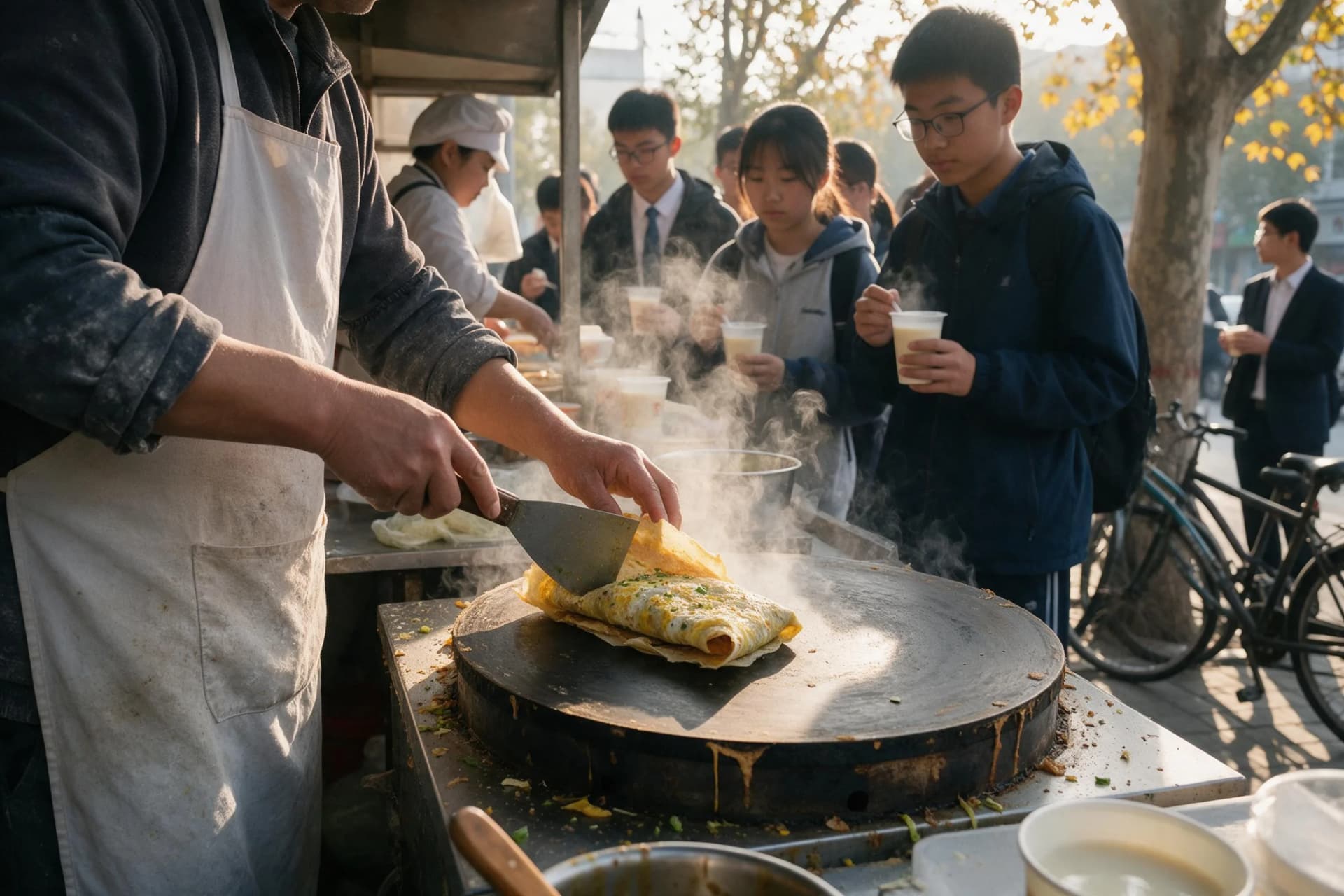
Some of the best eating happens before 9 a.m. Follow the office workers to a breakfast stall: jianbing, a crepe spread with egg, scallion, and a crispy cracker, folded hot into paper; steamed baozi buns; fried dough sticks called youtiao dunked in warm soy milk; and endless bowls of congee with pickles. Street food is generally safe when it is cooked fresh and the stall is busy - high turnover is your friend. Carry tissues and hand sanitizer, drink bottled or boiled water, and be adventurous, but trust your instincts about anything that has been sitting out in the sun.
Travelers with dietary needs can eat very well with a little preparation. Vegetarians should learn wo chi su and watch for meat broth, lard, and oyster sauce hidden in vegetable dishes; Buddhist restaurants near temples are a reliable haven. If you have a peanut or shellfish allergy, carry a translated card stating it clearly and avoid sauces and snacks you cannot verify. Muslim travelers will find halal restaurants, often marked with Arabic script, especially in Xi'an and the northwest. Chopsticks and a spoon are standard - ask for a fork if you need one - and many small restaurants do not supply napkins, so keep a pack of tissues in your bag.
Etiquette is mostly about generosity. Wait for the eldest or the host to start eating, take a little of everything, and never stand your chopsticks upright in rice - it echoes funeral incense. Rest them on the little rack or across your bowl. At a formal meal, toasting matters: raise your glass, say ganbei, and tap the table twice with two fingers to thank someone who pours your tea. The bill is often a friendly wrestling match; if you want to treat, arrange payment quietly with the server beforehand. And when you are full, chi bao le - I have eaten well - is the warmest compliment a table can receive.
Eating your way through China is not an add-on to the trip; it is the trip. Learn ten words, follow the crowds, and say yes to the strange and wonderful thing on the menu. When you are ready to plan around food - a Chengdu hotpot crawl, a Cantonese dim sum morning, a wet market walk with a local guide - the ChinaMira team can build the itinerary, book the tables, and translate the menu. Start with one bowl of noodles. The rest of China will follow.
Good to know
- The eight great cuisines
- Chinese cooking is usually grouped into eight regional traditions: Shandong (salty-fresh, seafood), Sichuan (numbing-spicy), Cantonese (fresh, meticulously sourced), Jiangsu (refined, often served at state banquets), Fujian (soups, red yeast rice), Zhejiang (light and delicate), Hunan (hot and deeply coloured) and Anhui (braising, smoking, steaming). Use them as a map: order what each city does best rather than hunting for generic 'Chinese food'.
- What a meal costs
- Street snacks and breakfast items run 5-30 yuan; noodles, dumplings or a rice plate 15-35 yuan; a mid-range restaurant dinner 40-90 yuan per person. A whole Peking duck at a reputable Beijing restaurant typically costs 180-300 yuan, and a hotpot dinner with drinks lands around 70-150 yuan per person. A comfortable food budget is 100-200 yuan per person per day, before alcohol.
- Best times to eat
- Breakfast runs roughly 06:30-09:30 at jianbing carts and baozi steamers. Lunch is 11:30-13:30, and many smaller restaurants close between about 14:00 and 17:00, so plan a late lunch carefully. Dinner service is 17:30-21:00, and night markets get going around 18:00 and wind down near midnight. Cantonese morning tea is a slow 07:00-11:00 affair; arrive before 09:00 on weekends to beat the queue.
- Paying for food
- Alipay and WeChat Pay dominate, and both accept linked foreign Visa and Mastercard. Transactions of 200 yuan or less carry no extra service fee; above 200 yuan a 3 percent fee applies, with a USD 5,000 single-transaction limit and a USD 50,000 annual limit. Tipping is not expected anywhere, and service charges are rare. Keep 100-200 yuan in small notes for old-school stalls and temple eateries.
- Phrases that work at the table
- nihao (hello), xiexie (thank you), zhege (this one), bu yao la (no chili), wo chi su (I eat vegetarian), bu yao rou (no meat), maidan (the bill, please) and ganbei (bottoms up). For allergies, carry a written Chinese card naming the ingredient; peanut oil, shellfish and meat broth hide in dishes that look meat-free.
- Entry rules for a food trip
- Since 20 August 2026 the 240-hour visa-free transit policy covers 57 countries and 65 ports across 24 provincial-level regions. You need a passport valid at least 3 months, a confirmed onward ticket to a third country or region within 240 hours, and you may move freely within the permitted areas. The 240-hour clock starts at 00:00 on the day after arrival. Work, study and reporting still require a proper visa.
Frequently asked questions
Is Chinese food spicy, and what do I say if I can't handle chili?
It depends entirely on the region. Sichuan, Hunan and Chongqing cooking leans hard on chili and numbing Sichuan pepper, while Cantonese, Jiangsu and Zhejiang dishes are mild, sweet and often steamed. Say 'bu yao la' (no chili) when ordering, or 'wei la' for mild in Sichuan. A gentle start is a Cantonese dim sum breakfast, which costs around 60-100 yuan per person and rarely brings any heat.
How much should I budget per day for food in China?
Street food is the bargain. A breakfast jianbing or two baozi runs 5-15 yuan (about one to two dollars), a bowl of noodles or a plate of dumplings 15-35 yuan, and a sit-down dinner at a mid-range restaurant 40-90 yuan per person. Budget 100-200 yuan per person per day to eat very well, or 250-400 yuan if you add a whole Peking duck or a hotpot feast. Tourist-strip restaurants can charge three to four times street-stall prices.
Can I use Alipay or WeChat Pay in China with a foreign credit card?
Yes. Both apps let you link an international Visa or Mastercard and pay by QR code almost everywhere, from night-market stalls to metro gates. There is no extra service fee on transactions of 200 yuan or less; above 200 yuan, Alipay and WeChat Pay add a 3 percent fee. The single-transaction limit is USD 5,000 and the annual limit is USD 50,000, so carry a backup card and 100-200 yuan in cash for the rare cash-only stall.
Do I need a visa for a food-focused trip to China?
Many travellers do not. As of 20 August 2026, China's 240-hour (10-day) visa-free transit covers citizens of 57 countries entering through 65 designated ports across 24 provincial-level regions, provided you hold a confirmed onward ticket to a third country or region and a passport valid for at least 3 months. Anyone else needs a tourist (L) visa, so verify your eligibility with China's National Immigration Administration before booking flights.
How do I order food in China without speaking Mandarin?
Pointing works remarkably well: many restaurants have photo menus, wall pictures or a display case, and a translation app with camera mode handles the rest. Learn four phrases and you are set - nihao (hello), xiexie (thank you), zhege (this one) and maidan (the bill, please). For delivery, Meituan and Ele.me are the local apps, though some features need a Chinese phone number; a hotel front desk can usually order for you.