
Wonder Story
The Rainbow Mountains of Zhangye: China's Most Colorful Landscape
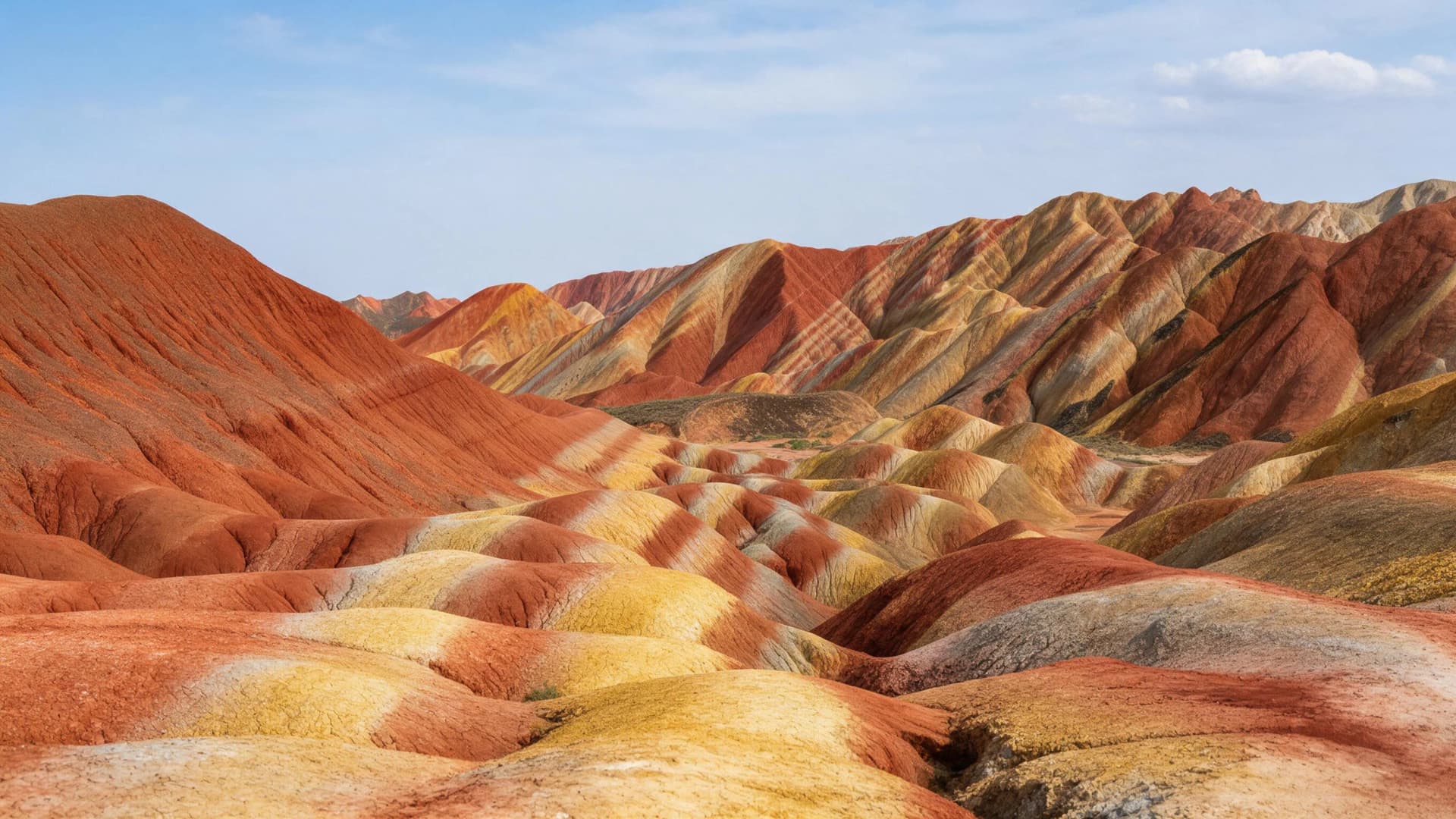
Deep in China's Gansu Province, the Rainbow Mountains of Zhangye rise in banded waves of crimson, gold, and green — a hundred-million-year-old landscape of tilted sandstone that feels less like geology than like a painting the earth made of itself. This is the story of the Danxia landforms, and how to stand inside them.
Some landscapes greet you slowly, unfurling as you approach. The Rainbow Mountains of Zhangye do the opposite: they stop you mid-step, the way a sudden sunset does. Standing on a wooden walkway as first light climbs the ridges, you watch whole hillsides burn in bands of crimson, tangerine, butter-yellow, and sage green, sweeping across the earth like the brushstrokes of an impossibly patient painter. In the hush around you, the truth settles in slowly: none of this is paint, and none of it is a trick of the light. It is stone.
Geologists call it the Zhangye Danxia National Geological Park, a name that translates beautifully: danxia means "rosy clouds," the poetic term China gives to its steep-walled red sandstone landscapes. Travelers have found a simpler name — the Rainbow Mountains. The park lies roughly an hour's drive west of Zhangye city in Gansu Province, along the Hexi Corridor that once carried Silk Road caravans, and in 2019 it was named a UNESCO Global Geopark — an official confirmation of what photographers have known for years. This is one of the most colorful places on Earth.
The colors are real, and their story begins more than a hundred million years ago, when this corner of Gansu lay beneath an inland basin of rivers, lakes, and drifting desert sands. Season after season, water sorted those sediments into thin, even layers — some rich in iron oxides, which hardened into reds and rusts; others lighter in mineral, which set as creams and ochres; a few tinted soft green by traces of other metals. Then the slow continental collision that raised the Tibetan Plateau and the Qilian Mountains squeezed and tilted those flat beds until they stood almost on end, and wind and rain spent millions of years carving away the softer rock to reveal the stripes you see today. Every band records an ancient climate — which is why locals call these the earth's diary written in stone.
The park is vast, so shuttle buses ferry you between viewpoints along the ridgeline, and broad boardwalks let you walk the curves at your own pace. Up close, the hills are not smooth; they ripple like frozen waves and stack like a layer cake, and the scale keeps resetting your sense of what you're seeing. A band of color you took for a painted line on the horizon turns out to be a cliff the size of a cathedral. Take your time: give each platform its quiet minutes, let the light move, and resist seeing everything in one breathless pass.
Light is the whole game here. At midday the high desert sun flattens the palette; in the low golden light of sunrise and sunset, the pigments deepen into almost impossible saturation, and long shadows make the striped slopes look three-dimensional. Many photographers say the hour after rain is the true prize, when the wet rock glows like polished ceramic, and a dusting of winter snow turns every red ridge into a striped ribbon. You will be standing at elevation under strong desert sun, so bring sunscreen, a hat, and layers — and plan to be on the viewpoints early or late rather than at noon.
The classic window for a visit runs June through September, when the weather is warm and the colors are at their most vivid; spring adds wildflowers to the surrounding grasslands, while autumn's crisp air and winter's snow reward travelers who don't mind the cold. Sunset draws the biggest crowds, so savvy visitors sleep near the gate the night before and enter at opening time, when morning light rakes across the ridges and you share the walkways with the sunrise instead of a crowd. A generous half day — or a full day split across both golden hours — is exactly right.
Zhangye makes a gentle base, and the journey there is part of the appeal. High-speed trains connect the city with Lanzhou, Xining, Xi'an, and points along the network, while the highway west follows the old Silk Road toward Jiayuguan and Dunhuang — so the Rainbow Mountains slip easily into a classic Gansu route or the longer Qinghai–Gansu loop beloved by photographers. Give the city an afternoon, too: the Giant Buddha Temple shelters one of China's largest reclining Buddhas, and the cliff-cut Horse Hoof Temple climbs into the Qilian foothills.
The Rainbow Mountains of Zhangye have a way of rearranging what you thought a landscape could be: a hundred million years of climate written in bands of color, waiting for someone to stand on a boardwalk at dawn and gasp. Come for the geology, the photography, or simply the urge to stand inside a painting — the mountains will meet you more than halfway. Ready to see them for yourself? Tell a ChinaMira travel designer when you'd like to go, and we'll weave the Danxia into a Gansu journey built around your pace, your budget, and the light you love.
Good to know
- Tickets and packages
- Gate admission is CNY 70 per person from 5 January 2026, up from CNY 54, with the compulsory shuttle bus adding about CNY 20, so the standard four-platform loop costs roughly CNY 90. The park sells three tiers: the regular loop, a comfort tour with private vehicle and guide (published before the 2026 rise at CNY 168-188 per person), and an in-depth small-vehicle tour (published at CNY 368, minimum three people) covering seven platforms including Wohu Gorge, Aohe and the Wanxiang Tulingu earth forest. Reconfirm the day's rates and buy through the official WeChat account or major booking apps.
- Opening hours 2026
- From 28 April to 31 August 2026 the scenic area opens 05:30-19:00, with ticket sales following the same schedule; in-depth-tour visitors must enter by 18:00, one hour before closing. Shoulder-season and winter hours are shorter - the 2024 Spring Festival week ran 07:30-17:00 - and the day's times are posted on the official WeChat account. The scenic area enquiry line is 0936-5623666, and the geopark's 24-hour hotline is 0936-8800760.
- Getting there
- Qicai Danxia Scenic Area, Nantai Village, Nijiaying Town, Linze County, about 40 km west of Zhangye city. Zhangye West Railway Station is roughly 36 km from the gate, about 50 minutes by car, and Zhangye Railway Station about 50 km, or one hour by road. High-speed trains reach Zhangye West from Lanzhou, Xining, Jiayuguan and Dunhuang, so base yourself in Zhangye city and finish the trip by taxi, shared shuttle or organised day tour.
- Best months and light
- May to October gives the strongest, most clearly separated bands, with sunrise and the last hour before sunset the prime photographic windows; in midsummer the sun sets close to 20:30 and the park opens at 05:30 in peak season. July and August are the hottest and busiest months, while clear winter days bring snow-dusted ridges and far smaller crowds. The site sits around 1,500 m above sea level, so expect strong sun, very dry air and a sharp temperature drop after dark.
- Platforms and the in-depth tour
- The standard shuttle loop stops at four platforms - Xianyuan, Yunhai, Jinxiu and Hongxia - and takes about two hours; Hongxia, the fourth, is the classic sunset viewpoint. The in-depth tour uses a small vehicle to reach seven platforms, adding Wohu Gorge, Aohe and the Wanxiang Tulingu earth forest, and takes two to three hours with a three-person minimum. There is no second charge at the standard platforms, and the whole scenic area covers roughly 50 sq km.
- Status, rules and neighbours
- The 322 sq km Zhangye National Geopark was designated a UNESCO Global Geopark in July 2020, passed revalidation with a green card in 2023, and was rated a national 5A scenic area in 2020. Boardwalks are compulsory, drones are restricted, and a single footprint on the soft rock can scar it for decades. Nearby, Binggou Danxia costs CNY 60 including shuttle and sells tickets 08:30-17:30, while Zhangye's Giant Buddha Temple has sheltered its reclining Buddha since 1098.
Frequently asked questions
How much does it cost to visit Zhangye Danxia in 2026, and is the shuttle bus included?
No: the shuttle is a separate, effectively compulsory ticket, because the roughly 50 sq km scenic area links its four viewing platforms by road only. Gate admission rose from CNY 54 to CNY 70 on 5 January 2026, and the shuttle costs about CNY 20 more, so budget roughly CNY 90 per adult for the standard loop. Half-price gate tickets apply to students, children and visitors aged 60-69, while the in-depth small-vehicle tour is priced separately, from around CNY 368 per person.
How do I get to Zhangye Danxia, and how far is it from the high-speed railway station?
The Qicai Danxia Scenic Area sits about 40 km west of Zhangye city in Linze County. Zhangye West Railway Station, the high-speed stop, is roughly 36 km from the gate, or about 50 minutes by car, while the older Zhangye Railway Station is about 50 km away, around one hour by road. High-speed trains connect Zhangye West with Lanzhou, Xining, Jiayuguan and Dunhuang, so most travellers sleep in Zhangye city and take a taxi, shared shuttle or day tour for the final leg.
What are the opening hours, and when is the best light for photographs?
In 2026 the park opens 05:30-19:00 from 28 April to 31 August, with ticket sales on the same schedule and the last in-depth-tour entry at 18:00. Colours are most saturated in the first hour after sunrise and the last hour before sunset, so aim for roughly 06:00-08:00 or 18:00-20:30 in summer, when the low sun rakes across the ridges. May to October is the best window overall, while July and August are the hottest and busiest months.
Is Binggou Danxia worth adding, and what does it cost?
Yes, especially if you want breathing room. Binggou Danxia, a red stone forest of towers, walls and ravines in Sunan County, draws a fraction of the Qicai Danxia crowd. Tickets cost CNY 60 per person including the shuttle, are sold 08:30-17:30, and the site is about a 1.5-hour drive from Zhangye city, so it is far better paired with Qicai Danxia across two days than squeezed into one afternoon.
Do children, students and seniors get discounts, and are there free-entry days?
Yes. Children under 1.2 m or aged 6 and under, plus visitors aged 70 and over, enter free, though the shuttle still has to be paid. Visitors aged 60-69, children 1.2-1.5 m, 6-18 year olds and full-time undergraduates pay half price on the gate ticket. The park has also run free-admission days on 8 March, 18 May, the second Saturday of June and 20 October, but those cover only the gate ticket, so confirm the current year's policy on the official Zhangye Qicai Danxia Scenic Area WeChat account.