
Luoyang Travel Guide: Longmen Grottoes, Peonies, and 1,500 Years of Capitals
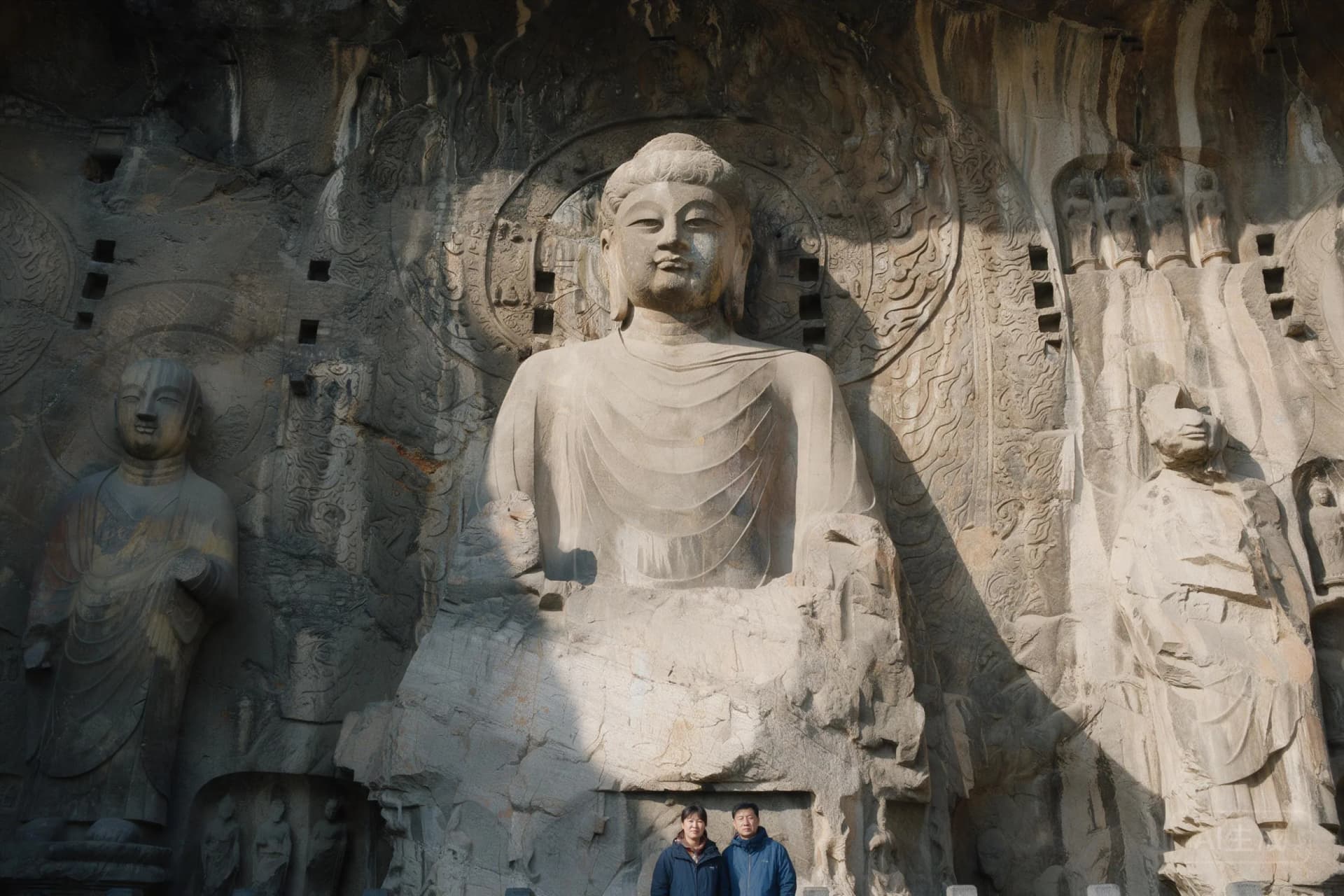
Luoyang was the capital of thirteen dynasties, and it still carries the weight of them: 100,000 Buddhist figures carved into a river cliff, China's first Buddhist temple, an empress's lost palace city and a springtime explosion of peonies. This guide covers what to see, what to eat, when to go and how to get there.
Luoyang takes its name from the river it sits beside: north of the Luo, facing south toward the mountains. For more than a thousand years this was one of the great capitals of China, seat of thirteen dynasties from the Xia and the Eastern Zhou through the Eastern Han, the Northern Wei, the Sui and the Tang. Merchants walked in off the Silk Road. Arriving today, you feel the layers before you can name them: a broad green river valley, tile-roofed lanes that smell of frying oil and incense, and stone Buddhas watching from a cliff a short ride from the center. Luoyang is not a museum city. It is a working place that happens to be sitting on top of an empire's worth of history.
Start with the Longmen Grottoes, about twelve kilometers south of town and the reason most travelers come. From 493 AD, when the Northern Wei moved their capital here, artisans spent roughly four centuries carving more than 2,300 caves and niches into the limestone cliffs on both banks of the Yi River. Inside are some 110,000 Buddhist figures, from thumb-sized bodhisattvas to the colossal Vairocana Buddha of Fengxian Temple, about seventeen meters tall, completed in 675 under Empress Wu Zetian. UNESCO listed the site in 2000. Walk the West Hill first, cross the bridge, then climb the East Hill for the view back across the water. Go at opening or after 3 p.m.; bring your passport for tickets, book ahead on holidays, and wear shoes that grip.
Then visit White Horse Temple, the quiet counterweight to Longmen's scale. Tradition dates its founding to 68 AD, when Emperor Ming of the Han sent envoys west for Buddhist scriptures; they returned with two Indian monks and a white horse carrying the sutras, and the temple took the animal's name. That makes it the first Buddhist temple in China. The courtyards are shaded and hushed, and behind the older halls a newer International Buddha Hall Garden gathers Thai, Burmese and Indian-style shrines built with donations from those countries. Allow two hours and go in the morning, when the light in the pines is soft.
Back in the city, the old town around Lijing Gate is where Luoyang relaxes. The gate itself is a rebuilt Ming-era tower, and from it a grid of pedestrian lanes runs down toward the river, lined with snack stalls, calligraphy shops and teahouses. Come hungry and come after dark, when the lanterns are on and the whole district smells like a kitchen. A short taxi ride away, the Sui and Tang Luoyang City National Heritage Park reconstructs the ceremonial heart of the Tang eastern capital, including the enormous Yingtian Gate and the Mingtang and Tiantang halls associated with Empress Wu Zetian. This was a capital built to impress the world.
For context, spend a half day in the museums. The Luoyang Museum holds one of the best collections of Tang sancai, the amber, green and cream glazed ceramics that traveled the Silk Road, along with bronzes and jade from the region's earliest dynasties; it is free, but you reserve a slot online with your passport. The Erlitou Site Museum of the Xia Capital takes you back nearly 4,000 years to a Bronze Age palace complex that may be the earliest Chinese capital of all. And the Luoyang Ancient Tombs Museum, built underground, reconstructs decorated tomb chambers from the Han through the Song.
Luoyang food is famously soupy, and the signature is the water banquet, a ritual meal of twenty-four dishes that arrive in a set order, most of them brothy and served in bowls. The star is often the peony swallow dish, a delicate arrangement of steamed radish, egg and broth shaped to look like a blooming peony; it was created for Empress Wu and named for the city's flower. Between meals, look for bu fan tang, a peppery soup poured over greens and vermicelli, jiang mian tiao, noodles in a lightly fermented mung-bean broth, and crisp guotie potstickers from the old-town stalls. Order what the next table is having.
Time your trip to the peonies if you can. Luoyang has grown them for more than 1,500 years, and the annual Peony Cultural Festival runs from April 1 into early May, when parks like the National Peony Garden and Wangcheng Park fill with hundreds of varieties in bloom; book hotels weeks ahead. Autumn is the other sweet spot, with mild days, clear light on the grottoes and far fewer crowds. Summer is hot and humid, winter is dry and cold but quiet and cheap. Getting here is simple: Luoyang Longmen station sits on the Zhengzhou-Xi'an high-speed line, roughly forty minutes from Zhengzhou, about an hour and a half from Xi'an and around four hours from Beijing, and two metro lines cover the city center.
Luoyang rewards travelers who give it two or three unhurried days. Stand beneath a seventeen-meter Buddha in the morning, walk the courtyards of China's first Buddhist temple before lunch, eat your way through a twenty-four-dish banquet at night, and if you come in April, end the day under a canopy of peonies. Ready to build that trip? Tell a ChinaMira travel designer your dates and pace, and we will shape Luoyang, the grottoes and the rest of Henan into an itinerary that fits, handling tickets, drivers and trusted local guides so you can spend your time looking up.
Good to know
- Best time to visit
- Mid-April is peony season: the China Luoyang Peony Cultural Festival opened on 1 April and runs through the month (the 43rd edition opened 1 April 2026), filling parks such as the National Peony Garden and Wangcheng Park but also spiking hotel rates, so book weeks ahead. Late September to October is the other sweet spot, with mild days, clear light on the grottoes and far fewer crowds. Summer is hot and humid; winter is dry, cold, quiet and cheap.
- Longmen Grottoes tickets and hours
- About 12 km south of the city. Day admission is USD 13 from 1 March to 31 October, with ticket sales 08:00-17:30 and last entry 18:00; winter hours are shorter. The separate evening tour is also USD 13 and runs about 17:30-19:30, closing at 21:00, but covers only the West Hill and Xiangshan Temple. A shuttle inside the site costs USD 1.4 and a boat view USD 9.9. Entry is real-name, so bring your passport and reserve ahead on holidays.
- Other key tickets
- White Horse Temple, China's first Buddhist temple, costs USD 4.9 for adults, USD 2.5 for students, and is free for children under 1.4 m and visitors over 60; peak hours (April-October) are about 07:40-18:40 with last entry 18:00. At the Sui and Tang Luoyang City park, Mingtang and Tiantang cost USD 12, or USD 22 combined with Yingtian Gate and Jiuzhou Pool, and the site stays open late into the evening. The Luoyang Museum and the Erlitou Site Museum of the Xia Capital are free with online reservation and valid ID, and both close on Mondays outside public holidays and the peony festival.
- Getting there
- Luoyang Longmen station is on the Zhengzhou-Xi'an high-speed line, about 6 km from the Longmen Grottoes, 13 km from Luoyang's old main station and roughly 22 km from Beijiao Airport. Sample second-class fares and times: Zhengzhou 25-79 minutes from about USD 6.3, Xi'an North 1 hour 15 minutes to 1 hour 52 minutes from about USD 25, and Beijing West 3 to 4 hours 22 minutes from roughly USD 53. Book with your passport on the official 12306 app or website.
- Getting around
- Two metro lines cover the city centre and reach Luoyang Longmen railway station, and taxis or DiDi are cheap for short hops; a taxi from the centre to White Horse Temple takes about 30 minutes. Bus 56 runs to the temple from Luoyang station and bus 58 from Luoyang Longmen station. Alipay and WeChat Pay work almost everywhere, but carry your passport because attraction tickets are sold under your real name.
- Visa and entry
- China's 240-hour (10-day) visa-free transit now covers 55 nationalities, and Zhengzhou Xinzheng International Airport is a designated port whose permitted stay area is Henan province, so eligible travellers arriving with a confirmed onward ticket to a third country or region can add Luoyang to the trip. Other visitors need a tourist (L) visa. Always check the current country list and port rules with China's National Immigration Administration before booking flights.
Frequently asked questions
How much does it cost to visit the Longmen Grottoes, and do I need to book?
Admission is USD 13 for the day visit from 1 March to 31 October, when ticket sales run 08:00-17:30 and the last entry is 18:00; winter hours are shorter. The evening tour is a separate USD 13 ticket sold roughly 17:30-19:30 (check-in 18:00-20:00, site closes 21:00) and covers the West Hill and Xiangshan Temple only. Inside the scenic area a shuttle costs USD 1.4 and a boat ride USD 9.9. Tickets are real-name, so carry the passport you booked with and reserve ahead on holidays.
How do I get to Luoyang, and how long is the train from Xi'an, Zhengzhou or Beijing?
Luoyang Longmen station sits on the Zhengzhou-Xi'an high-speed line: Xi'an North is 1 hour 15 minutes to 1 hour 52 minutes away with second-class seats from about USD 25, Zhengzhou takes only 25-79 minutes from about USD 6.3, and Beijing West is 3 to 4 hours 22 minutes from roughly USD 53. The station is about 6 km from the Longmen Grottoes, and Metro Line 2 links it to the city centre. Book on the official 12306 app or site with your passport.
When is the best time to see Luoyang's peonies?
The China Luoyang Peony Cultural Festival opens on 1 April and runs through the month; the 43rd edition opened on 1 April 2026 with more than 20 events. That is peak bloom in parks such as the National Peony Garden and Wangcheng Park, but also peak hotel demand, so book rooms several weeks ahead. If you want the grottoes with clear light and thin crowds instead, come in late September or October.
How many days do you need in Luoyang?
Two to three unhurried days. Day one covers the Longmen Grottoes (USD 13) and the old town around Lijing Gate at night; day two pairs White Horse Temple, which costs USD 4.9 (USD 2.5 for students and free for children under 1.4 m and visitors over 60), with the free Luoyang Museum; a third day adds the Sui and Tang Luoyang City park, where Mingtang and Tiantang cost USD 12 or USD 22 combined with Yingtian Gate and Jiuzhou Pool.
Do I need a visa to visit Luoyang?
Not always: 55 nationalities can use China's 240-hour (10-day) visa-free transit, and Zhengzhou Xinzheng International Airport in Henan is a designated entry port, so eligible travellers with a confirmed onward ticket to a third country can enter there and visit Luoyang within Henan province. Everyone else needs a tourist (L) visa. Rules and the country list change, so confirm with China's National Immigration Administration before booking.
Keep exploring
Plan with ChinaMira
Turn this into a trip
Use this guide as a starting point — we can handle the route, guides, trains and the visa invitation letter.