
Attraction
Big Wild Goose Pagoda, Xi'an: Xuanzang's Seven-Story Tang Tower
A warm, story-driven guide to Xi'an's Big Wild Goose Pagoda: the Tang monk Xuanzang, the seven stories he raised to hold a library of Sanskrit scrolls, what tickets and seasonal hours really cost, the climb and its Tang tablets, and the North Square fountain that lights up the evening, plus metro directions.
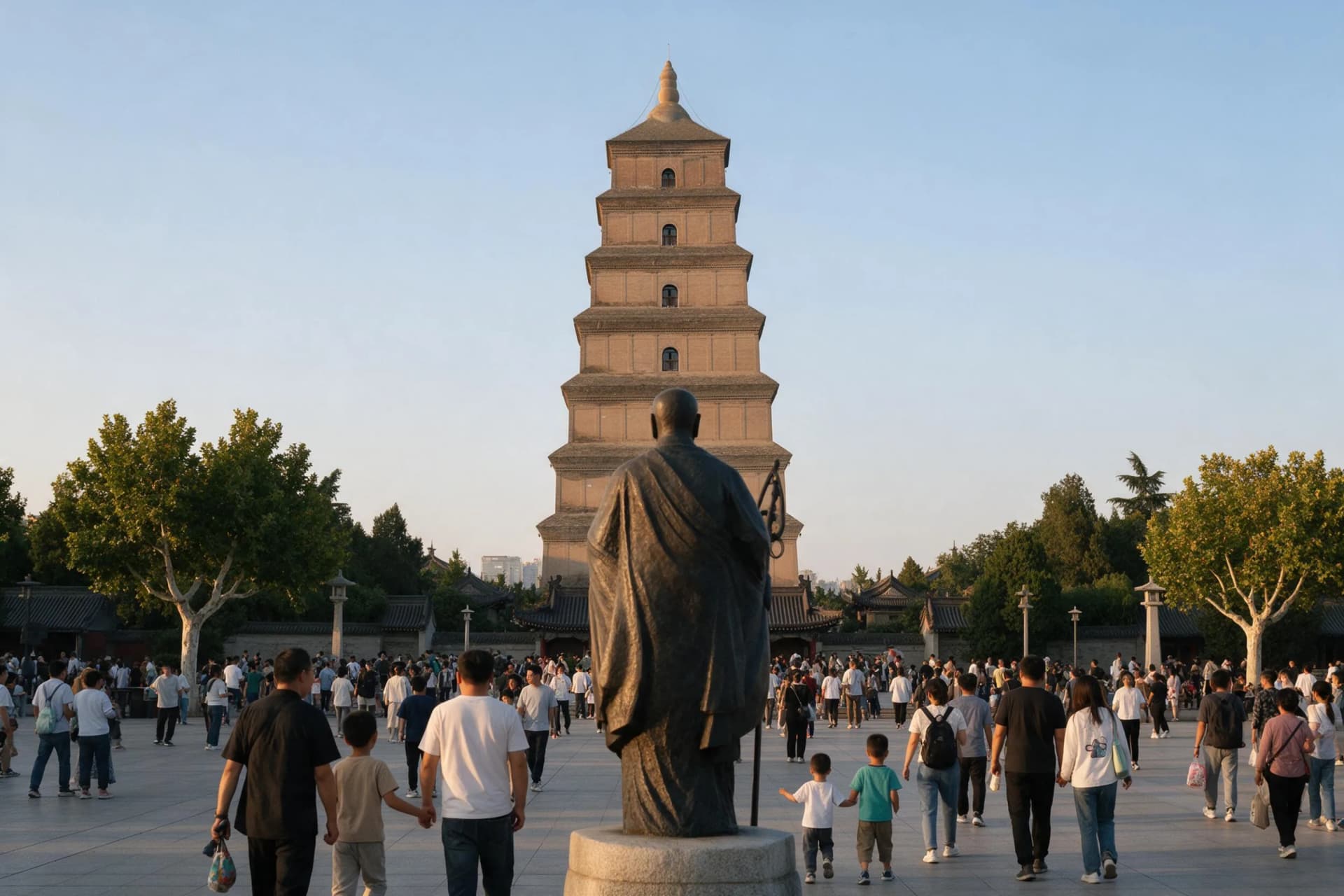
Walk south from the Bell Tower and the city loosens: gray concrete gives way to plane trees, then to a broad plaza where a bronze monk stands with his staff, facing a tower of pale brick. Xuanzang — the real man behind Journey to the West — has been standing there since 652, and the Big Wild Goose Pagoda behind him has served as his library ever since. Come at dusk, when the low light warms the brick and the square fills with families, and the building stops being a monument and becomes a place people actually use.
The story behind it is a travel story. Xuanzang left Chang'an in 629, crossed the deserts and mountains of Central Asia, studied for years in India, and came home in 645 with hundreds of Sanskrit scrolls and one urgent problem: where do you keep a library that must not burn? His first pagoda, finished in 652, was a five-story tower about 60 meters high and built in the Indian style. It burned. What you climb today is the descendant of that idea — brick, patient, and still holding the journey.
The present tower is a survivor with a complicated biography. Rebuilt under Empress Wu Zetian as a seven-story structure, later expanded to ten, damaged in war and restored again, it took its current form during the Ming dynasty, when masons in 1604 wrapped the old Tang core in a 60-centimeter layer of new brick. That is why the outside looks Ming and the bones are Tang. Including its base, the pagoda stands about 64.5 meters tall and holds seven stories; from the upper floors you look down on the gray tiled roofs of Da Ci'en Temple, the green sweep of Qujiang, and, on a clear evening, the whole southern city.
Entry works in two steps, and knowing them saves confusion. Da Ci'en Temple, the working monastery that surrounds the pagoda, charges CNY 40 per adult from March 1 to November 30 and CNY 25 from December 1 to the end of February. The climb itself is a separate CNY 30, bought inside the grounds. The stair is narrow and worn smooth, the landings are cool and dim, and the reward is not only the view: on the way up you pass stone door lintels carved with Buddhas and Heavenly Kings, and, just outside the south door at ground level, two Tang tablets carrying texts by Emperor Taizong and Emperor Gaozong in the calligraphy of Chu Suiliang. Most visitors walk past them in thirty seconds. Take five minutes.
Da Ci'en is not a museum kept behind glass; it is a working temple, and the rhythm of the place still belongs to the monks. Arrive soon after opening and you may catch chanting in one of the halls, the sound drifting across the courtyard while a few worshippers bow at the steps. In the Tang dynasty this was also where successful candidates in the imperial examinations came to inscribe their names — the phrase "inscription at the Wild Goose Pagoda" became shorthand for passing the hardest exam in the world. Stand in that courtyard and you understand the ambition; the tower was the tallest thing a scholar could climb.
For a thousand years the pagoda also had a slow, alarming problem. Overpumping of groundwater around it pulled the tower out of true, and by 1996 surveyors measured a lean of about one meter. The city's answer was unglamorous and effective: more than 400 wells around the site were sealed, and the pagoda began to creep back, shifting roughly nine millimeters in the opposite direction by 2006. In 2014 UNESCO inscribed it as part of the Silk Roads World Heritage listing, recognizing not just the brick but the journey — the transmission of Buddhist texts from India to China that the tower was built to hold.
Plan around the seasons. The temple opens at 8:00 and closes at 18:30 from March through November, with the last tickets sold at 17:30; from December to the end of February it closes at 18:00 and stops selling at 17:00. Metro Line 3 or Line 4 brings you to Dayanta station, where Exit C or D puts you about a five-minute walk from the South Square. Evenings belong to the North Square, where the musical fountain — one of the largest matrix fountains in Asia — typically runs an evening show around 21:00 from April to October and around 20:00 from November to March, with a midday show added in peak season. Each run lasts 10 to 15 minutes, and the fountain usually pauses on Mondays for maintenance. Stay afterward for the lights of Grand Tang Ever-Bright City.
Give the pagoda half a day, not an hour. Pair it with the Shaanxi History Museum, the city wall at sunset, or a morning at the Terracotta Army, and let the Tang dynasty run through the whole day instead of stopping at one photo. That is the kind of trip ChinaMira builds best: timed tickets, an English-speaking guide who can read the Tang tablets with you, a private car waiting when the fountain ends, and the rest of Xi'an arranged around it. Tell us your dates, and we will put Xuanzang's tower at the center of a day that actually makes sense. The monk carried his library across Asia; you only have to cross the city.
Good to know
- Temple and pagoda tickets
- Da Ci'en Temple costs CNY 40 per adult from March 1 to November 30 and CNY 25 from December 1 to the end of February. Climbing the pagoda is a separate CNY 30.
- Opening hours
- 8:00-18:30 from March through November, last tickets at 17:30; 8:00-18:00 from December to the end of February, last tickets at 17:00.
- Getting there
- Metro Line 3 or 4 to Dayanta station, Exit C or D, about a five-minute walk to the South Square. Buses 5, 19, 21, 22 and 23 stop at Dayanta South Square.
- Fountain shows
- Evening show around 21:00 from April to October and around 20:00 from November to March, with a midday show added in peak season. Each run lasts 10-15 minutes; the fountain usually pauses on Mondays.
- Height and age
- Seven stories and about 64.5 meters, first built in 652 and inscribed by UNESCO in 2014 as part of the Silk Roads World Heritage site.
- Time to allow
- About 1.5 to 2 hours for the temple, the Tang tablets and the climb, plus 30 minutes if you stay for the evening fountain.
Frequently asked questions
How much does it cost to visit the Big Wild Goose Pagoda?
CNY 40 per adult for Da Ci'en Temple from March 1 to November 30, and CNY 25 from December 1 to the end of February, plus CNY 30 if you want to climb the pagoda itself. Students, seniors and children usually qualify for half price or free entry, and the pagoda ticket is bought inside the temple grounds.
What are the opening hours of the temple and the pagoda?
8:00 to 18:30 from March 1 to November 30, with the last tickets sold at 17:30, and 8:00 to 18:00 from December 1 to the end of February, with the last tickets at 17:00. Allow about 1.5 to 2 hours for the halls, the two Tang tablets by the south door and the climb.
When is the musical fountain show at the North Square?
April through October it usually runs an evening show around 21:00 and a midday show around noon, while November through March drops to a single evening show around 20:00. Each run lasts 10 to 15 minutes, the fountain normally pauses on Mondays for maintenance, and the plaza itself is free.
How do I get to the Big Wild Goose Pagoda in Xi'an?
Metro Line 3 or Line 4 to Dayanta station, Exit C or D, puts you about a five-minute walk from the South Square. Buses 5, 19, 21, 22 and 23 stop at Dayanta South Square, and a taxi from the Bell Tower takes roughly 15 minutes.