
City Guide
Dunhuang Travel Guide: Caves, Camels and the Edge of the Taklamakan
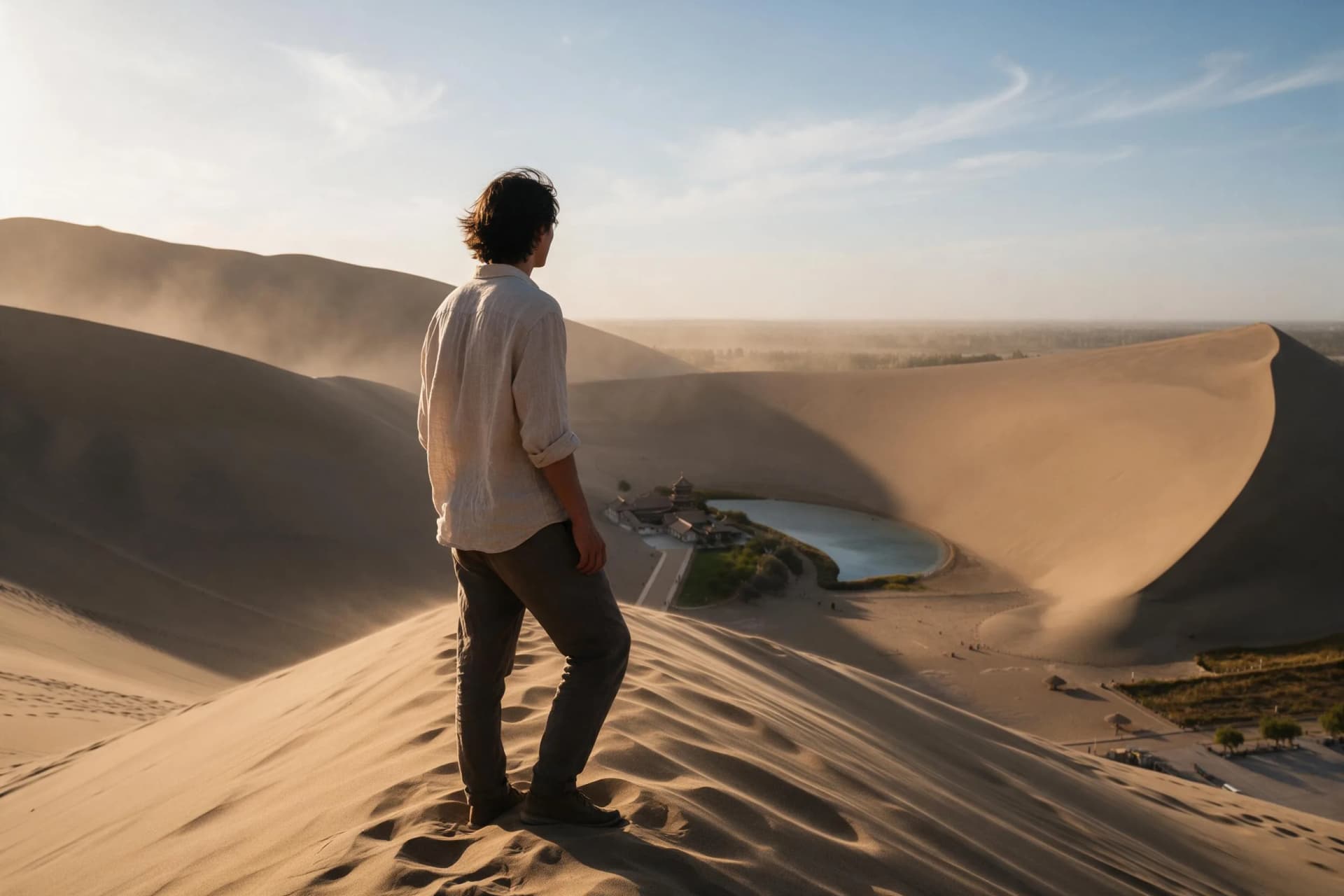
Dunhuang is the Silk Road oasis where painted caves, singing sand dunes and Han-dynasty frontier forts sit within an hour of each other. This guide covers booking Mogao Caves in advance, the best hours at Crescent Lake, the desert west route, local food and the practical details that make a 2-3 day visit run smoothly.
Dunhuang sits in a shallow green bowl at the western edge of the Hexi Corridor, surrounded on three sides by the Taklamakan and Gobi deserts. For centuries this was the last comfortable stop before the Silk Road split into its northern and southern branches, and that geography is the whole story of the place: merchants, monks and envoys arrived dusty, gave thanks and commissioned cave shrines. Today the town is small, walkable in its core and easy to like, with poplar-lined streets, apricot orchards on the outskirts and a sky that turns deep orange around 8 p.m. in summer. You can see its three headline sights in two full days, but three days lets you breathe.
Start with the Mogao Caves, 25 kilometers southeast of town and the reason most people come. The cliff holds 735 caves; 492 still contain paintings or sculpture, roughly 45,000 square meters of murals and more than 2,000 painted figures, built over about a thousand years from the 4th century onward and listed by UNESCO in 1987. Tickets are real-name and capped daily, so book on the official Dunhuang Academy site as soon as your dates are fixed, and bring the passport you booked with. The standard A ticket includes two short digital films at the visitor center, a shuttle bus to the cliff and a guided look at eight caves with a small group; the cheaper emergency ticket shows four caves and sells out on holidays. Photography is banned inside every cave, and rightly so, since flash and exhaled moisture damage pigment. Your guide carries a flashlight and a key, and seeing the great seated Buddha of Cave 96 emerge from the dark is unforgettable. Cave 17, the sealed library cave, and the early caves 275 and 285 reward anyone who reads a little beforehand.
On your second morning or, better, in the late afternoon, go to Mingsha Shan and Crescent Lake, the dunes that begin at the southern edge of town. This is the postcard: a crescent-shaped spring with a small pagoda pavilion, held in place for two thousand years by wind patterns and a low water table, ringed by dunes that rise more than 200 meters. Go early for soft light and cool sand, or around 6 p.m. for the classic sunset, and note that the entrance ticket is valid for several days if you register it, so you can come back for both. Rent the orange cloth shoe covers at the gate, climb the wooden walkway rather than the open sand if you value your calves, and take the camel train once, even if it feels touristy. When the wind rises, the dunes really do hum, a low resonance that gave the mountain its Chinese name.
The west route is a full day of driving through open desert, so hire a car and driver or join a small-group tour. Typical stops are the Yardang National Geopark, a wind-carved city of clay ridges that locals call the Ghost City; Yumen Pass, the Han-dynasty Jade Gate that marked the empire's edge; and Yangguan Pass to the south, where the departing-poet farewells of the Tang imagination actually happened. The surviving mud-and-reed Great Wall here is two thousand years old and startlingly humble up close. Distances are long, fuel and water are limited, and there is almost no shade, so carry two liters per person, wear a hat, and expect fine grit in everything by evening.
Closer to town, fill the gaps with the Dunhuang Museum, which is free and gives the caves context, and the Western Thousand Buddha Caves if you want more painted grottoes without the Mogao crowds. Evenings belong to the Shazhou Night Market and the cluster of food streets around it: lamb skewers dusted with cumin and chili, donkey-meat yellow noodles, cold apricot juice, grilled eggplant, and jujube and dried apricots to take home. For a bigger night out, the Encore Dunhuang and Silk Road dance-and-music shows are spectacle rather than scholarship, but they land well with families. Book tickets a day ahead in July, August and the National Day holiday.
Practical notes. Dunhuang sits at about 1,140 meters, which is gentle, but the air is extremely dry: pack lip balm, eye drops, a refillable bottle and sunscreen, and drink more than you think you need. Summer days top 35 C and the sun sets after 9 p.m., spring can bring sandstorms, and winter is cold, clear and wonderfully empty. The sweet spots are mid-May to June and September to October. Cash is rarely needed; Alipay and WeChat Pay linked to an international card work in most shops, though a few hundred yuan in cash is useful for small vendors at the night market. Fly into Dunhuang Mogao International Airport, or come by train from Lanzhou or Xi'an, transferring at Liuyuan South if you are on the high-speed line. The town center is tiny; taxis are cheap and few drivers speak English, so carry your hotel's name in Chinese.
Ready to walk where the caravans turned west? Tell ChinaMira your dates and travel style, and we will help you lock in Mogao Caves tickets before they vanish, pair Dunhuang with the rest of the Hexi Corridor or a Qinghai-Gansu loop, and build a trip that leaves room for a slow sunset on the dunes. Explore our Dunhuang itineraries, or send us a message and we will start planning today.
Good to know
- Mogao Caves: tickets and booking
- About 25 km southeast of Dunhuang. Peak season (1 April-30 November) opens 08:00-18:00 with last ticket check at 16:10; winter (1 December-31 March) runs 09:00-17:00 with last check at 15:10. Real-name timed entry is capped at 6,000 regular visitors and 12,000 emergency visitors a day. The A ticket is CNY 238 peak or CNY 140 winter (two films plus eight caves in peak season, ten in winter); the B emergency ticket is CNY 100 for four caves and no films. Special caves cost about CNY 150-200 each and are sold on site from 11:00 to 14:00, around 100 tickets an hour. Book through the official WeChat mini-program or www.mgk.org.cn, arrive at the Digital Exhibition Center 30 minutes early, and leave cameras and drones behind.
- Mingsha Shan and Crescent Lake
- About 5 km south of the city center, with dunes rising more than 200 m above the crescent-shaped spring. Tickets are CNY 110 from 1 April to 31 October and CNY 55 from 1 November to 31 March, valid for 72 hours of face-scan re-entry once registered; since 2025 they are sold online only, 1-15 days ahead. Summer hours run about 05:00-20:30, spring around 06:00-19:30 and winter 07:30-18:00. Bus No. 3 costs about CNY 1 and a taxi around CNY 15-20; cloth shoe covers are sold at the gate and a camel ride takes roughly 40 minutes.
- Western desert route
- Plan a full day of driving. The combined Yangguan and Yumen Pass ticket is CNY 90; Yangguan alone is CNY 50 (open 08:00-19:30) and Yumen Pass CNY 40, with in-site sightseeing buses at CNY 20 and CNY 50. Yardang National Geopark, about 160 km northwest, charges CNY 50 plus around CNY 70 for the shuttle and opens 07:00-17:00, with a sunset departure. A round-trip bus from Dunhuang bus station costs CNY 120 (CNY 140 from the railway station or airport), while a chartered car for the day runs roughly CNY 300-600 depending on the route and season.
- Getting there
- Lanzhou lies 1,110 km east. Direct D trains from Lanzhou West reach Dunhuang in 7.5-9 hours, with second class about CNY 324 and first class CNY 518; ordinary sleepers take 13.5-14.5 hours from CNY 247.5. Flights from Lanzhou take 1.5-2 hours. Dunhuang Mogao International Airport (DNH) is 13 km east of town, served by an airport shuttle at CNY 10, a local bus at CNY 3 and taxis at about CNY 30; the town center is small and taxis start at CNY 5.
- Best months and weather
- Mid-May to June and September to October are the sweet spots, with mild days, cool nights and calmer air for dune walking and camel riding. July averages a high near 34-35°C and January a low near -16°C, and annual precipitation is only about 35 mm. Dunhuang sits at roughly 1,140 m, so altitude is not a problem, but the air is extremely dry: pack lip balm, eye drops, sunscreen and a refillable bottle, and drink more water than you think you need.
- Food, night market and money
- The Shazhou Night Market and the food streets around it are busiest after 21:00. A bowl of huangmian, hand-pulled yellow noodles under donkey-meat sauce, costs about CNY 20-35, and a glass of apricot juice pressed from local Li Guang apricots is CNY 5-8. Alipay and WeChat Pay linked to an international card work in most shops, though a few hundred yuan in cash is useful for small vendors; taxis start at CNY 5 and most hops around town stay under CNY 15.
Frequently asked questions
How far ahead should I book Mogao Caves tickets, and can I buy them at the gate?
Book on the official 'Mogao Caves Reservation' WeChat mini-program as soon as your dates are locked, because reservations open about 30 days ahead and the regular A ticket is capped at 6,000 visitors a day. In peak season those tickets can sell out within minutes, and there is no ticket window at the cliff itself: you check in at the Digital Exhibition Center in town and ride the shuttle out, arriving at least 30 minutes before your time slot. Carry the passport you booked with, as entry is real-name.
How much do Mogao Caves tickets cost, and what is included?
From 1 April to 30 November the regular A ticket is CNY 238 and covers two digital films at the visitor center, the shuttle bus and a guided look at eight caves with a group of 10-30 people, taking about 3.5-4 hours. From 1 December to 31 March the price drops to CNY 140 and the route includes ten caves. The standby emergency B ticket is CNY 100 and shows four caves (96, 130, 148 and 100) with no films, taking about two hours.
When is the best time to visit Dunhuang, and when should I be on the dunes?
Mid-May to June and September to October give the mildest days, calmest air and best dune light. July averages a high near 34-35°C and January a low around -16°C, while spring can bring sandstorms that close the caves and dunes. At Mingsha Shan the gates open as early as 05:00 in summer, so aim for 05:00-08:00 for cool sand and soft light or return around 18:00-20:00 for sunset; one ticket stays valid for 72 hours.
How many days do you need in Dunhuang?
Two full days cover the three headline sights: the Mogao Caves on day one, Mingsha Shan and Crescent Lake plus the Shazhou Night Market on day two. Three days is better, because it lets you return to the dunes for both a sunrise and a sunset and still fit the long western desert loop to Yumen Pass, Yangguan and Yardang. Add a spare afternoon for the free Dunhuang Museum, and note the night market is liveliest after 21:00.
What does the Mingsha Shan ticket include, and how do I get there from town?
Entry costs CNY 110 from 1 April to 31 October and CNY 55 from 1 November to 31 March, and it is valid for 72 hours of unlimited face-scan re-entry once you register at the gate on your first visit. Since 2025 tickets are sold online only, 1-15 days ahead through the official 'Mingsha Shan Yueya Spring' WeChat mini-program or an OTA app. Bus No. 3 runs straight there for about CNY 1, a taxi takes roughly 15 minutes for CNY 15-20, and a camel ride lasts about 40 minutes.