
Attraction
Leshan Giant Buddha: The 71-Meter Tang Statue That Watches Three Rivers
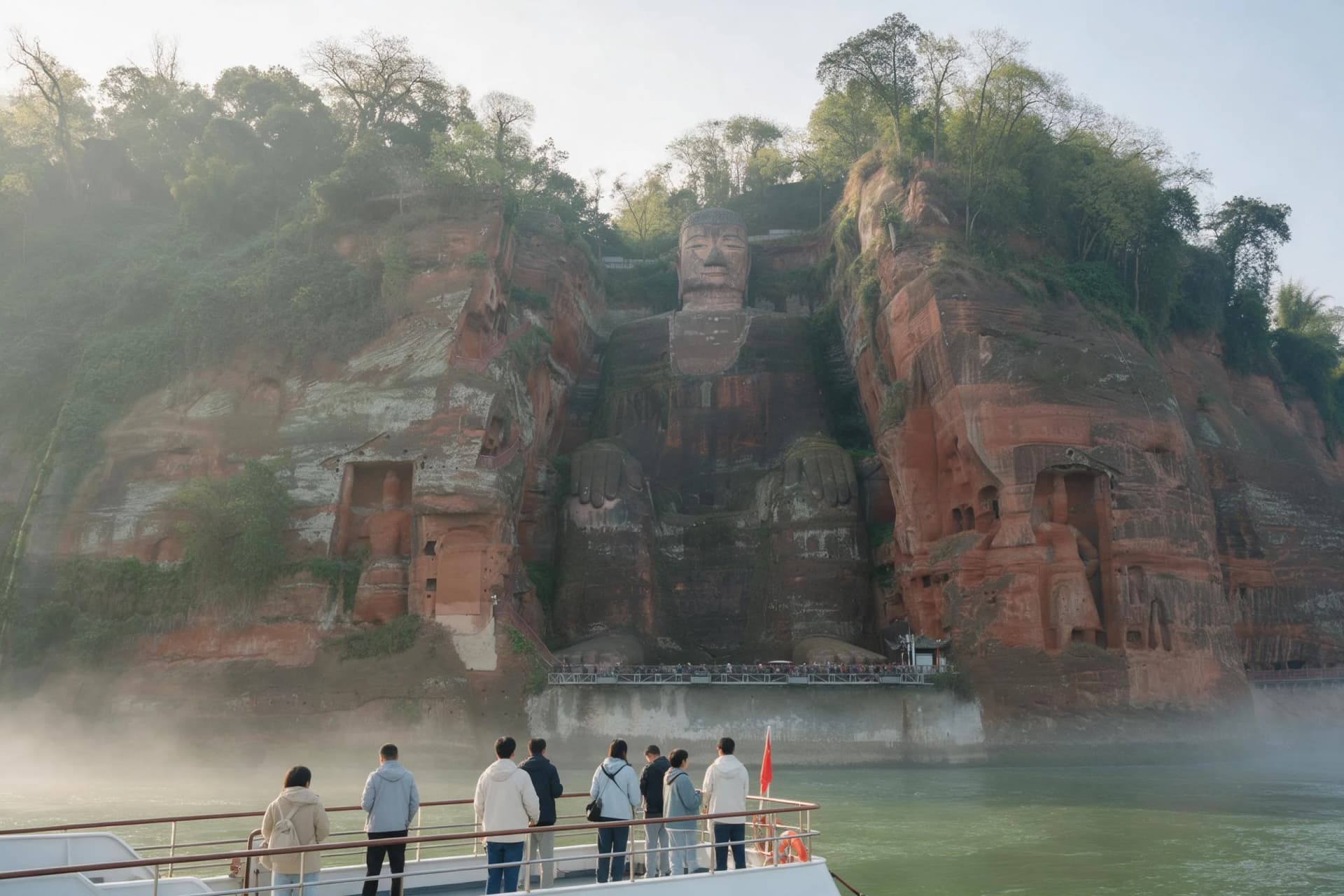
The Leshan Giant Buddha is a 71-meter Tang-dynasty carving at the meeting of three Sichuan rivers, begun in 713 and finished ninety years later. This guide covers the monk Haitong's stubborn vision, the hidden drainage that saved the statue, the Nine Bends Plank Road, ticket and boat prices, the best months, and how to reach Leshan from Chengdu.
The boat slows where the Min, the Dadu and the Qingyi meet, and the cliff above you stops looking like a cliff. What you took for a weathered rock face is a face: eyelids the length of a canoe, a nose taller than a doorway, and shoulders that seem to hold the whole hillside together. Up close, the Leshan Giant Buddha is not a statue you look at. He is a presence who has been watching this water for twelve hundred years, and he does not hurry for anyone.
The rivers explain everything. In 713, when the Tang dynasty was at its height, the monk Haitong began carving Maitreya, the Buddha of the future, into the red sandstone of Lingyun Mountain at Qiluan Peak. The confluence below was a graveyard for boats, three currents colliding in whirlpools that swallowed cargo and crews. Haitong believed a Buddha would calm the water. The story locals tell is that when officials came for the money he had raised, he gouged out his own eye to prove he would not hand it over. He died before the work was finished; two later officials carried it on, and the statue was complete in 803, ninety years after the first chisel.
The measurements are the story. The finished Buddha stands 71 meters, about 233 feet, from the crown of his head to the soles of his feet. The head alone is 14.7 meters, the ears stretch 7 meters, and the shoulders span 24 meters. The scenic area counts 1,021 coils of hair on the head, and what most visitors never notice is that the coils are not only decoration. Carved channels run behind them and down the body, draining rainwater away from the soft stone. The Buddha has survived twelve centuries partly because he was designed to survive them.
You meet him in stages. From the top of Lingyun Mountain you look down on the crown and out across the water; the head sits level with the treetops and the rivers run a long way below. Then the Nine Bends Plank Road begins its descent, a narrow stairway cut into the cliff that folds back on itself, step after step, until the face is beside you and then above you. In peak season the queue for that stairway is the slow part of the day, so start early; the boat is the shortcut. At the bottom, on the platform at his feet, his toenails are taller than your knees, and the three rivers keep moving the way they always have.
The boat is the other way to see him, and for many travelers it is the better one. Cruises leave from the pier near the scenic area and make a short loop across the confluence; the Buddha rises from the water in full profile, the cliff opening behind him, and you finally understand the scale that the plank road hides. The mountain route costs about CNY 80 per adult and the river boat about CNY 70. Some people do both, the boat for the whole figure and the mountain for the face and the feet.
Timing matters more here than at most Chinese sights. The gates generally open around 07:30 from spring through autumn and around 08:00 in winter, and that first hour is the calmest; by mid-morning the tour groups arrive in force. March to May and September to November bring the most comfortable weather, with mild temperatures and clearer skies. July and August are hot, humid and crowded, while the October Golden Week and Spring Festival holidays turn the stairway into a slow-moving line. If your dates land on a holiday, book ahead and be at the gate when it opens.
Leshan sits about an hour by high-speed train from Chengdu East, which makes the Buddha an easy day trip from the Sichuan capital; trains run through the day and the ride is comfortable. From Leshan Station, city buses head toward the scenic area and a taxi is the quickest option. The mountain holds more than the statue: Lingyun Temple and Wuyou Temple sit among the pines, and the Mahao Tomb nearby preserves Han-dynasty cliff tombs carved into the rock. Many travelers pair Leshan with Mount Emei, which shares the same UNESCO inscription, and stay overnight in Leshan for an early start.
The Giant Buddha has outlasted the dynasty that carved him, the boats he was meant to protect, and the monks who began the work. He is still there at the confluence, and the rivers still run. Tell ChinaMira your travel dates and we will build the day around him: timed entry, a private car from Chengdu or Leshan, the boat if the stairway is busy, and a guide who can explain what Haitong's eye actually bought. Start with our Chengdu guide for the days on either side, check the month-by-month when-to-visit guide for your season, and see how this story fits our history journeys across China.
Good to know
- Tickets
- The mountain-route ticket is about CNY 80 per adult and the river-view boat about CNY 70. Buy with your passport through the official channel; holiday dates sell out, and prices can change, so confirm the current rate when you book.
- Opening hours
- Gates generally open around 07:30 from spring through autumn and around 08:00 in winter, with last entry well before closing. Arrive in the first hour to stay ahead of the tour groups and the stairway queue.
- Best months
- March to May and September to November for mild weather and clearer skies. July and August are hot, humid and crowded, while October Golden Week and Spring Festival are the busiest dates of the year.
- Getting there
- About one hour by high-speed rail from Chengdu East to Leshan, with trains through the day. From Leshan Station, city buses run to the scenic area and a taxi is the quickest option; the Buddha works well as a day trip from Chengdu.
- The statue
- 71 meters tall, about 233 feet, with a 14.7-meter head, 7-meter ears and 24-meter shoulders. The scenic area counts 1,021 hair coils, whose carved channels drain rainwater away from the sandstone.
- Time to allow
- Plan three to four hours for the mountain route and the Nine Bends Plank Road, plus about an hour if you add the river boat. Pair the visit with Mount Emei, which shares the same 1996 UNESCO inscription.
Frequently asked questions
How much does it cost to see the Leshan Giant Buddha?
Expect about CNY 80 per adult for the mountain-route ticket and about CNY 70 for the river boat that shows the statue from the water. Children, students and seniors often pay less, so confirm the current rate when you book, and bring the passport you booked with.
When is the best time of year to visit the Leshan Giant Buddha?
March to May and September to November bring the mildest weather and the clearest skies. The gates open around 07:30 in the warmer months and around 08:00 in winter; July and August are hot and crowded, and October Golden Week and Spring Festival are the busiest dates of the year.
How do I get to the Leshan Giant Buddha from Chengdu?
About one hour by high-speed rail from Chengdu East to Leshan, with departures through the day. From Leshan Station, city buses run to the scenic area and a taxi is the quickest option; most travelers see the Buddha as a day trip from Chengdu or combine it with Mount Emei.
How long should I allow for the Leshan Giant Buddha?
Allow three to four hours for the mountain route, including the descent along the Nine Bends Plank Road and the climb back up, and add about an hour if you also take the river boat for the full frontal view. Queues are longest from mid-morning, so start at opening.