
Attraction
The Terracotta Army, Xi'an: A Buried Legion Still on Duty
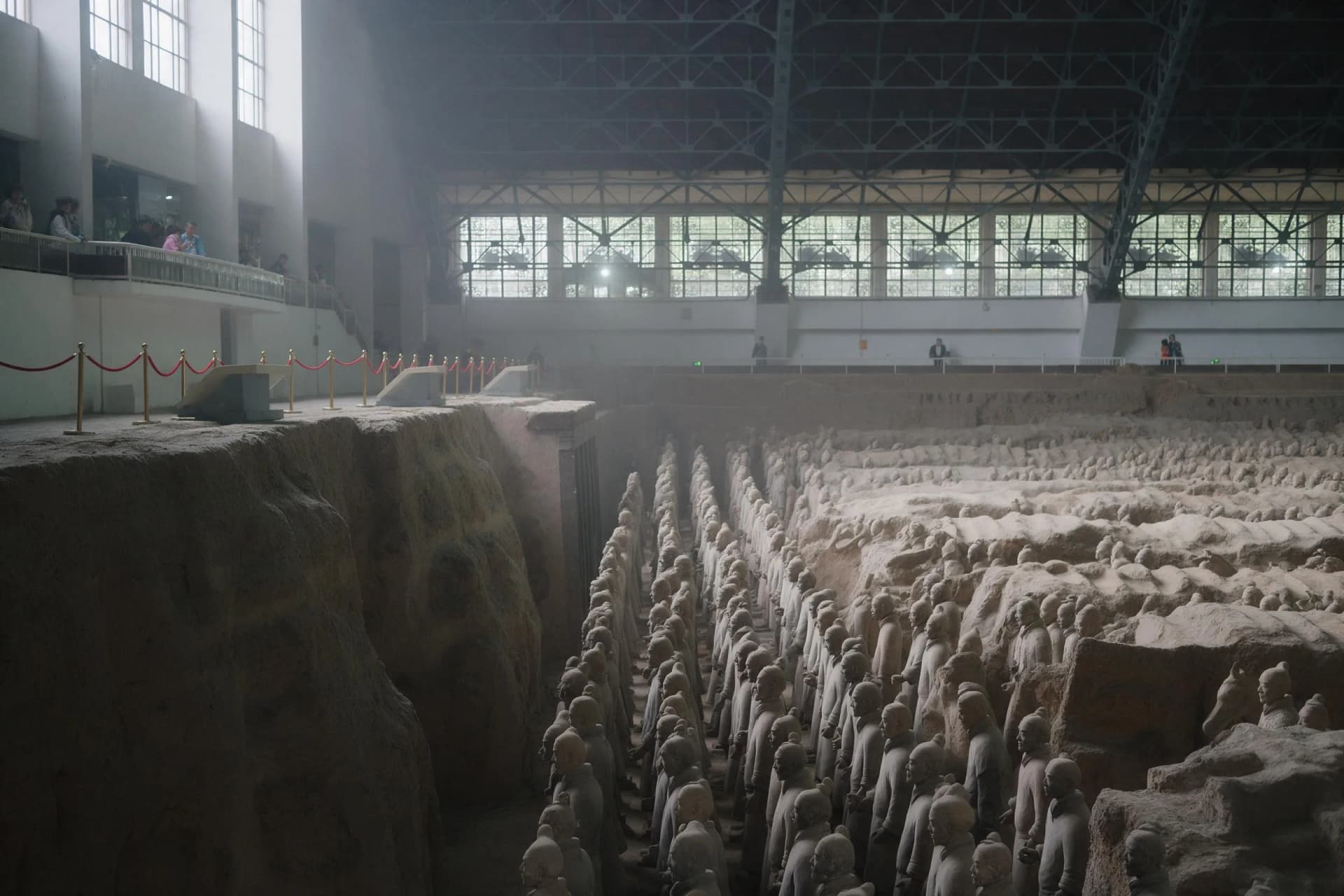
The Terracotta Army is the reason most travelers come to Xi'an: more than 8,000 life-size clay soldiers, archers, charioteers and horses buried for 2,200 years beside the tomb of Qin Shi Huang, China's first emperor. This story-led guide explains how farmers found the site in 1974, what you actually see in Pits One, Two and Three, why the paint vanished within minutes of excavation, and the practical details — 120-yuan timed tickets booked with your passport, seasonal hours, bus and metro routes, and the best months to go.
Nothing prepares you for the scale of Pit One. You step into a hall the size of an aircraft hangar, and the floor drops away into a long trench packed with rows of clay soldiers standing exactly where they were arranged more than two thousand years ago. They face east in battle order — a vanguard four abreast, armored ranks stretching behind them, timber beams dividing the corridors. Around you, hundreds of visitors talk and take photos. Down there, the army is completely silent.
The army was found by accident. In March 1974, farmers from Xiyang Village near Lintong were digging a well and hauled up baked clay fragments: a torso, part of a head, bronze arrowheads. They reported the find, archaeologists arrived, and within two years three pits had been mapped. One digger, Yang Zhifa, became a local celebrity, though the fortune the site created never reached him. Farmers here had turned up broken figures for generations and thought little of them; nobody had imagined an entire buried army.
The man they were made for was Ying Zheng, king of Qin, who by 221 BC had defeated six rival states and named himself Qin Shi Huang, the First Emperor. He standardized weights, measures, currency and writing across China and linked frontier walls into what became the Great Wall. He was obsessed with death: work on his mausoleum began while he was in his twenties. The Han historian Sima Qian later claimed 700,000 laborers were pressed into the project and that the tomb held crossbow traps and rivers of mercury. Qin Shi Huang died in 210 BC, and his dynasty collapsed within four years.
The army was his answer to the question every ruler of his age asked: how do you keep an empire in the next world? Pit One, the largest, holds massed infantry and war chariots, roughly 6,000 figures in eleven corridors. Pit Two is a mixed battlefield of cavalrymen, archers and charioteers. Pit Three is a command post, its officers frozen mid-briefing. Every face was modeled individually, and every rank has its own armor and boots. They were painted in pinks, reds, greens and blacks over a lacquer base; most of it flaked away within minutes of meeting dry modern air. Two half-size bronze chariots have their own hall.
The soldiers are only part of what lies here. The full necropolis covers around 56 square kilometers around the emperor's tomb mound — a low, grassy pyramid northeast of the museum that archaeologists have deliberately never opened. Around it they have found pits of acrobats and strongmen, bronze cranes and swans, and stone armor. Your ticket includes both the museum and Lishan Garden, the mausoleum area itself, and a free shuttle links the two. Many visitors skip it and miss the strangest sight of the day: a grassy hill that has kept its secret for 2,200 years.
Excavation here is slow on purpose. Inside Pit One, archaeologists in blue coats crouch between the ranks with brushes and bamboo picks, working a few square meters at a time. Fragments are lifted, labeled and carried to the on-site restoration lab, where a single shattered figure can take months to rebuild. New finds still surface; recent seasons in Pit Two have yielded additional chariots and figures. UNESCO listed the site in 1987, and it remains an active dig you can watch through glass, not a finished display.
Go prepared, because the logistics matter. The combined adult ticket costs 120 yuan and covers both the museum and Lishan Garden; under-16s enter free and students pay half price. Tickets are timed, real-name reservations, so book through the official museum channel with your passport number. Hours run roughly 8:30 a.m. to 6 p.m. from mid-March to mid-November, and to 5:30 p.m. in winter. The site is about an hour east of central Xi'an: take tourist bus 306 (游5) from the north square of Xi'an Railway Station, or Metro Line 9 to Huaqingchi then a local bus. Give it three to four hours, start in Pit One before the tour groups build, and hire a guide — the commentary is what turns clay into human faces.
Timing changes everything. April, May, September and October bring the mildest weather and the biggest crowds; arrive at opening and you can have Pit One almost to yourself. Xi'an summers are hot, humid and heaving, and the pits are not air-conditioned. Winter is cold and quiet, and low January light makes the soldiers easier to photograph than at any other time of year. Avoid the Lunar New Year holiday and October's National Day week. With a spare half day, pair the site with the Tang hot springs at Huaqing Pool nearby.
Standing at the railing of Pit One, you are looking at the moment a young empire tried to make itself eternal — and very nearly succeeded. The soldiers are chipped, patched and faded, yet still on duty, still facing east for a ruler who died before most of them were finished. Tell ChinaMira your travel dates and we will lock in your timed tickets before they sell out, arrange a guide who can read the ranks and repairs, and build the rest of your Xi'an days around it — the Ming city wall at sunset, the Muslim Quarter after dark, and the long road back through Chinese history.
Good to know
- Tickets
- Adult 120 yuan year-round (peak and winter are the same price), students 60 yuan with a valid student card, free for visitors 65 and over, children 16 and under with a parent, serving soldiers, firefighters and disabled visitors. The ticket covers the Terracotta Army Museum (Pits 1, 2, 3 and the cultural relics hall) plus Lishan Garden and the shuttle between them; even free categories must reserve in advance.
- Booking and ID
- Real-name reservations open 7 days ahead through the official site bmy.com.cn or the official WeChat accounts; the museum authorises no third-party sellers. Daily capacity is 65,000 visitors. Chinese ID, passports and Hong Kong, Macau and Taiwan permits are all accepted, but you must present the original document used at booking at the ticket gate.
- Opening hours
- Peak season March 16-November 15: entry 8:30 am-5 pm, site closes 6:30 pm. Winter November 16-March 15: entry 8:30 am-4:30 pm, site closes 6 pm. Both halves of the museum stop admitting at those times, so see the pits first and allow 30 minutes for the shuttle if you also plan to visit Lishan Garden.
- Getting there
- About 40 km east of central Xi'an, in Lintong, Lintong District. Metro Line 9 to Huaqingchi then bus 602 or tourist shuttle 613 costs 2 yuan and takes roughly 20 minutes; bus 306 (Tour Bus 5) from Xi'an Railway Station costs 7 yuan and takes about an hour. The direct tourist bus from Big Wild Goose Pagoda is 25 yuan, and taxis or private cars take 50-70 minutes.
- Scale and layout
- More than 8,000 life-size figures have been found in three pits. Pit 1 is 230 m long and holds an estimated 6,000 infantry in battle formation; Pit 2 contains cavalry, kneeling and standing archers and a general; Pit 3, small and L-shaped, was the command post. Two half-size bronze chariots, unearthed in 1980, are displayed in Lishan Garden.
- Dates and visitors
- Farmers sinking a well at Xiyang village struck the site in March 1974; the first museum hall opened over Pit 1 in 1979, and UNESCO inscribed the Mausoleum of the First Qin Emperor in 1987. The museum received 11.61 million visitors in 2024, the highest of any provincial-level museum in China, and the figures were originally painted before the pigment flaked off within minutes of exposure.
Frequently asked questions
How much does it cost to visit the Terracotta Army, and what does the ticket include?
The adult ticket is 120 yuan year-round, with no separate winter discount, and full-time undergraduate students and below pay 60 yuan with a valid student card. Visitors aged 65 and over, children aged 16 and under accompanied by a parent, serving soldiers, firefighters and disabled visitors enter free but still need a reservation. The single ticket covers both the Terracotta Army Museum (Pits 1, 2 and 3 plus the cultural relics hall) and Lishan Garden, and the shuttle bus between the two sites is included.
Do I have to book Terracotta Army tickets in advance, and can I use my passport?
Yes: the museum is real-name and reservation-only, with no same-day walk-up sales, and tickets open 7 days ahead on the official site bmy.com.cn or the official WeChat accounts. Daily capacity is capped at 65,000 visitors, and peak-season and holiday slots sell out fast. Foreign travellers book with their passport number and must carry the original passport to the gate, since a photo or photocopy is not accepted.
What are the Terracotta Army's opening hours, and when is the quietest time to go?
In peak season (March 16 to November 15) the site opens at 8:30 am with last entry at 5 pm and closing at 6:30 pm; in winter (November 16 to March 15) it runs 8:30 am to 4:30 pm and closes at 6 pm. Arrive for the 8:30 am opening or after 2 pm, when tour coaches have moved on. Avoid October 1-7 Golden Week and the Lunar New Year holiday, when the 65,000 daily cap is reached.
How do I get to the Terracotta Army from Xi'an?
The museum sits about 40 km east of central Xi'an in Lintong. The cheapest route is Metro Line 9 to Huaqingchi, then local bus 602 or the Lintong tourist shuttle 613 to the Bingmayong stop for 2 yuan, roughly 20 minutes. Bus 306 (Tour Bus 5) leaves Xi'an Railway Station for the museum, costs 7 yuan and takes about an hour, while a taxi or private car takes 50-70 minutes depending on traffic.
How long should I allow for the Terracotta Army, and is Lishan Garden worth it?
Budget three to four hours. The three pits and the cultural relics hall take about 1.5 hours, and Lishan Garden, with the emperor's tomb mound and the Bronze Chariots Museum, takes another 1.5 hours; the free shuttle between them takes about 30 minutes each way. The half-size bronze chariots, unearthed in 1980 and rebuilt from more than 3,000 fragments, are the highlight most day-trippers skip.