
Travel Guide
Dali Food Guide: What to Eat in Yunnan's Ancient Town
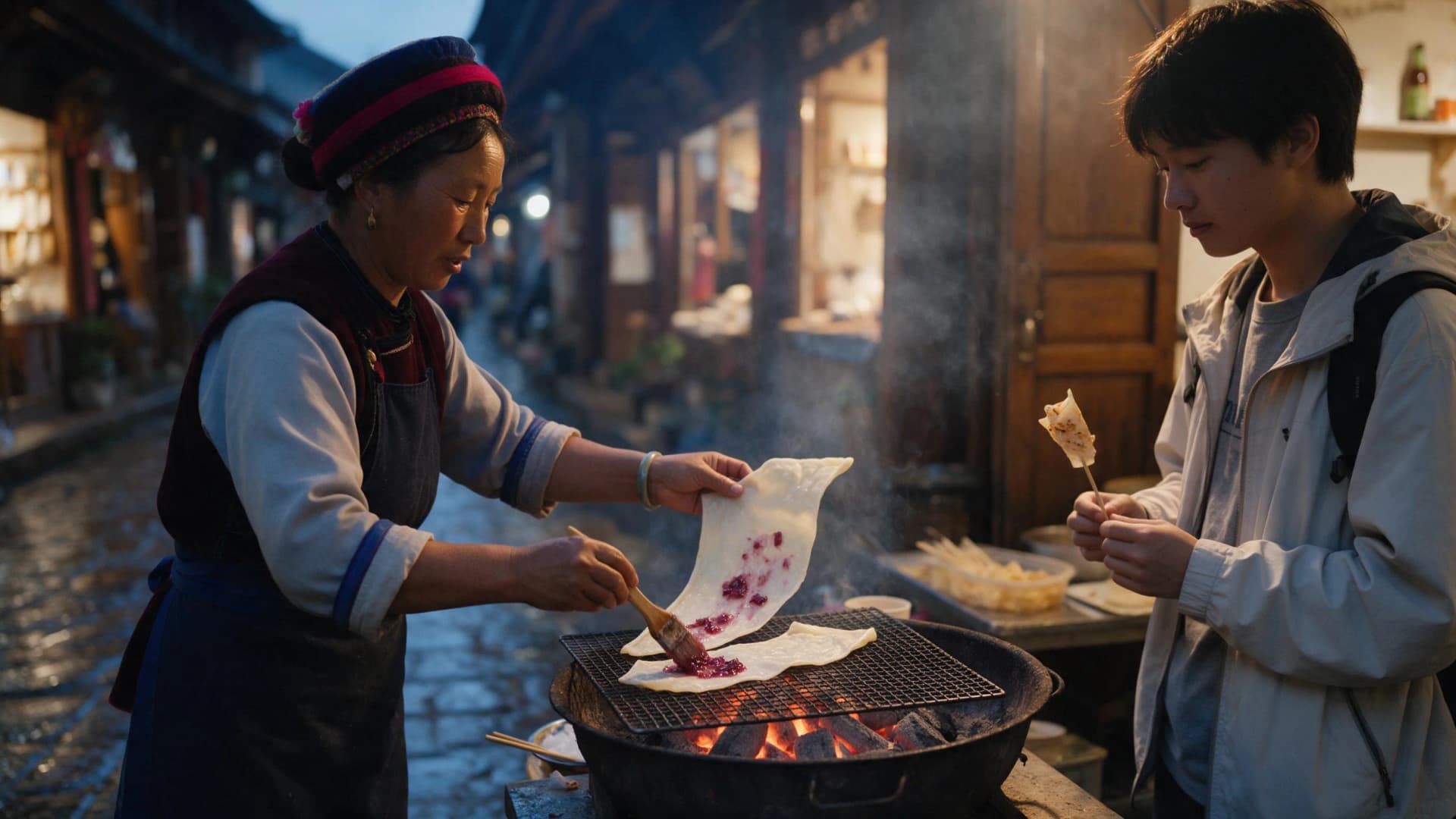
Dali eats differently from the rest of China. In this high-altitude Yunnan valley, the Bai people grill stretched milk curd on street corners, bake flaky flatbread in clay ovens, and braise Erhai Lake fish with sour papaya and chili. This guide covers the dishes worth chasing, where locals actually eat them, what to pay, and how to build a food-focused day around the old town.
The first thing that hits you in Dali is not the mountain. It is the smell: woodsmoke, chili oil, and something sweet and milky drifting off a street griddle. I arrived on the high-speed train from Kunming, dropped my bag inside the old town's stone walls, and followed my nose down Renmin Road until I found a woman turning thin sheets of stretched milk curd over a charcoal brazier. She brushed one with rose jam, handed it to me on a skewer, and laughed at my face. That grilled milk fan cost three yuan and taught me more about the Bai people of Yunnan than any museum could.
Dali sits at roughly 1,970 meters, pinned between the long ridge of Cangshan and the wide silver plate of Erhai Lake. The Bai have farmed this valley for more than a thousand years, and their cooking shows it: freshwater fish, mountain herbs, wheat from the lakeside fields, and dairy in a country that mostly ignores it. This is one of the few places in China where cheese is street food. Come hungry, and plan your days around meals rather than the other way round.
Rushan, or milk fan, is Dali's signature. Fresh cow's milk is stretched, wound around bamboo poles, and dried into pale sheets that look like parchment. Vendors grill them until they puff and blister, then paint them with rose jam, chocolate, or a savory chili rub. Buy one from a brazier on Renmin Road or in Xizhou and eat it immediately, while the edges are still crisp. For something closer to cheese, order rubing, a firm pressed milk cake fried in oil until golden and dusted with salt.
Xizhou baba is the valley's other obsession: a flaky griddle flatbread layered with lard and baked against the wall of a clay oven. Order it savory, with minced pork, scallion, and a whisper of pepper, or sweet, with brown sugar or rose jam. In Xizhou, about twenty kilometers north of the old town, families have made them for generations, and the morning market is the best place to eat one hot. Pair it with the three-course Bai tea ceremony, which moves from a bitter first cup to a sweet second and a lingering third.
Erhai Lake fills the Dali plate. The classic is suanla yu, sour-spicy fish braised with tomato, pickled papaya, and a fistful of dried chilies, served in a shallow pan with rice to soak up the broth. Look too for casserole fish, simmered with ham, tofu, and mushrooms, and for the delicate stems of the edible lake flower that appear in spring. If you only sit down to one proper Bai meal in Dali, make it a fish dinner beside the water, ordered family style.
Breakfast is where Dali feels most like itself. Grills fire up before eight for erkuai, chewy rice cakes toasted over coals and folded around pickles, bean paste, or egg. Bowls of er si rice noodles steam on every corner, and on warm days locals queue for liang ji mixian, cold chicken rice noodles dressed with vinegar, chili, peanuts, and herbs. Wash it down with mi liang xia, a chilled jelly drink that looks like tiny shrimp and tastes of brown sugar and mint.
Braver eaters should ask about shengpi, a Bai ritual dish of pork skin singed over straw fire and served with a sharp dip of vinegar, chili, and wild herbs. Traditionally it includes briefly cured raw meat, so treat it as a genuine local delicacy rather than a novelty: eat it at a busy Bai family restaurant where turnover is high, and skip it if your stomach is unproven. Vegetarians do well here, since grilled dairy, mushrooms, rice cakes, and stir-fried mountain greens are everywhere.
Two more Yunnan staples deserve a place on your table. Nuodeng ham is cured with salt and aged in mountain caves until it is deep red and nutty, sliced thin over rice or folded into pastries. From June through September, wild mushroom season turns every kitchen serious, with porcini, chanterelles, and prized termite mushrooms stir-fried with garlic or simmered in chicken broth. Finish with diaomei, a green plum carved into a spiral and cured in honey, and a cold bottle of the local Wind, Flower, Snow, Moon beer.
Practical eating in Dali is cheap and easy. Street snacks run three to fifteen yuan, a bowl of noodles ten to twenty, and a full Bai banquet sixty to one hundred twenty per person. The best food clusters on Renmin Road, Fuxing Road, and the lanes around the South Gate, but walk one block off the main drag for better prices and fewer photo menus. Most kitchens close by nine, so eat early. Tell staff bu la if you cannot handle chili, and carry tissues, since many small shops do not provide them.
Come between March and May or September and November, when the valley is dry, the lake is blue, and the markets are full. The high-speed rail from Kunming takes about two hours, and the old town is a short taxi or bus ride from Dali station. Our ChinaMira specialists know which brazier grills the best milk fan, which Xizhou courtyard serves fish the way grandmothers make it, and how to fit Dali's food streets into a longer Yunnan route. Send us your dates and your appetite, and we will build the itinerary around the table.
Good to know
- Best time to eat your way through Dali
- March–May and September–November for dry, clear days; June–September for wild mushroom season
- Getting there
- About two hours by high-speed rail from Kunming to Dali station, then a short ride to the old town
- Typical prices
- Street snacks 3–15 CNY; noodle bowls 10–20 CNY; Bai banquet 60–120 CNY per person
- Must-try dishes
- Grilled milk fan, Xizhou baba, suanla yu (sour-spicy fish), rubing, cold chicken rice noodles
- Altitude and sun
- Dali sits near 1,970 meters; the UV is strong year-round, so bring a hat and sunscreen
- Payments and language
- Alipay and WeChat Pay are standard; English is limited outside hotels, so a translation app helps
Frequently asked questions
What food is Dali, Yunnan famous for?
Dali is known for grilled milk fan (rushan), flaky Xizhou baba flatbread, sour-spicy Erhai Lake fish, fried milk cake (rubing), cold chicken rice noodles, and cured Nuodeng ham. Its Bai kitchens use dairy in ways rare elsewhere in China.
How much does it cost to eat in Dali Ancient Town?
Street snacks usually cost three to fifteen yuan, a bowl of rice noodles about ten to twenty yuan, and a full Bai banquet sixty to one hundred twenty yuan per person. Cash is rarely needed, since Alipay and WeChat Pay work almost everywhere.
Is Dali food very spicy, and can vegetarians eat well?
Dali cooking is milder than Sichuan, though chili and pickled papaya appear often. Say bu la to ask for no chili. Vegetarians can eat well on grilled milk fan, rubing, rice cakes, wild mushrooms, tofu, and stir-fried mountain greens.
When is the best time to visit Dali for food?
March to May and September to November bring dry, clear weather and full markets. June through September is wild mushroom season, the best time of year for Yunnan's famous fungi, though afternoons can be rainy.