Lhasa & Nyingchi Getting There and Around: Airports, Trains, Taxis & Buses
Arriving in Tibet is a descent as much as a journey: Lhasa sits at 11,975 feet, Nyingchi at about 9,800, and the railway links the two in under four hours. This guide covers airport shuttles, taxi and bus fares, train classes, permits, and the gentle pacing that keeps altitude comfortable from your very first breath on the plateau.
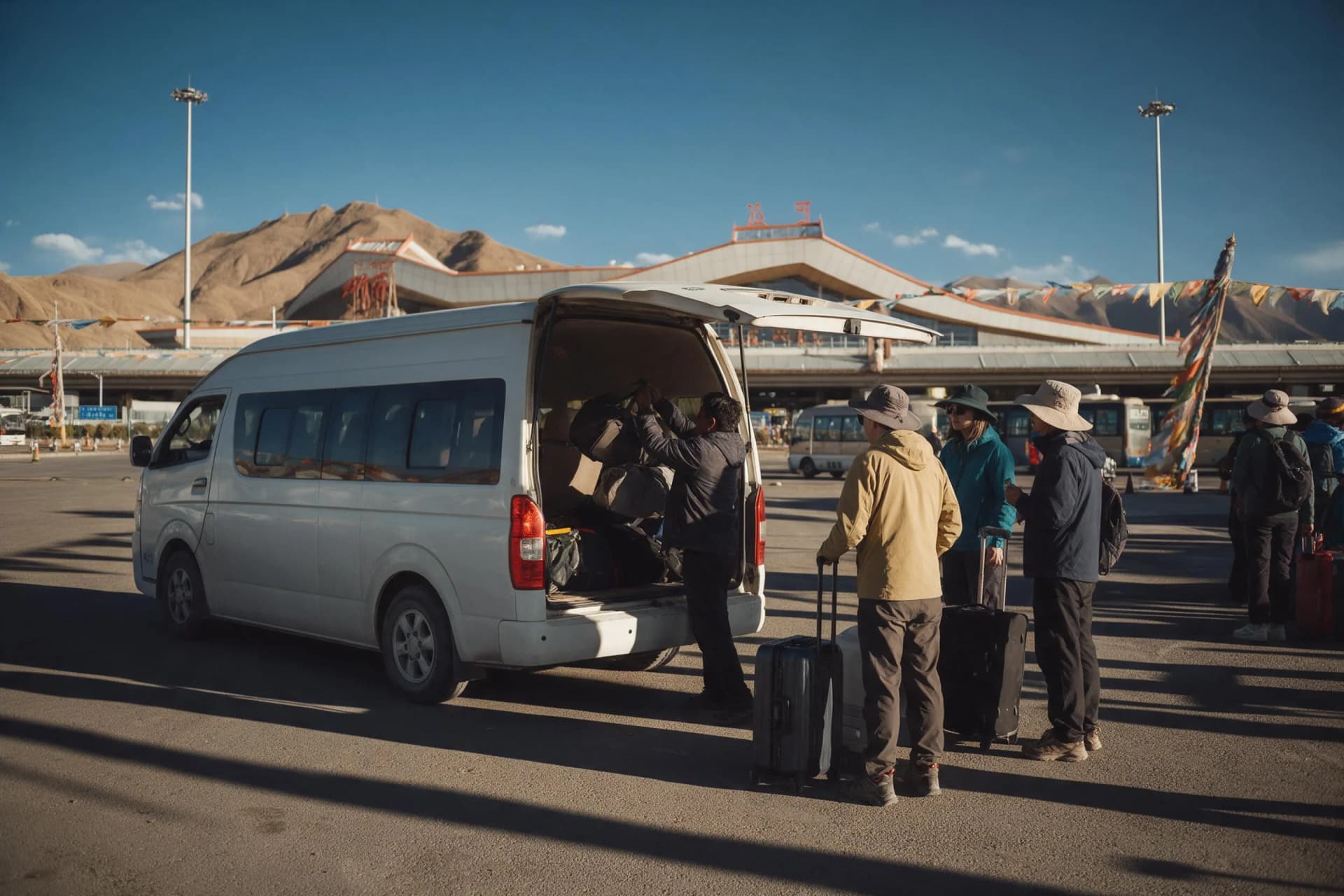
Every Tibet trip begins the same way: the aircraft noses down between bare brown ridges, the door opens, and the air hits you, thin and cold and impossibly bright at 3,650 meters (11,975 feet). Lhasa Gonggar International Airport (LXA) sits about 62 kilometers (38.5 miles) south of the city on the far bank of the Yarlung Tsangpo, so the drive in is your first real look at the plateau. Treat arrival as the start of the itinerary, not the gap before it. The body needs 24 to 48 hours to catch up, and the choices you make on day one, how you transfer, where you sleep, how slowly you climb stairs, set the tone for everything after.
From Gonggar, the airport shuttle bus is the easy, inexpensive choice: USD 4.2 per person, leaving roughly every 30 minutes between about 05:40 and 14:30, with the ride to the Civil Aviation Ticket Office downtown taking about an hour. From there it is a five-minute walk to the Potala Palace. A taxi takes about 45 minutes and costs USD 18-21 to the Potala area; a chartered vehicle for up to four passengers runs around USD 35. Many agency packages include a private pickup, which is the gentlest option after a flight, because a driver who knows the altitude will not rush you or your bags.
If you arrive by rail, you step out at one of the highest stations in the world. Lhasa Railway Station lies about 9 to 10 kilometers (5.6 to 6.2 miles) from the old city, a 20- to 30-minute taxi ride costing USD 2.8-4.2, or a longer hop on public buses that leave from the terminal beside the station. The train from Xining takes roughly 21 hours and crosses the Tanggula Pass above 5,000 meters (16,400 feet). It is a spectacular approach and a hard one. Arrive, check in, and do nothing more ambitious than sweet tea.
Once you are settled, Lhasa is compact, and its rhythm is better on foot than on four wheels. There is no subway. City buses cost USD 0.14 a ride and are easy once you match the bilingual stop maps. Taxis charge USD 1.4 for the first 3 kilometers and USD 0.28 for each kilometer after, with a waiting fee of USD 0.14 per 3 minutes. Ride-hailing through Gaode or Didi covers the Potala, Sera and Drepung. Pedicabs around the Barkhor cost USD 1.4-2.8 and are slower, friendlier and better for photographs. For the old town itself, walk: the Barkhor kora is a loop measured in steps, not minutes.
Then comes the twist that makes this route unusual: instead of climbing, you descend. The Lhasa-Nyingchi railway crosses 436 kilometers (271 miles) of eastern Tibet at up to 160 kilometers per hour, threading nine stations through the Yarlung Tsangpo valley with oxygen piped into every carriage. The daily C881 leaves Lhasa at 07:45 and reaches Nyingchi at 11:33, a run of 3 hours 48 minutes; second class costs USD 18 and first class USD 29. Two slower trains, K6831 and K6833, take 5 hours 1 minute and 5 hours 34 minutes. Nyingchi Railway Station stands near 2,995 meters, and the town below is lower, greener and warmer than Lhasa, which is exactly why the train is the kindest way to move.
Nyingchi Mainling Airport (LZY) is the other air gateway, 40 kilometers (25 miles) from Bayi Town, with a USD 3.5 shuttle bus that takes about an hour and meets arriving flights; buses back to the airport leave Bayi at 07:30 and 07:50. From Bayi, the region opens up by hired car, because Basum Tso, the Yarlung Tsangpo Grand Canyon and the peach-blossom villages are not served by frequent public transport. Local buses from Bayi Coach Station head toward Bahe Bridge for about USD 4.2, but a licensed driver is the practical choice for lakes and canyons. Distances look short on a map and are not: mountain roads bend, and a 70-kilometer run can take two hours.
None of this is bookable on a whim. Foreign travelers need a Tibet Travel Permit arranged through a registered agency, usually 15 to 20 days ahead, plus a separate Alien's Travel Permit for Nyingchi, and documents are checked at road and rail checkpoints. The paperwork has a wellness upside: it forces a plan. Build in a rest day, drink more water than you think you need, skip alcohol for the first 48 hours, and take seriously any headache, poor sleep or breathlessness that does not settle. If you feel worse, descend rather than push on. The train to lower Nyingchi is a treatment as much as a transfer.
The calendar matters too. Late March into mid-April turns Nyingchi's valleys pink with wild peach blossom; April to June and September to October bring clear skies and mild days; November through March is dry, sunny and cold, with quieter trains and cheaper rooms. Whatever month you choose, the sequence holds: land, rest, ride the rails east, and let the altitude set the pace. Tell ChinaMira your dates, your fitness and how far you want to go, and we will arrange the permits, meet you at the airport or station, book the Lhasa-Nyingchi train, and build the slow, well-paced Tibet trip this landscape deserves. The fact sheet below collects the fares and times.
Good to know
- Arrival airport
- Lhasa Gonggar (LXA) is 62 km (38.5 mi) south of the city; airport shuttle USD 4.2 (about 1 hour), taxi USD 18-21 (about 45 minutes).
- Rail arrival
- Lhasa Railway Station is 9-10 km (5.6-6.2 mi) from downtown; taxi USD 2.8-4.2 (20-30 minutes) or buses from the terminal beside the station.
- City transport
- No subway; city buses USD 0.14 a ride, taxis USD 1.4 for the first 3 km then USD 0.28/km, pedicabs USD 1.4-2.8, ride-hailing via Gaode or Didi.
- Lhasa-Nyingchi train
- 436 km (271 mi); daily C881 Lhasa 07:45 to Nyingchi 11:33 (3 h 48 min); second class USD 18, first class USD 29, business class USD 64.
- Nyingchi access
- Nyingchi Mainling Airport (LZY) is 40 km (25 mi) from Bayi Town; shuttle USD 3.5, about 1 hour, with buses back to the airport at 07:30 and 07:50.
- Permits
- Tibet Travel Permit arranged through a registered agency 15-20 days ahead, plus a separate Alien's Travel Permit for Nyingchi; carry your passport.
Frequently asked questions
How do I get from Lhasa Gonggar Airport to the city?
About USD 4.2 and roughly one hour gets you downtown on the airport shuttle bus, which leaves every 30 minutes from about 05:40 to 14:30; a taxi to the Potala area takes about 45 minutes and costs USD 18-21. Gonggar (LXA) is 62 kilometers (38.5 miles) south of the city.
How long is the train from Lhasa to Nyingchi, and what does it cost?
Three hours 48 minutes on the daily C881, which leaves Lhasa at 07:45 and arrives in Nyingchi at 11:33; second class costs USD 18 and first class USD 29. Slower K6831 and K6833 trains take 5 hours 1 minute and 5 hours 34 minutes over the 436-kilometer (271-mile) route.
How do I get around Lhasa without a car?
USD 0.14 buys a city bus ride in Lhasa, which has no subway; taxis charge USD 1.4 for the first 3 kilometers and USD 0.28 per kilometer after, and pedicabs around the Barkhor cost USD 1.4-2.8. The old town is walkable, and ride-hailing apps cover the Potala, Sera and Drepung.
When is the best time to travel to Lhasa and Nyingchi?
Late March to mid-April is peak peach blossom in Nyingchi; April to June and September to October bring clear, mild days; November to March is dry, sunny and cold, with quieter trains and cheaper rooms. Whatever month you pick, arrange permits 15 to 20 days ahead.
Keep exploring
Plan with ChinaMira
Turn this into a trip
Use this guide as a starting point — we can handle the route, guides, trains and the visa invitation letter.