
Attraction
Summer Palace, Beijing: An Imperial Garden Built for a Birthday
A warm, story-driven guide to the Summer Palace in Beijing: the Qing emperors and Empress Dowager Cixi who shaped it, the Long Corridor, Longevity Hill and Kunming Lake, the quiet gardens behind the hill that most visitors miss, plus tickets, metro directions, opening hours and the best season and hour to walk it.
The first thing the Summer Palace does is slow you down. You come through the north gate at Beigongmen, Beijing traffic fades behind a screen of old pines, and then there is water: Kunming Lake opening wide to the south, Longevity Hill rising on your right, and the octagonal Tower of Buddhist Incense sitting on top of it like a crown. Retirees practice calligraphy on the flagstones with long water brushes. A boatman poles a skiff past the lotus leaves. This is an imperial garden, but on a weekday morning in spring it feels like the city's own backyard.
That double life is the whole story of the place. In 1750 the Qianlong Emperor ordered a garden built around Jar Hill and a widened lake of clear ripples, a gift for his mother's sixtieth birthday; he named it Qingyi Yuan, the Garden of Clear Ripples, and had the excavated earth piled up to reshape the hill so the whole landscape looked natural while being entirely made by hand. Anglo-French troops burned it in 1860 during the Second Opium War. Empress Dowager Cixi rebuilt it in 1888 and renamed it Yihe Yuan, the Garden of Nurtured Harmony, and the accusation that she diverted navy funds to pay for it has followed the place ever since. It was looted again in 1900, repaired, and in 1924, after the last emperor left the Forbidden City, it opened as a public park. UNESCO inscribed it in 1998 as an outstanding expression of Chinese landscape garden design.
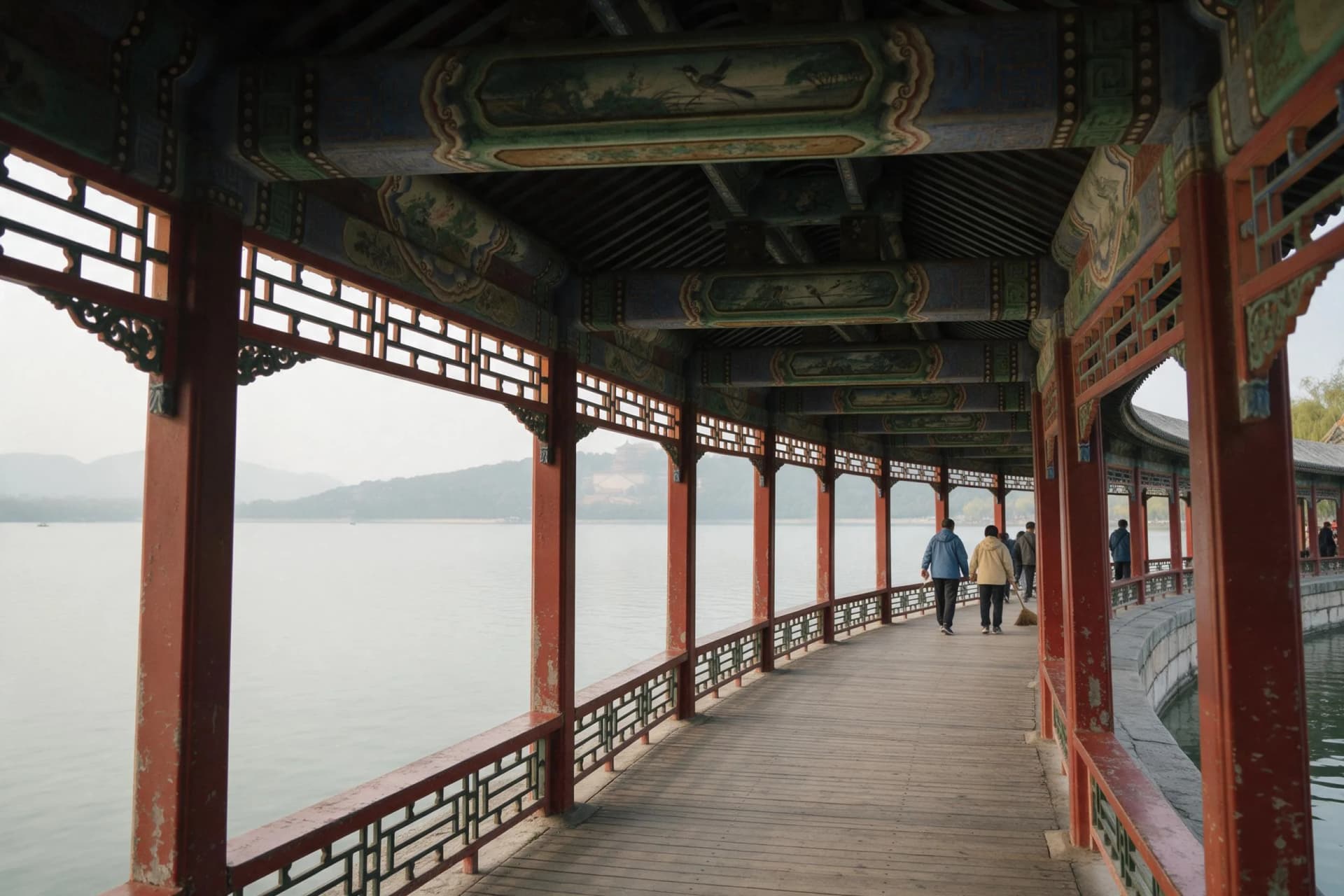
Begin with the Long Corridor. Seven hundred and twenty-eight meters of covered walkway run along the north shore of Kunming Lake, 273 bays in all, and above your head are more than 14,000 paintings: landscapes, flowers, birds, and scenes from novels such as Journey to the West and Romance of the Three Kingdoms, arranged so that almost no section repeats. Cixi walked here in rain and snow, and so do you, dry, watching the lake slide past between the red pillars. At the western end the hill climbs to the Tower of Buddhist Incense, a 41-meter timber and glazed-tile pavilion on a 20-meter stone terrace. The stairs are steep and the reward is the photograph everyone carries home: the whole lake, the West Causeway, Nanhu Island, and Beijing dissolving into haze beyond.
Down at the water, the Seventeen-Arch Bridge arcs 150 meters to Nanhu Island, guarded by hundreds of small stone lions. Walk it just before sunset, when the arches stack into perfect circles on the still surface. A bronze ox has watched the eastern shore since 1755. Further west, the Marble Boat, a stone-and-wood pavilion shaped like a paddle steamer and rebuilt in 1893, remains the emblem of an empire spending on pleasure while its navy starved. If your legs are tired, take a ferry across the lake; the crossing costs a few yuan and gives you Longevity Hill from the water, which is how the designers intended it to be seen.
Most visitors never reach the quieter half. Behind Longevity Hill, Suzhou Street recreates a Jiangnan water lane, with shops and stone bridges along a narrow canal where court eunuchs once played at being merchants. The Garden of Harmonious Interests, laid out in 1751 after a garden in Wuxi, is a small masterpiece of borrowed scenery. And at the Garden of Virtue and Harmony, Cixi's three-story Grand Theater still stands; she watched opera here for hours on end, and the surrounding courtyards now hold a museum of the rooms she furnished.
Practical planning is simple. Take Metro Line 4 to Beigongmen for the north gate or to Xiyuan for the east gate, and Line 16 also stops at Xiyuan; both are a short walk from the ticket gates. Park entry runs about 30 yuan in peak season, April 1 to October 31, and 20 yuan in winter, while a combined ticket of roughly 60 or 50 yuan adds the Tower of Buddhist Incense, Suzhou Street, the Garden of Virtue and Harmony and the Wenchang Gallery. Carry your passport, set up Alipay or WeChat Pay before you arrive, and expect serious walking: the full loop around the lake is well over six kilometers, so wear broken-in shoes.
Season changes everything. Mid-April brings peach and cherry blossom along the West Causeway and the softest light of the year. July and August fill the lake with lotus and the paths with crowds. Late October turns the hillsides gold and the air clear. January can freeze Kunming Lake hard enough for skaters, with the tower sharp against a deep blue sky. Arrive at opening, around 6:30 in summer and 7 in winter, and you will have the Long Corridor almost to yourself. Weekday mornings are the local secret; weekends and Golden Week holidays are not.
Give the Summer Palace a full half day, ideally with a guide who can explain which corridor painting is which and why a stone boat mattered. Then let ChinaMira build the rest of your Beijing around it: the Forbidden City, a quiet stretch of the Great Wall, the Temple of Heaven at dawn, a hutong dinner, and the timing that keeps you ahead of the buses. Send us your dates and we will handle tickets, transport and a licensed guide, so all you have to do is walk slowly and keep looking up.
Good to know
- Location
- Haidian District, northwest Beijing, roughly 15 km from the city center; reached by Metro Line 4 to Beigongmen or Xiyuan, and Line 16 to Xiyuan.
- Opening hours
- Park gates open about 6:30 a.m. and close around 6 p.m. in peak season, and 7 a.m. to 5 p.m. in winter; inner halls open later and close earlier.
- Tickets
- About 30 yuan park entry in peak season and 20 yuan in winter; a combined ticket of roughly 60 or 50 yuan adds the Tower of Buddhist Incense, Suzhou Street, the Garden of Virtue and Harmony and Wenchang Gallery.
- Scale
- Around 297 hectares in total, with Kunming Lake covering about three-quarters of the site, the Long Corridor running 728 meters, and a full lakeside loop of more than 6 km.
- Best timing
- Weekday mornings at opening, mid-April for blossom and late October for clear golden light; allow three to four hours, or a half day for the quieter gardens.
- Built and rebuilt
- First laid out in 1750 as the Garden of Clear Ripples, burned in 1860, rebuilt by Empress Dowager Cixi in 1888 as the Garden of Nurtured Harmony, and opened as a public park in 1924; UNESCO World Heritage since 1998.
Frequently asked questions
How much time do you need at the Summer Palace?
Plan at least three to four hours for the classic route: the Long Corridor, Longevity Hill, the Seventeen-Arch Bridge and the lakefront. Allow a full half day if you want Suzhou Street, the Garden of Harmonious Interests and a boat ride across Kunming Lake.
What is the best time of year to visit the Summer Palace?
Mid-April, for blossom and soft light, and late October, for crisp golden days, are the two sweet spots. Summer brings lotus flowers and heavy crowds, while winter is cold, quiet and sometimes freezes the lake enough for skating.
How do you get to the Summer Palace by subway?
Take Metro Line 4 to Beigongmen for the north gate or to Xiyuan for the east gate, and Line 16 also serves Xiyuan. Both stations are a five- to ten-minute walk from the entrances, and the ride from central Beijing takes around 40 minutes.