
Attraction
Yu Garden, Shanghai: The Ming Garden a Son Built for His Father
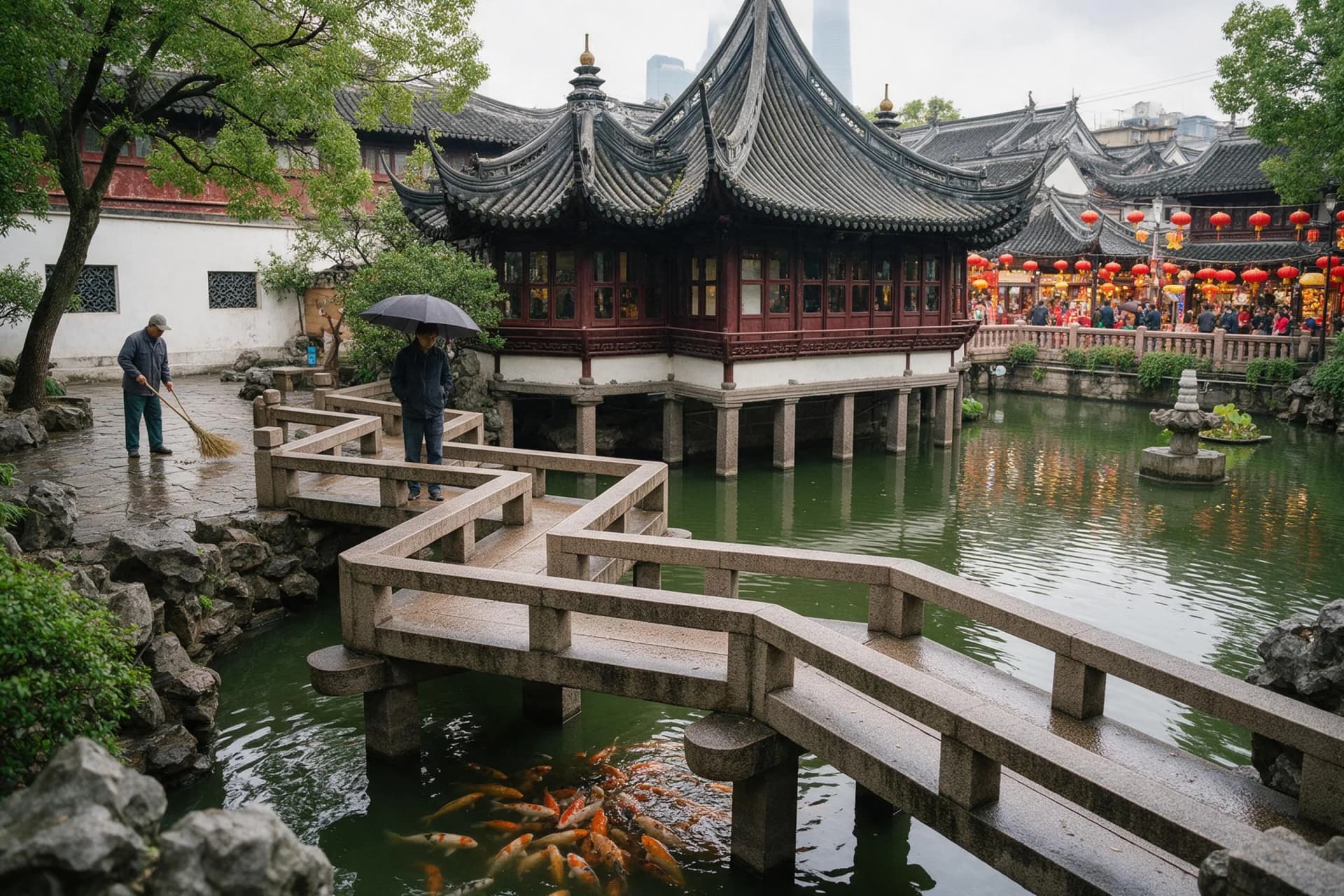
Yu Garden is Ming Shanghai's gentlest story: a private garden Pan Yunduan began in 1559 to comfort his aging father, its name meaning pleasing and satisfying to one's parents. Behind the dragon walls wait a five-ton Taihu limestone rock, a twelve-meter rockery, koi ponds and the lantern-lit lanes of the Old City bazaar. This guide covers what to see, when to go and how to plan the morning.
By half past eight the Old City is already awake, but Yu Garden is still cool and quiet. Vendors are lifting shutters along the bazaar lanes, a kettle sings somewhere behind the teahouse, and koi drift in slow gold arcs beneath the zigzag bridge. Then the gates open, and four centuries fold into a single morning: grey dragon walls, a rockery rising like a small mountain range, and, all around it, glass towers belonging to a city that did not exist when this garden was made. Yu Garden is the oldest thing most visitors will touch in Shanghai, and it was never built to be a monument. It was built to make an old man comfortable.
Yu means pleasing and satisfying to one's parents. Pan Yunduan, a Ming official who had just failed an imperial examination, began the garden in 1559 as a gift for his father, Pan En, then a minister in his old age; a posting to distant Sichuan delayed the work for nearly twenty years, so the garden finally opened in 1577. The name carries the whole idea: a son's filial piety, planted and roofed and stocked with ponds. Everything else here is detail, and the detail is what rewards a slow hour.
Cross the Nine-Turn Bridge, pass the teahouse forecourt, and the garden unfolds as six linked worlds, each screened from the next by dragon walls whose grey tile ridges rise and fall like a sleeping spine. Sansui Hall comes first, opening onto the Grand Rockery — some twelve meters of yellow stone shaped into peaks, cliffs and winding caves, attributed to the Ming master Zhang Nanyang. Then the Chamber of the Ten Thousand Flowers, shaded by a ginkgo said to be four centuries old; the Heralding Spring Hall of 1820; the Hall of Jade Magnificence, furnished in rosewood; and finally the Inner Garden, a compressed universe of ponds, pavilions and towers. Roughly forty scenic spots are packed into two hectares, so a visit feels less like walking through a park than turning the pages of a scroll, one framed view at a time.
The strangest treasure of all is a rock. The Exquisite Jade Rock stands roughly three and a half meters tall and weighs around five tons, a porous Taihu limestone riddled with holes and worn by water into something between a cloud and a sponge. Legend holds that it was quarried in the Song dynasty for Emperor Huizong's imperial garden and then lost when the boat carrying it sank in the Huangpu River; centuries later, the story goes, it was fished out and presented to the Pan family. Historians argue about the tale. Visitors prefer it. Walk a slow circle around the stone and the light keeps changing, which is exactly why Chinese gardens place such rocks where they do.
Yu Garden has been broken and rebuilt more than once. British troops occupied the lakeside pavilion that now houses the Huxinting Teahouse during the First Opium War in 1842; the Small Swords Society made its headquarters in the Heralding Spring Hall during its 1853 uprising, and by the time Qing troops retook the grounds most of the original buildings had been destroyed. Japanese forces damaged what survived in 1942. A restoration that began in the 1950s brought the garden back, and it opened to the public in 1961. The teahouse, perched on stone stilts above the pond since the 1850s, still pours tea — a fine place to sit once the lanes outside fill with elbows.
Outside the gate, the City God Temple bazaar does its best to distract you. This is where Shanghai eats, haggles and buys gold, and the founding stall of the city's soup-dumpling habit stands right here: Nanxiang Mantou Dian, which traces its recipe to Nanxiang town in the Shanghai suburbs and has been steaming baskets in the bazaar for more than a century. Join the ground-floor takeaway queue for the classic pork xiaolongbao, pleated thin and filled with broth that will scald the impatient, or climb upstairs and sit down for the crab-roe version. Either way, bite a small hole first, sip, then eat. The fact sheet below carries the address, the hours and the price of a basket.
Plan the day around the garden's own rhythm. Arrive at opening, when the light is soft and the tour groups are still assembling; by mid-morning the narrow corridors between halls are shoulder to shoulder. Reserve a timed, real-name entry online with your passport before you travel; the fact sheet below sets out the opening hours, the closure day, the seasonal ticket prices and who qualifies for a discount. Give the garden a slow pass through all six areas rather than a sprint to the exit, then let the bazaar have the rest of your morning.
From the gate it is an easy walk east to the riverside facades of the Bund, where Shanghai's other great piece of history faces the skyline across the water. Our Bund guide explains what those stone banks and trading houses once were, our Shanghai guide builds the rest of the city around them, and our Suzhou guide turns a spare day into the classical gardens that taught Yu Garden's builders their craft. Check our month-by-month China guide before you fix your dates, then tell ChinaMira when you are coming and how much time you have. We will book the garden's timed slot, find your table for dumplings, and shape the days so that your first stop in Shanghai is also its oldest story.
Good to know
- Getting there
- Shanghai Metro Line 10 or Line 14 to Yuyuan Garden station, then a 5- to 7-minute walk; the Bund is about 20 minutes on foot east. Metro fares are distance-based, roughly CNY 3-6, and a taxi from People's Square takes about 10 minutes outside rush hour.
- Tickets
- CNY 40 from April to June and September to November; CNY 30 from July to August and December to March. Half price for visitors over 60, free for children under 1.3 m. Entry is timed and real-name, so reserve online with your passport.
- Opening hours
- 9 a.m. to 4:30 p.m.; closed Mondays except public holidays. The surrounding bazaar and City God Temple area stay open later and cost nothing to wander.
- Best months
- April-May brings blossoms and mild days; September-November brings clear, cool weather and turning leaves. July-August is hot and humid, December-March is cold but quiet, and weekday mornings are calmest in every season.
- Time needed
- 90 minutes to 2 hours inside the garden, plus about an hour for the bazaar and a pot of tea at Huxinting.
- Snack stop
- Nanxiang Mantou Dian, 85 Yuyuan Old Street: pork xiaolongbao about CNY 25 for a basket of 12 at the ground-floor takeaway counter, with the upstairs crab-roe baskets costing more. Open 7 a.m. to 8 p.m.
Frequently asked questions
Do I need to book Yu Garden tickets in advance?
Yes. Entry is timed and real-name, so reserve online with your passport before the day you plan to visit; the gate does not reliably sell same-day tickets in busy periods, so check the fact sheet before you fix your date.
How long does a visit to Yu Garden take?
Give it a leisurely morning rather than a flying visit, and check the fact sheet's time-needed row for a working estimate. The garden is compact, but its best moments reward a slower pace.
Why is it called Yu Garden?
Yu means pleasing and satisfying to one's parents. Pan Yunduan began the garden as a comfort to his father in old age, so it is also known as the Garden of Peace and Comfort.
What should I eat near Yu Garden?
Go to Nanxiang Mantou Dian in the City God Temple bazaar: queue at the ground-floor takeaway window for classic pork soup dumplings, or sit upstairs for the crab-roe version. The fact sheet lists the address, hours and basket price.